
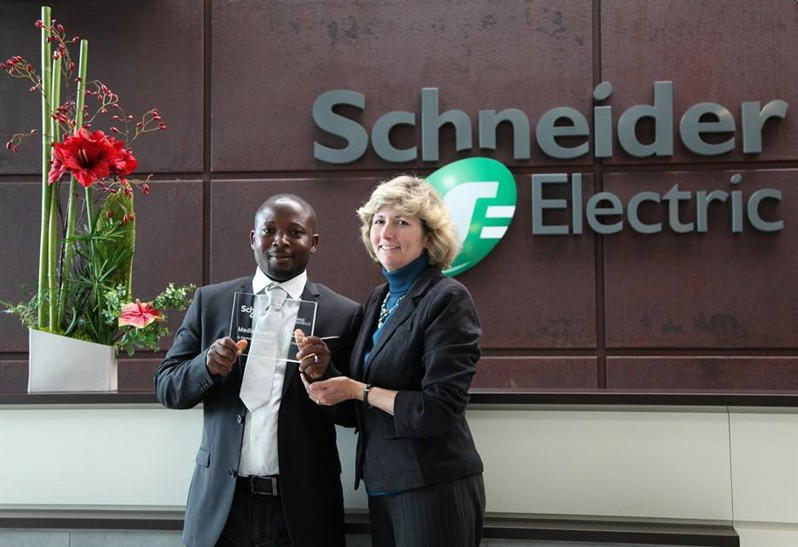
Photo: Adedeji Ademigbuji, senior correspondent at The Nation newspaper (Nigeria), receives from Tracy Garner, Schneider Electric’s Global Anti-Counterfeiting Manager, the award for outstanding reporting on electrical counterfeiting during a special ceremony in Grenoble, France.
Investigative reports from Nigeria and Senegal exposed the threat of counterfeit electrical products, prompting public outcry, regulatory action, and continental recognition through a Schneider Electric media award on electrical counterfeiting in Africa.
By Femi Ajasa, Online Editor
Fires linked to electrical faults intensified in Nigeria and Senegal. From Alaba International Market in Lagos to the crowded districts of Dakar, leading journalists traced these incidents to a common source: counterfeit electrical products. Substandard wires, fuses, switches, and circuit breakers—often carrying forged quality marks—had infiltrated homes, offices, and public buildings.
In Nigeria, Adedeji Ademigbuji of The Nation newspaper published an investigative feature titled “Checking the Menace of Fake Electrical Products.” His report revealed that up to 70 per cent of electrical goods sold in markets such as Alaba in Lagos, Southwest Nigeria, were fake or did not meet minimum safety standards. Official data from the Standards Organisation of Nigeria (SON) pointed to counterfeit electrical products as a major cause of fires and building damage. In Lagos alone, thousands of incidents were recorded annually.
Meanwhile, in Senegal, Birame Faye of Le Quotidien examined a series of fires that had devastated street markets and homes. His investigation linked the March 2013 Medina market fire—which killed nine children—to poor-quality wiring. Faye’s findings showed that 93 per cent of Dakar homes had non-compliant electrical installations and that 80 per cent of electrical goods sold locally were counterfeit, largely imported from Asia. His report, published on the first anniversary of the tragedy, ignited national debate and prompted scrutiny of supply chains and construction standards.
In response to the growing crisis, Schneider Electric, a global energy management company headquartered in France, launched the Media Awards on Electrical Counterfeiting in Africa. The one-time award recognised exceptional journalism that raised awareness of the dangers posed by fake electrical products.
The judging panel evaluated submissions on investigative depth, public relevance, clarity, factual integrity, and potential for policy impact. Entries came from journalists across the continent. The panel reached a unanimous decision: Ademigbuji (English-speaking African country) and Faye (French-speaking African country) were named joint winners.
The awards were presented on 26 September in Grenoble, France, by Tracy Garner, Schneider Electric’s Global Anti-Counterfeiting Manager.
“These stories did not merely highlight a problem,” she noted during the ceremony. “They presented compelling cases for reform, directly engaging consumers, regulators, and suppliers.”
Mohammed Saad, then President of Schneider Electric Africa, also commended the winners. “We were deeply impressed by both the quantity and quality of entries. Judging was difficult, but our decision was clear. These two journalists exemplify the role of the media in public safety.”
The award was continental in scope and carried both national and international significance. Schneider Electric, active in over 100 countries, brought credibility and visibility to the issue. The initiative sought to connect journalists, technical experts, and consumers through high-quality reporting.
No prior Africa-wide media recognition existed for work on electrical safety or counterfeiting, underscoring the uniqueness of the award.
Counterfeiting as a Regional Threat
From 2012 to 2014, data from the International Electrotechnical Commission and national standards agencies across Africa confirmed a spike in counterfeit electrical products. These substandard items were identified as key contributors to fire outbreaks, equipment failure, and structural risk.
In Nigeria, SON estimated that fake products cost the economy ₦500 billion annually. Electrical goods were a major component, with frequent links to fires in residential and commercial buildings. Imported cables and circuit protection devices lacking essential safety features were common.
In Senegal, 2012 saw over ten major market fires, causing more than £33 million in losses. Faye’s reporting exposed how unregulated imports and weak enforcement allowed counterfeit products to dominate the market, with consequences reaching schools, hospitals, and government offices.
Both journalists demonstrated that this was not merely a consumer issue—it was a systemic development challenge. Poor procurement standards, inadequate oversight, and low public awareness combined to turn essential infrastructure into safety hazards.
Institutional Response
The investigative work triggered concrete action. In Nigeria, SON expanded enforcement operations, seized shipments, and launched campaigns on product verification. The media played a central role in framing the problem as a matter of public safety, not just economic crime.
In Senegal, Faye’s findings prompted legislative debate and led to new inspections of public buildings. Civil society organisations joined the response, targeting informal traders and educating consumers on product standards.
The Schneider Electric recognition further amplified these efforts, lending global validation to the work and providing a platform for the journalists to participate in forums on counterfeiting, safety, and regulation.
Enduring Impact
By revealing hidden risks in widely-used products, Ademigbuji and Faye helped protect lives, shape policy, and reframe counterfeit goods as a critical development issue. The award highlighted journalism’s ability to inform, influence, and compel action—especially in sectors where public safety intersects with market failure.
Disclaimer
Comments expressed here do not reflect the opinions of Vanguard newspapers or any employee thereof.