
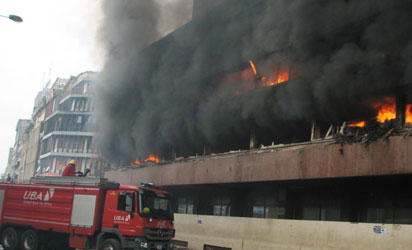
Great Nigeria Insurance Company Limited, popularly called Great Nigeria House on fire.
By Adisa Adeleye
Nigeria is an interesting country where “everything goes” and where all things are possible even as the events look clumsy. Amidst claims and counter-claims about the loss of Gwazo and Bama, the gallant security forces are fighting ferociously to maintain the Nigerian territory against the onslaught of the Boko Haram insurgents.
The general sympathy goes to the gallant security forces, which, out of their duty, turn their guns against other Nigerians in a disastrous patricidal conflict. It is reminiscent of the sad but unnecessary Biafran war. The vital question is: Are the Boko Haram insurgents Nigerians?
The invasion of Nigerian territories by these foreign terrors, to many patriots, calls for a more serious approach than what is the present position – a bitterly divided political class. It would have been a different case, many wise people attest, if the forces at the war fronts (the insurgents seem to be shifting grounds) are solidly backed by a united nation.
But unfortunately, the selfish but crafty politicians have set their minds and hearts on the alluring prospects of 2015 and not being disturbed by the prediction of doom by the Cassandras of this world.
The other day, the happy band of party surpporters mustered more than four million signatures to advise President Jonathan to seek re-election in 2015. That was in addition to the more than one million signatories of supporters in the South-Western zone of the country.
The problem with the appealing sycophants is that none of them suggested the mobilization from their groups those to follow the President to Chibok (Sambisa Forest) in a return visit to the earlier one by the parents of the abducted girls. However, President Goodluck Jonathan, now wiser by experience, has accepted the adoration with his infectious smile and grace.
He would certainly not want to sacrifice the integrity of his country (which he promised to keep in 2011) to the uncertainties of 2015, even if the political atmosphere appears to be very bright. The Opposition too, considering Nigerian slippery political terrain, may not be sure of victory.
My insistence on a more inclusive federal government or a genuine national government has provoked some reactionary responses from my readers. Some saw my call for unity at this period, (with the 2015 elections less than six months away) a diversionary tactics, while others think it is now too late to expect Nigerian politicians to think positively, even when the unity of the country is threatened.
Many political analysts have attributed some of Nigeria’s problems to sad misunderstanding of the principle of multi-party system in a democratic environment. Political parties are expected to offer different approaches to government in terms of ideology and methodology. The choice is left to the people to make a final choice.
In Britain, voters are left to indicate their preference between Tory (Capitalism), Liberal (Capitalism with a dose of mixed economy) and Labour (Reformed socialism but with heavy doses of social services). The present British Government is made up of Tory and Social Liberal parties.
It is often said that a country (and its people) would get the type of government it wants. The prevailing circumstances would dictate the type of government each country would prefer.
During the economic depression of the 1930s, Britain opted for a National Government to defend the Pound. The National Government was also able to tackle the ranging problem of mass unemployment through government intervention in the economy through the adoption of Keynesian new Economics.
In the Nigerian politics, as it is being currently practiced, no party is different from the other in its political and economic operations. The federal, state and the local governments are based on government and the opposition principle, i.e. the party with the highest number of legislators would form the government, leaving the other parties in opposition to lick their wounds. The resultant political horizon is a bitterly divided class of oppressive majority and often rebellious minority.
After the military coup of 1966 and the counter coup that followed immediately, Nigeria blundered into Biafran bloody contest between 1967 and 1970 with undeserved devastation and unjustified agony. If Biafra (former Eastern Region) was denied right to exercise its sovereignty, what is left today for these gallant people?
These people have become supporters of any ruling power block since after the war, forming the visible but back-bone of the present administration of President Jonathan. The Opposition is strongly rooted in the North-West, North-East and South-Western zones of the country. What happens if there is a change of political fortune in 2015?
The victors of 1970 did not understand how to exercise power in a multi-national or plural society; there is little evidence that the present leadership and innocent backers have learnt sufficient lesson from the past events to evolve the necessary consensus on national issues. It is absolutely clear that insurgency is quite beyond the capacity of a single party.
The shameful exhibition of traits of disunity would continue to strengthen these enemies of the country who appear to be waxing stronger every moment.
The economy
If the political parties have not seen the need to work together in the real transformation of the economy as opposed to the paper macro-economic stability with increase in GDP and increase in unemployment, the practice of tough monetary policy should be discarded. It is not necessary for a poor economy.
A “cheap money” (low interest lending interest rate) policy would release funds to all capital starved SMEs, provide funds for private housing developments and rural reconstructions by local governments. Such a policy would lead to industrial expansion, thus impacting positively unemployment.
The argument of the Central Bank that if surplus funds in the banking system to operate freely as basis for bank‘s credit. The volume of loans would have been so fast and the purchasing power so expanded as to precipitate a boom and consequent inflationary disaster. This should not happen in a well managed situation.
Disclaimer
Comments expressed here do not reflect the opinions of Vanguard newspapers or any employee thereof.