
By Bisi Lawrence
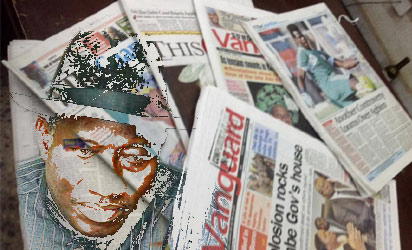
WHEN Muhammadu Buhari came into the saddle as Nigeria’s military ruler he astounded quite a number of people by one of his early statements: “I am going to tamper with the press,” he announced.
It was even less amusing when he matched his words with action by slapping no less than three elements of the press from different media houses into prison. Journalists had been incarcerated in our country before then, but never in such an open manner in defiance of justice. He made the profession of journalism look like a crime. That, unfortunately, has been happening in some parts of the world, and is still happening today.
What makes this horrible pastime so established is the nature of what the profession stands for. In simple terms, it stands for the dissemination of information through systems of communication. The widest gulf between human beings and animals is created by the human speech, by which men form a link of understanding among themselves. No other creature has that gift. Anyone who possesses the ability to use the human word, spoken or written, and that effectively, has the instrument to transmit his opinions and desires to other minds and cause a reaction in favour or against a given idea. An organ that has the power of transmitting such opinions and desires to thousands of minds at the same time can create immeasurable change in any situation. That is the media. The respect or resentment of that power finds expression in the welcome or suppression of those who labour in the mill-house of that industry.
Politicians, or military rulers like Buhari, are always “tampering with the press” usually through those who are its committed professionals. The stripe of professionalism depicts them as one in purpose, which is the pursuit of what is news. Now, news is said to be the “report” of an event — not the event itself. To all that, usually is added the garnish of truthfulness, objectivity, and other laudable ideals, as a matter of course. But in the core of the reporter’s heart is the objective of being the first to give it out. That is why wags get away with the profanity that “news is something that someone somewhere doesn’t want known”. And when that someone somewhere is somewhat powerful, the reporter has got his neck on the line.
So it has been from the day the printing machine gave the power to mass communication through Martin Luther’s Ninety-five Theses. And so it is till this day, when the Islam State Group of the Middle East are putting American journalists, captured while covering the war in Syria, to death by decapitation. Their only crime was being there to perform their duty, to do their job. For that, they paid the ultimate price.
It is much less for the three members of the Al Jazeera, the well-known independent television station which started out from Qatar. They are now in an Egyptian prison accused of collaborating with the Muslim Brotherhood which is now a proscribed party, having been ousted from government by the incumbent regime. Peter Creste and Mohammed Fahmy each got seven years jail sentence, while Baher Mohammed received ten years because he was found with a spent cartridge which he declared he picked up at the scene of a demonstration. They have appealed against their sentences.
Years ago, the international community would have been aghast at their fate, but journalists are now fair game in the hands of power. All the same, the fate of these journalists has excited a surge of sympathy— in some cases mixed with disgust—in various circles. Ban Ki-Moon of the United Nations has also appealed to the Egyptian authorities, all to no avail. The Egyptian President says he would not interfere with the decision of the Judiciary, though intervening may not be equated to interfering if properly presented.
Civil organizations have rallied to support the Al-Jazeera Three. The spread is becoming world-wide and Nigeria should not be left out. We are a nation with a robust history of freedom of speech, and we are, after all, one-fifth of the population of the continent. Our press enjoys a tradition of civilised activity, and we should not in anyway be abashed at aligning ourselves with the cause of Al-Jazeera at this time. We cannot forget the recent recognition accorded one of our journalists by the television station. That should give us a sense of kinship. This is a call to the media organisations of this country today —the Nigerian Union of Journalists, the Guild of Editors, the Proprietors et al — to stand up and be counted in the cause of press freedom.
The World Cup in Brazil was about one month away when a commentator declared that by the time the soccer fiesta was over, the issue of the girls abducted from Chibok would have been forgotten. Many people supported that view but were perspicacious enough to add that it could indeed happen that way, especially if Nigeria was able to emerge into the group of the last eight—to say nothing about being in the last four! It was true that the wanton kidnap of the girls had excited the express sympathy of almost the whole world, ranging from the ordinary citizens of various countries to the high and mighty in different lands. And here at home, the cry of “Bring Black Our Girls” rode on the rooftops.
The World Cup is over. Nigeria’s success was modest. The issue of the missing Chibok girls is still very much with us. One event that might indeed have overshadowed the disappearance of the girls is the eruption of the dread Ebola disease which landed in the country with sustained drama, and continues to hold the populace in a grip of muzzled terror. It has shown a remorseless capacity for taking the lives of its victims swiftly and silently, striking back ferociously at those who are out to see its end. It is said to have no cure, though its grip on the lives of some fortunate people who contacted it was lost through a series of therapy that might be described as blind. Though the drug seems to have been effective, it has not been endowed with any profound trust whilst the horrible disease continues to snap out the existence of hapless human beings, depriving young men of their brides and destroying close comradeship and its joys. Ebola has become the harbinger of sudden death in the land.
But it still could not suppress the heartfelt grief and ensuing anxiety of the Boko Haram menace. The darkness that these marauders have spread around the North-eastern parts of this country continues to baffle us. Their blood-thirstiness befuddles the mind. They seem to be from another planet, another age. They attack defenseless areas and murder our citizens with a viciousness that leaves us gasping. They hold out a religious flag whose tenets they flout, and attempt to lay claim on territories to which they have neither right nor title. And they are ready to stare us down through the ugly visage of war. Without any given reason.
Held in the twin vice of Ebola and Boko Haram, we float past our other shortcomings. It is trite to recount them. We all know them —power shortage, poor roads, poor health delivery, poor health delivery services — no need to name them indeed. However, it is significant that some of these inadequacies have been heightened by the ills of the twin evils of insecurity and infirmity that are holding us in thrall.
It is not enough to spend precious breath ranting about the cause and reason for the awful mess that surrounds us any longer, to which some erudite experts strive to advert our minds. Rather, this is the season for serious thought leading to meaningful action. We have to engage our plight with the indomitable purpose of overcoming it soon. And we can do that expeditiously by fully involving the press—yes, the media.
The relevant authorities should see the wisdom of regarding institutions of the mass media as their partners, comrades to be carried along in the discharge of projects and the formulation of plans. A collision course is sometime the result even in the absence of a conflict of purpose. This leads to reports that are accounted to be inaccurate and then ascribed to mischief where none was intended. The press is out to serve the people and therefore put their interest first, over and above the cosmetic presentation of obvious errors and misdeeds.
We are dealing here with calamitous circumstances that affect the entire congregation of the people of this nation. This is not politics where the luxury — or indulgence — of partisanship may be accommodated. For instance, journalists were virtually “enlisted” during the civil war. Several became front-line reporters and correspondents were outfitted in military uniforms, bearing the woes and sharing the triumphs of engagement. In the face of these disasters we are one.
Disclaimer
Comments expressed here do not reflect the opinions of Vanguard newspapers or any employee thereof.