
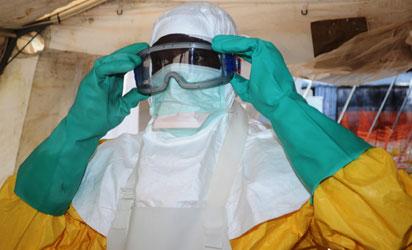
A file photo taken on June 28, 2014 shows a member of Doctors Without Borders (MSF) putting on protective gear at the isolation ward of the Donka Hospital in Conakry, where people infected with the Ebola virus are being treated. Guinea announced on August 9, 2014 it was closing its land borders with Liberia, Sierra Leone over Ebola fears. AFP PHOTO
By Prince Osuagwu
Nigeria and indeed all African nations have been put to task on three possible ways technology can be used to stamp out the dreaded Ebola disease currently ravaging the people and economies of the continent.

These tasks including stronger political commitment, establishment of a critical national database centre and establishment of National Health Emergencies News & Information Radio Station, are contained in a letter written by the Africa Emergency Technology Response Forum, AETRF, to the African Union, AU, all African Heads of state and Governments, including Nigeria.
The technologists are part of the over 65 African Tech experts worldwide, divided into two groups which meet via teleconferencing in two separate locations of South Africa and Ghana, just for the purpose of proffering technology solutions to arrest the Ebola pandemic.
For them, Information and Communications Technology, ICT, must be at the centre and in critical terms, the backbone of Sustainable solution, to the Ebola spread in Africa.
In the letter made available to Hi-Tech, dated September 1, 2014 and titled: Africa Ebola Virus Crisis: African Technologists Urge More Robust Technology Based Response Strategy, the technology experts said they were alarmed and spurred into action by the declaration of the World Health Organisation, WHO, that “the 2014 Ebola Virus disease outbreak continues to evolve in alarming ways, with the severely affected countries struggling to control the escalating outbreak.”
The group reasoned that since information technology is exploding throughout the continent and even the most remote areas have tremendous mobile technology coverage, there is need for greater attention to technology as a means of controlling the outbreak.
The AETRF said in the letter, that it also believed that the expertise of technology professionals, practitioners and volunteers can be more effectively harnessed to curtail the monster virus and save lives.
The letter spelt it out, point blank, that, “the Ebola Virus disease outbreak cannot be effectively controlled without the critical inclusion, deployment, application and use of Information Technology infrastructure, tools and enabling resources.”
Part of the letter reads: “While we commend the constructive interventions already in place, we recognize that more needs to be done.
The AETRF calls on all African Heads of State and governments to endorse and approve the following recommendations aimed at combating the Ebola outbreak while also helping to build the infrastructure to avoid future catastrophes and save lives:
* “Increase the political commitment to stop the Ebola Virus Disease Outbreak by immediately designating a technology leader on the National task force to coordinate the government’s technology initiatives in response to the Ebola outbreak.
This leader should have the government’s full mandate to leverage government resources, private sector or NGO efforts in fulfilling any relevant Ebola response communications, data gathering, contact mapping and analysis of efforts;
* “Encourage all African Countries to, each, establish a National Data Center to host the National Call Center for Ebola. This platform will provide the flexibility for countries to access on-demand cloud based technology solutions in response to public safety emergencies and post-crisis analysis;
* “Encourage all African countries to, each, establish a National Health Emergencies News & Information Radio Station that compiles, vets and disseminates accurate health information including preventive measures related to hygiene, health education and emergency information.
In addition to the radio station, we recommend the use of all available communications platforms including and not limited to television, SMS messaging and social media. These healthcare communications should be available in local languages and should address all diseases that impact the lives of Africans including Ebola, Cholera and Malaria.
“With these recommendations, we wish to reaffirm our commitment to global efforts to halt the spread of the Ebola virus on the African continent”.
The letter was signed by twelve designated African tech experts both in the continent and in diaspora. They include, the Co-Founder/Business Development Manager, iSpace Foundation, Ghana, Kwesi Eyison; Nigeria’s Dr Chris Uwaje, who is Chairman Mobile Software Solutions Nigeria and immideate Past-President, Institute of Software Practitioners of Nigeria (ISPON).
Others are Wilmot J Gibson, Principal Engagement Manager
Microsoft Services Americas, New England Division; Clement K. Tay, Webmaster at the Ministry of Health & Social Welfare, Government of the Republic of Liberia; Kevin Schuster, Director of Partnerships, North America, VOTO Mobile, United States; Pearlyn Budu, Director of Partnerships, West Africa, VOTO Mobile, Ghana.
There are also Siafa Sherman of Synogy Consulting, Nigeria; Emira Woods, Director of Social Impact, ThoughtWorks, United States; Prieska Villily Buthelezi, ThoughtWorks South Africa; Wahne Tubman, Director, Enwah Interactive, South Africa; Evelyn A. Lewis, CEO SBTS Group, Sierra Leone and Cecil John, Chief Executive Architect, virtualdeveloper.com Corp, United States.
Recall that sequel to this letter, the group had earlier declared its findings that there was inadequate real-time GIS mapping of information to indicate statistics related to the Ebola spread, coupled with inadequate service delivery and prevention efforts for the disease.
It also berated limited internet connectivity, especially in rural areas and urban centres, making case that this should be addressed.
Other facilities it identified to be lacking in the Ebola fight, included essential health facilities with strong internet access, real time information, adequate tools for pulling information from affected members of the public into Systems at Ministries of Health, effective contacting, tracing and follow-up for those ill or quarantined.
They also contended that insufficient attention to remote areas, minimal collaboration amongst different impacted countries, lack of collaboration between governments and non-governmental organizations, can never allow the fight to stamp out Ebola to be result oriented.
Disclaimer
Comments expressed here do not reflect the opinions of Vanguard newspapers or any employee thereof.