
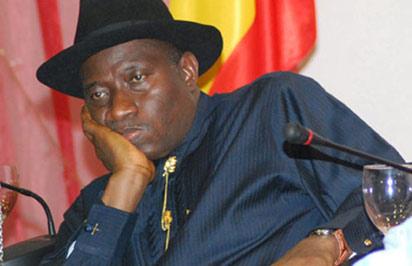
Jonathan
By Adisa Adeleye
In the normal (by Nigerian standard) week that witnessed shedding of innocent blood in Kaduna and other places, I join other Nigerians in celebrating the miraculous escape of the former Head of State, General Muhammadu Buhari from attempts on his life. The country has been saved from the proverbial “monkey and baboon soaked in blood” episode, perhaps on a larger proportion to the last bloody clashes witnessed after the 2011 presidential election. It was also pleasing news that President Jonathan recognized this while expressing sympathy on those who lost their lives in the dastardly attacks.
Now coming back to the main topic, two of the readers of this column expressed their anger over my consistent call for a ‘genuine national government‘ when, according to one of them, there is no need for it. Such a move, one of them sentimentally argued, the year of reckoning is a few months away for the re-election of President Jonathan to be confirmed. The other argument is equally sentimental to the fact that the needed change after fifteen wasted years is just at the corner. Both arguments seem simplistic if not puerile when placed side by side with the predicted prognosis in 2015 by the foreign pessimists.
In all probability, the political ground for the landslide victory for President Jonathan is well watered. With the fresh political onslaught in the South-West by losing Ondo to Labour (PDP‘s ally) and landslide victory in Ekiti (with heavy security present) and a likely success in Osun, the gate-way to Yoruba Kingdom looks wide-open, as the theory goes.
The expected success calculation goes further. With massive and solid votes from the East and more than 99 per cent returns from the South-South, especially in Rivers and Bayelsa where committed human voters aided by fishes (not destroyed by oil operations) could render valuable help. And before 2015 real elections, the mighty sword of ‘Impeachment‘ is dangling ferociously over the heads of many governors, especially those who have decamped into other parties. The sword has been used effectively over the head of Nyako of Adamawa and may succeed in Nasarawa where PDP has majority of legislators but an elected APC governor.
The analysis so far points to an unassailable position of President Jonathan in 2015 without a thought on factors in favour of the Opposition which are based on the rock of the votes of the people of the North (with cattle and friendly neighbours) and also ghost voters of the South-West (laughs). Some argue, and rightly so, that a party which in fifteen years could not guarantee security in many parts of the country, could not eradicate poverty through mass employment and could not provide electric supply in adequate quantity to stimulate the economy, should be denied the luxury of another four years in office.
However, the pertinent question is who says that votes of the people really determine the winner of a Presidential election? Observers should cast their minds back to the 1979 and 1983 elections when the late Dr. Nnamdi Azikiwe (APP) and late Chief Awolowo (UPN) lost to Alhaji Shehu Shagari of NPN. Stories should also be collected from living losers of past presidential elections – Olu Falae against Obasanjo; Buhari against Obasanjo; Buhari against Yar‘Adua and Ebele Jonathan. All petition cases went to the Supreme Court, leaving vestiges of political bitterness that linger on till date.
Many analysts believe that presidential elections are won and lost through the machinations (schemes) of the real powers behind the scenes. The old army political junta which was believed to have created the PDP to have one of its own as President would not fold its arms or close its eyes at that crucial time.
Any serious political watcher of election processes in Nigeria since Independence in 1960, and after 1999 would think twice about being sacrosanct about any presidential election result. The Abiola victory which was achieved through massive votes of the people (in spite of the contentious Mushu-Mushu ticket) was annulled by the Military President, Ibrahim Babangida in 1993. In 1999, it was clear that Chief (Gen) Obasanjo was the former military junta‘s choice. Obasanjo was believed to have picked the late Yar‘Adua and also, the current President is believed to be his candidate. He would have done everything possible within the laws of the land to ensure their victories.
Many patriotic Nigerians believe, and fervently so, that the strong national political unity fervor that propelled Moshood Abiola to victory in 1993 had dissolved into patches of religion and ethnicity. Unfortunately, the old political actors had now become political gladiators of disunity
While it may be cruel and inconsiderate to blame President Jonathan for the ills of today, it could also be true that his administration has not been able to meet adequately the current challenges. The Boko Haram insurgency challenges are causing political and economic anxieties even with gallant efforts of the country‘s security forces. The unemployment question continues to cast doubts on poverty eradication policies, while inequitable distribution of income (by creating wealthy and poor classes) tends to promote wider avenue for bitter class struggles. It is a sign of a swift drift into a dungeon of hopelessness and avoidable disintegration.
What is the answer to political disunity and economic uncertainties of the present? The problem lies in how the federal government is constituted in a plural state where the constituent parts are not evenly endowed in political and economic resources.
There should absolutely be no reason for the North to insist on holding on to power or feel unsafe if the President is from any other area outside the North. It is my firm belief that the ‘winner-takes-all‘ mentality being demonstrated by the present crop of politicians could not heal the sour political wound.
A negotiated political arrangement is what is needed to overcome the ravaging problems. Viewed from any angle, the country‘s problems are based on Boko Haram insurgency, growing poverty, ravaging unemployment, armed robberies, kidnappings and political assassinations. If after 15 years, the ruling party could find no suitable answer, then something else should be tried.
There is no nation in the world which had not got its problems in the past. The quicker resolution of such problems rested on the innovative minds of their leaders. When American capitalism was severely tested by the depression of the 1930s in the United States, President Roosevelt came with the idea of budget deficit (spending more than income) which allowed the injection of more funds by government into the economy for infrastructural developments. Also, in the 1930s when Britain (our past colonial masters) was faced with grave economic crisis, it resolved to form a National Government – to save the British Pound.
Should we now call on the former rulers – Babangida, Abdusallam Abubakar, and Obasanjo to help to get the stubborn and recalcitrant forces to come together in the face of a gruesome war against their fatherland?
Disclaimer
Comments expressed here do not reflect the opinions of Vanguard newspapers or any employee thereof.