
By Sola Ogundipe
One short sleep past, we wake eternally, and death shall be no more; Death, thou shalt die”. A window sticker bearing these last two verses of John Donne’s holy sonnet, “Death be not proud”, caught this reporter’s attention.
It is pasted on the rear window of a dark blue Volvo 740 Estate ambulance that slows down briefly, but does not come to a complete stop before driving through the open gates of the Lagos Mainland Hospital, Yaba, Lagos – the designated centre for the management of Ebola Virus Disease.

After what seems an eternity (actually just a few seconds), the ambulance slowly approached the hospital building some 100 metres from the main gates, turned left and disappeared from sight.
One could not but reminisce about the phenomenon called death. Was it a surprise that another person just died? No, it wasn’t. People die everyday. The pertinent question is “when shall death die”, as predicted by Donne in his sonnet?
The Scripture has long stated that it is appointed unto everyone to die. Death is the final frontier. Although people abhor death, it is not essentially because of the “why”, but more as a result of the “how”. People tend to be more worried by the question of “how will I die” much more than that of “when will I die” – though the when is also important. This worry plays out right from the main gates of the institution.
For obvious reasons anyone would be forgiven for branding the premises of 1, Mainland Hospital Road, a no-go area. Ordinarily the average Lagosian and other persons do their utmost to keep away from places like hospitals infamously associated with life and death over the years.
But that is not to say people do not go to hospitals. As a matter of fact, people do go to the Mainland Hospital because it was built by people for people. To be exact, if there is one place one expects to find people with something or anything to do with notifiable infectious diseases, such as Tuberculosis, HIV/AIDS, cholera, meningitis, rotavirus, hepatitis, etc., either as a patient or healthcare personnel, it is at this hospital.
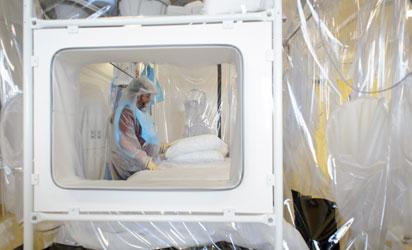
Lately, the hospital has taken on a brand new responsibility as quarantine centre for victims of Ebola Virus Disease, EVD. These persons are permanently under round the clock observation and treatment.
Anyone who has ever visited the renowned health institution, would agree that its location isn’t one you just happen to “stumble on” or accidentally “pass by”. While not exactly hidden, the facility, formerly known as the Infectious Diseases Hospital, IDH, is conveniently tucked away from the curious public.
On the long drive down to what has, in the last couple of weeks become the frontline health facility in the fight against the dreaded Ebola virus, there is no anxiety or dread, only curiosity and expectation.
Much further away along the trail to the destination, are military health formations and places of worship. A row of shops sited roughly a kilometre to the entrance gates gives no impression to the unwary about what is ahead.
On the approach, attempts to engage the shop owners in conversation is futile. Everyone knows what is going on at the facility down the road, but no one is bothered about the reporter’s mission or interested enough to complain. Perhaps there are no complaints, one is compelled to conclude. “No comment” is the universal language.
Just before getting to the place itself where the fight against the disease is being fought, the educational institution to the right and military barracks to the left hold no attention for the casual observer.
The general mood around is normal. Commercial motorcycles and motorised tricycles (keke), convey visitors right up to the gates. The four security personnel manning the gates are pleasant but alert. They are male and female. Their dark green uniform is set off by the white gloves and face/nose masks. A quick look round confirms that every security personnel in sight is wearing the gloves and mask. Nothing surprising, after all, it’s an infectious diseases health institution.
Inside, the premises is neat and inviting. There is an aura of calm. As you walk down, a Police pick-up van drives past. On the load bay is a body wrapped in a cloth. Its the second to be brought-in in just a matter of minutes. The body is flanked by a man and a woman. They look downcast. Walking down further, one takes in the layout of the area. More security personnel ahead.
Entry into the open hospital building is carefully checked and monitored. Understandably, access into the main quarantine unit area and ward is forbidden. Can one see any of the doctors, nurses and other personnel? They are likely busy . They must be inside, applying their special training in infectious diseases. How about the outpatients? One gathers the isolation ward is sealed tight and strictly out of bounds.
The protocol is very strict, one gathers. Medical staff must comply with every safety regulation when attending to a patient. Several instruments and medicaments are dedicated to patients individually and destroyed afterwards.
In line with WHO recommendation, a lot of heat-sealed plastic bags is employed for containment and disposal.
Protection from highly contagious infections such as Ebola is highly considered and effected. No compromise is permitted when dealing with an infectious disease like Ebola, a specialist explained previously. There is also a decontamination unit or chamber.
The laboratory section is indistinct. How are samples handled? Are all the essential pieces of equipment in one place? What about the hospital waste. How is it disposed?
So far two persons have died of Ebola in Nigeria. Nine tested positive and 139 are under surveillance. All positive cases are monitored and treated at this facility.
The dead are the same two known earlier, the index case and the health worker who we unfortunately lost some days ago. Eight of those positive are Nigerians and one was an American Liberian. Seven are alive and receiving treatment in Lagos. Nigeria’s case fertility rate for Ebola is currently 28.6 percent. In the ECOWAS region, the case fertility rate stands at 55 percent which means 45 percent of people who have suffered Ebola are alive.
There are more suspected cases being monitored. Scientists have proved that having Ebola does not mean being confined to death because there are survivors although no cure. To date, the response to the Ebola virus threat has been coordinated, from the first responders to the operational non-hospital staff, down to the on-ground medical staff. But there are still many unanswered questions.
Is Ebola epidemic truly out of control as experts fear possible Ebola pandemic?
Are these fears founded?
What would be the implication of an Ebola pandemic?
In the absence of a vaccine, what magic bullet do exists against Ebola virus?
Disclaimer
Comments expressed here do not reflect the opinions of Vanguard newspapers or any employee thereof.