
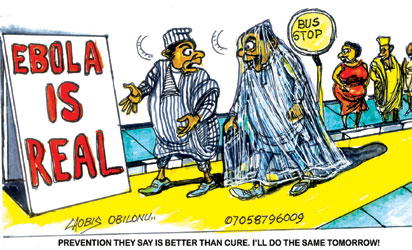
By Femi Ogunyemi
While the eye of the hurricane of Ebola still sits on a cluster of small countries in far West Africa, its wind shears has now engulfed our nation, Nigeria.

From the heroic actions of the dedicated doctor and staff of First Consultants Hospital in Obalende, to the swift action of both Federal and State Governments (despite political differences), Nigeria has stemmed the spread of this deadly virus.
The Ebola virus (in all its five cowardly disguises) invades the body like a thief, to plunder and destroy everything in its wake, including, eventually, itself. This tiny creature attacks tissues and leaves a bloody haemorrhage in its trail. It is not the only “hemorrhagic” fever…there are Lassa, Marburg,and Dengue fevers as well.
Ebola not the most powerful
Ebola is actually not among the most powerful of viruses when OUTSIDE the body. It can be removed by simple washing of hands. It struggles to transgress normal intact skin.
It takes contact with an afflicted, clinically symptomatic person to become infected.
The (ordinary) cold virus is more resilient. It remains in dry handkerchiefs and other fomites, even when the afflicted person appears hale and hearty.
Hepatitis B
The hepatitis B virus can remain dangerously infective on a piece of paper for weeks. It remains in the blood, gently doing its damage to the liver and other organs, over many years.
While Ebola will, stupidly, destroy its host and hence itself, the slow-poison deadly HIV virus, can remain and maintain its (infective) state in its host for decades.
21 days
It takes Ebola up to 21 days to start wearing down its host’s defense systems. Symptoms manifest and the person becomes infective.
The ‘flu virus will get to that stage within a week!
Finally, when those that survive Ebola recover (and figures show that 10-50 percent will survive), the virus disappears. It is gone from the blood. The survivor’s body is even able to produce soldiers (antibodies) that are ready to attack the same virus (strain) if it should invade again.
Chicken Pox
Compare this to the chickenpox virus, which, after its temporary, devastating and disfiguring initial onslaught, will disappear from the BLOOD….but can hide in the central nervous system for up to 80 years! When the chickenpox virus awakens decades later, it starts to attack peripheral nerves and leaves a trail of debilitating severe neuropathic pain conditions in the sufferer.
Yes, Ebola is deadly, but it is in its biological stupidity, that prevention is its best antidote.
Lest we forget, there are three other diseases wreaking havoc across our region.
AIDS
At the end of 2012, 35.3million people were living with HIV. That same year, some 2.3 million people became newly infected, and 1.7 million died of AIDS, including 230 000 children. Close to 10 million people in low- and middle-income countries were receiving antiretroviral therapy at the end of 2012. More than two-thirds of new HIV infections are in sub-Saharan Africa.
TB
There were an estimated 8.6 million new cases of TB in 2012 (including 1.1 million cases among people with HIV) and an estimated 1.3 million deaths (including 320, 000 people with HIV), making this disease one of the world’s biggest infectious killers.
Malaria
Around the world, 3.3 billion people are at risk of contracting malaria. In 2012, an estimated 207 million cases occurred, and the disease killed approx. 627 000 people – most of them children under five in Africa. On average, malaria kills a child every minute.
To all health
workers
The heroic doctors and health workers at First Consultants, and those battling Ebola nationwide and across West Africa, have been treating these three ailments for decades.
Let us not relent in carrying on their battles. Let us not forget that the commonest cause of fever remains malaria; that other deadly dangers exist through contact with other person’s body fluids; and that dirty, insanitary foods and water are still the commonest causes of typhoid and diarrhea.
Ebola has come and, like all epidemics, it will go. As we mourn the departed, we must carry on the work for which they sacrificed.
Disclaimer
Comments expressed here do not reflect the opinions of Vanguard newspapers or any employee thereof.