
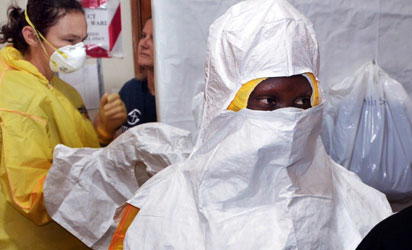
File image for illustration.
You do not go to a gun duel armed with a knife, neither do you wear boxing gloves to a wrestling match. Common sense dictates that one goes to battle with the right equipment.
Ebola Virus Disease connotes war. When dealing with an adversary that is a contagious virus with a potentially lethal, high danger index and almost total fatality rate as the Ebola virus, it is sensible not just to be appropriately armed, but advisable to go with your entire arsenal.

A picture taken on July 24, 2014 shows staff of the Christian charity Samaritan’s Purse putting on protective gear in the ELWA hospital in the Liberian capital Monrovia. An American doctor battling West Africa’s Ebola epidemic has himself fallen sick with the disease in Liberia, Samaritan’s Purse said on July 27. AFP PHOTO /
Taking measures to be protected from contracting the deadly virus – especially if it’s your job to come into contact with patients who have it – is no mean task either.
This is where the Personal Protection Equipment, PPE, worn by doctors and other healthcare personnel who are dealing with the worst Ebola virus outbreak in history, come in.
The doctors and others wearing the gear, which involves a layer of scrubs, rubber boots, rubber gowns, an impermeable Tyvek suit and hood, a respirator and goggles is now a common sight. Each element of the PPE is crucial and has a specific function.
The Ebola virus can only be transmitted through contact with bodily fluids, hence the suits are meant to protect the wearer from directly touching any contaminated fluids and/surfaces. Infection control, through sterilisation of equipment and surfaces, is also extremely important.
Disclaimer
Comments expressed here do not reflect the opinions of Vanguard newspapers or any employee thereof.