
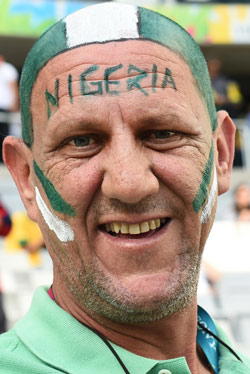
BRAZIL, Curitiba : A Nigerian fan is pictured prior to a Group F football match between Iran and Nigeria at the Baixada Arena in Curitiba during the 2014 FIFA World Cup on June 16, 2014. AFP PHOTO
By Ochereome Nnanna
THE National Conference made far-reaching resolutions on Thursday, July 3rd 2014 when it approved the creation of eighteen additional states in the country. If this resolution is put in the constitution, Nigeria will become a federation of 54 states, with about 174 million people and landmass of 923,768 square kilometres.
Compare this with other famous federations such as India (1.2 billion people, 29 states/seven territories and landmass of 3,16,414), the United States (50 states, 9.83 million square kilometres and 318 million people) and Russia (81 states, 17 million square kilometres of landmass and 145 million people). You will realise that, pound-for-pound, Nigeria will become the most minutely split federation per capita in the world in relation to our landmass and population (though the Russian is spread thinner due to its intimidating landmass).
Increasing the number of states from 36 to 54 will be a departure from the general trend of agitations as we prepared for the conference. Most agitators felt that a new, more viable Nigerian federation should revert to the regional structure: either Gowon’s old twelve-state structure that balanced the north and south, east and west; or the six geopolitical zones that conform to the natural “home zones” of Nigerians. These would form the basis for the distribution of the wealth of the nation to give every section a sense of belonging and satisfaction while also providing the various political elites their much needed platforms to assert their political influence.
Secondly, a regional structure was meant to cut down the cost of governance and allow the federating units to be able to operate normal budgets where the capital expenditure will dominate the recurrent. The regions were seen as the best options for federating units, where true federalism can thrive and healthy competition will lead to the rapid development of the country. Those who have for decades called for true federalism had hoped that devolution of power to the regions or geopolitical zones would remove the overbearing dominance of the centre, which was foisted by the military.
At the conference, however, certain complications cropped up. The foremost of these was the question of how to achieve the nationally-agreed agenda of creating an additional state for the South East to bring it to par with four other zones in the country. How could the other zones offer the sacrifice to the South East without any incentive in a nation where people are not known to fight injustice unless the shoe is pinching them? Since there were other overwhelming demands for additional states from all the geopolitical zones, the creation of eighteen new states will solve this problem and also correct the imbalance of the North West being the only zone with seven states.
Secondly, it has become abundantly clear that the 36 state structure has created new majority monsters and trapped minorities who could never hope to produce governors. The cases of Benue and Kogi states, where the Tiv and Igala respectively, have stubbornly refused to share power with smaller minorities since their states were created, stand out. Other states have managed to broker charters of equity, but Benue, Kogi and even Delta States have excluded certain parts of their states from producing governors. It is this renewed agitation from perceived internal minorities of states that has led to more states turning the table against a return to the regions. Secondly, some of the newly “liberated” backwater areas of the old regions (Ebonyi, Ekiti, Bayelsa, Jigawa, Gombe, Akwa Ibom and others) would not want to return to their old regional underdog positions after tasting the sweet wine of self-determination.
The Nigerian federation is, therefore, living true to its historical essence. While most federations came together to form a common bond, the artificial territory created by a foreign colonial power finds itself splitting down the line, with emerging new political interest groups demanding the platform for their own slice of the national cake.
Nigeria is beginning to conform to Professor Jibril Aminu’s pet vision. In April 1994, Aminu, who incidentally is a delegate to the ongoing Confab, gave a lecture in which he shocked many in the audience by declaring that Nigeria did not need a “true federation” made up of strong federating units.
He said instead, Nigeria needed a strong federal government with weak federating units. He called for the abolition of states and retention of the local government areas; a two-tier arrangement. Otherwise, according him, let there be a continuous creation of more states until the states will be so many and so weak as not to be able to challenge the federal government as the former Eastern Region did in 1966.
The Professor of Cardiology affirmed that a strong centre was the only guarantee for national stability. Every state would become increasingly more dependent on the Centre. That way, no one will like (or be able) to secede. With 54 states, Nigeria will be well on the way to Aminu’s dream federation.
It will be a federation built on unending scrambling for the national cake, with ethnic, religious and sectional rancours always deployed to get more from the commonwealth. It will increase the cult of parasitism and dependency, and the power of the centre will guarantee that the struggle to produce the president will remain bloody. The Confab may have aggravated the problem rather than solving it.
Disclaimer
Comments expressed here do not reflect the opinions of Vanguard newspapers or any employee thereof.