
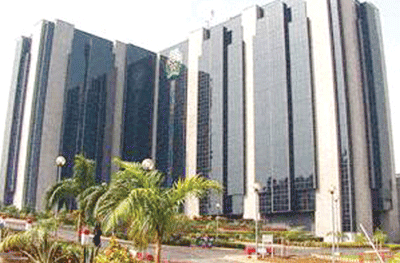
The Central Bank of Nigeria head office in Abuja.
By Dele Sobowale
Those who do not remember the past are condemned to repeat it.” George Santayana, 1863-1952. (VANGUARD BOOK OF QUOTATIONS p 93).

As you are reading this article being written on July 1, 2014, the nation is supposed to have gone totally cashless. Now, if you are wondering why your pocket or handbag is still full of cash or why you cannot purchase the new television set with a credit card, but must surrender hard cash, then welcome to reality – which is a commodity lacking in the Central Bank of Nigeria.
Incidentally, this year marks the twenty-second anniversary of my first taste of detention in Nigeria under a military administration. It was in the year 1992, when I wrote a column titled CBN: CONFUSED BANK OF NIGERIA after the bank released a set of new policies which I thought would never work; and which did not work.
Instead, it made the matter worse for the implementation of the Structural Adjustment Programme, SAP, which President Babangida introduced and which was unraveling rapidly and dangerously for Nigeria. I was not aware that the Nigerian Governor of CBN, under a military regime, was so shielded from harsh criticism as to warrant getting a columnist arrested and detained.
VANGUARD came out on that, personally historical, morning at dawn and by ten in the morning, my office, at the Nigerian Institute of Management, NIM, Victoria Island, was invaded by gun-totting Mobile Policemen, asking brusquely, “where is Dele Sobowale?” The fault was partly mine and partly that of VANGUARD. Written boldly at the bottom of each column was “Dele Sobowale is a Senior Lecturer/Consultant at the Nigerian Institute of Management, Victoria Island.” So the “Gestapo” did not have to search for me.
Two hours after, I was cooling my heels in an interrogation room. Those assigned to grill me asked the following questions in tones suggesting an inquisition was in progress. “Who are you to question the Governor of Central Bank of Nigeria?” “Are you an economist?” “Who is paying you to rubbish the policies of the Federal Government of Nigeria?” “Do you want to cause confusion?”
For hours the questioning went on; sometimes the same question is asked in a different way and the same answer was given. Finding me “uncooperative”, they then turned the screws on the NIM which ran an annual training programme for CBN. That programme alone accounted, at the time, for about twelve and a half per cent of NIM’s annual revenue.
NIM was ordered to ask me to write an apology or terminate my appointment – otherwise there would be no more training programme. Sensing that I was putting the Institute in an ethical dilemma – defend intellectual freedom of expression and lose a lot of funds or sell their staff for money —I chose to resign to save NIM.
I refused to recant. The Governor of the CBN died a few months after that episode and the policy was reversed by the next CBN governor. It was one of my most painful sacrifices for Nigeria because I really intended to make a career at NIM.
What was wrong with the policy IBB’s CBN introduced at the time? In reality the policy was conceptually sound but it was premature. Nigeria, in 1992, was not prepared for the execution of that policy. It would have, and did create, more problems than it solved. I hope to locate the article and get it published among my selected columns; it was one of my most prophetic.
When the CBN embarked on the cashless policy, about three years ago, there was apprehension that, just as in 1992, we might be pushing a brilliant policy too fast for our good. E-payment, and all the attendant benefits associated with it, is fraught with many dangers – almost none of which had been adequately addressed.
Cyber fraud had already become very sophisticated (fraudsters have had years of practice with the US and the advanced economies) and Nigeria, starting so late, and having developed its own crop of expert criminals, was a feast about to be delivered – unless the banking authorities can leap-frog the safeguards which other nations had installed – quite unsuccessfully one might add.
Nothing known to me would suggest that the CBN had worked out the problems involved. On the contrary, cyber fraud involving banks seems to be increasing – with depositors losing their deposits – frequently without repayment. A personal example would illustrate the point.
My wife, usually very conservative, has never been one of those Marketing professionals would classify as a maverick. She seldom joins those who are the first to try anything. Predictably, she was one of the last few to obtain an ATM card among our circle of friends and associates. Even then she used it sparingly.
She was sitting at home, with her ATM card in her handbag when she received an alert from UBA that her account had been debited for a withdrawal. Till today, she had received no refund even when it was established that the withdrawal was made in Aba. She had been in Aba in the 1970s when as the National Sales Director for Boots Company Nigeria Limited I asked her to accompany me to see the East. That is an experience which occurs now several thousand times a day….
Disclaimer
Comments expressed here do not reflect the opinions of Vanguard newspapers or any employee thereof.