
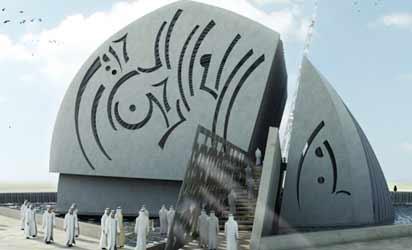
Like the daily sun, this verse too shines with a new splendour and brilliance at the beginning of each chapter of the Quran. No wonder the Prophet (s.a.w) said: “Any important work that does not begin with Bismillah is devoid of Barakah.”

In the Glorious Quran, the word Bismillah Rahamani Raheem appeared in 114 places, begining every surah except Surat At-Taubah or otherwise called Al-Bara’ah (chapter 9) and appeared two times in Suratul An-Naml,(chapter 27), first at the begining and another in verse 30.
Ibn Kathir also said in his commentary that some of the scholars agreed that Bismillah is a part of an Ayah in Surat An-Naml (chapter 27). They disagree over whether it is a separate Ayah before every Surah, or if it is an Ayah, or a part of an Ayah, included in every Surah where the Bismillah appears in its beginning. Ad-Daraqutni also recorded a Hadith from Abu Hurayrah from the Prophet that supports this Hadith by Ibn Khuzaymah. Also, similar statements were attributed to ‘Ali, Ibn ‘Abbas and others.
The opinion that Bismillah is an Ayah of every Surah, except Al-Bara’ah (chapter 9), was attributed to (the Companions) Ibn ‘Abbas, Ibn ‘Umar, Ibn Az-Zubayr, Abu Hurayrah and ‘Ali.
This opinion was also attributed to the Tabi‘in: ‘Ata’, Tawus, Sa‘id bin Jubayr, Makhul and Az-Zuhri. This is also the view of ‘Abdullah bin Al-Mubarak, Ash-Shafi‘i, Ahmad bin Hanbal, (in one report from him) Ishaq bin Rahwayh and Abu ‘Ubayd Al-Qasim bin Salam. On the other hand, Malik, Abu Hanifah and their followers said that Bismillah is not an ayah in Suratul-Fatiha or any other Surah. Dawud said that it is a separate ayah in the beginning of every Surah, not part of the Surah itself, and this opinion was also attributed to Ahmad bin Hanbal.
Just as it was stated above in the hadith, Prophet Sulaimon started his work with the verse; remember also when Arch Angel Gabriel visited the Prophet for the first time at cave Hira, The angel said, “iqra,” i.e., “read.” The Holy Prophet, (s.a.w), replied, “I do not know how to read.” The angel repeated the same words and the Holy Prophet, repeated his answer. And so it happened three times. The fourth time the angel said, “Iqra bismi-Rabbika-alazhi Khalaq,” i.e., “Read in the name of your Lord who creates.” Then the Holy Prophet, (s.a.w), started reciting. So, it is clear that the the phrase “With the name of Allah.” is powerful.
Again, when a person recites ‘Bismillahir-Rahmanir-Rahim’ at the beginning of any task, it is implied as putting God first which will make every step of the activity successful. So, reciting the verse is not restricted to the recitation of the Holy Quran alone, but very important at the beginning of every work. “any work started without reciting ‘bismillahir-Rahmanir-Rahim’ is without blessing, and certainly if any person starts his work by asking for the help of God, then his work will be blessed.
Allah, Most High, is perfect in goodness and benevolence. When man, without any effort on his own part, is granted through Allah’s attribute of Rahman, limitless mercy and blessings, and observes the Rahma and Ihsan of God, then in the heart of the worshipper, a love for God is born. As these blessings and the grace of Allah’s Mercy and Ihsan descend upon the believer, his love for God keeps on increasing. The more a person becomes a beloved of God, the more praiseworthy he becomes.
Allah is the name of the essence of God, the Most High, and this is the greatest name that is embeded in all the other names of God. For instance, al-Rahman (The Beneficent, pronounced as Ar-Rahman) is a name of God. Allah is an independent word which is the name of the essence of God, and this is unique to the Arabic language as no other language has a name for the essence of God. The Quran itself explains the meaning of the name Allah where it states “Lahu al-asma al-husna” (to him belong (all) the beautiful names). The name incorporates within itself all the perfect attributes in their entire completeness.
‘Ar-Rahman’ and ‘Ar-Raheem’:
‘Ar-Rahman’ (the Beneficent) is He whose generosity is so great that before the birth of man and without any effort or labour on man’s part, the entire resources required for his sustenance were provided. Ar-Rahim’ refers to the mercy which is granted repeatedly and these attributes manifest themselves time and again and have an excellent and improving effect on each person’s actions.
It is stated in the Hadith, that God, Most High, is the ‘Rahman’ (Beneficent) of this world and the ‘Rahim’ (Merciful) of the hereafter. This is because Rahman, before the birth of man, merely out of his beneficence provided the entire resources for the sustenance and progress of man. So, this entire world is a manifestation of the attribute Rahman. The attribute Raheem rewards man for good works and this is fully manifested in the hereafter.
Land, water, fire, the sun, the moon, rain, etc., exist due to the stipulation of the attribute Rahman. Man’s labour of ploughing and watering the land, is rewarded manifold through the necessary stipulation of the attribute Rahim, so that each seed sown can be returned seven hundred fold. In the same way, eyes, ears, hands, feet, intelligence and knowledge, are all manifestations of God’s attribute Rahman (beneficence). When man utilises these resources and gets excellent results, this is necessary stipulation of the attribute Rahim.
So, when a person starts a work by reciting Bismillahir-Rahmanir-Rahim, he acknowledges and thanks God, Most High, for the blessings which God provided merely out of the demands of his attribute Rahman. On the one hand man, is asking God’s help for assistance, provided as a manifestation of the attribute Rahman (Mercy)in order to achieve his objective, and through the attribute Raheem, that the work he wants to carry out may produce excellent results.
To be successful in the world, it is essential to possess correct knowledge, for without correct and complete knowledge, no action, whether for the world or the hereafter, produces effective or correct results.
And, unless the results of deeds are correct and complete, there can be no success in the hereafter. The Quran completely possesses the principles and guidance by which man, by acting upon, can achieve the goodness of this world and the hereafter.
Whoever recites Bismillah hir-Rahman nir-Rahim, asks for complete and correct knowledge, as well as perfection in deeds, which produce excellent results. In other words, he asked for knowledge of the Quran and good deeds, and further requested perfection in these. One who receives the correct and complete knowledge of the Quran, and furthermore is blessed with excellence in works, is successful and achieves goodness in this world and the hereafter.
When Bismillah was revealed; Jabir was reported to have said that when:
In the Name of Allah, the Most Gracious, the Most Merciful; was revealed, the clouds gave way by moving to the East, the winds ceased blowing, the oceans became calm, the creatures prepared
themselves to listen, the shayatin were pelted with fire from the heavens and Allah, swearing an oath by His honour, declared: Anyone who says this name of mine upon anything, I will surely impart barakah in that thing. Ad Durrul Manthur and Ibn Kathir
In Ad-Durrul Manthur, Ibn Umar t is reported as saying that surely, whenever Arch Angel Gabriel used to bring message to the Prophet, he used to first recite the ayah. In Bismillah there are three names of Allah: 1) Allah which is His personal name indicating that all projects can only be initiated by the will and wish of Allah. 2) Rahman (mercy) which is His attributive name indicating that only Allah can keep that project intact and existent guarding it against destruction.
3) Raheem (Most Merciful) which is also His attribute name indicating that only Allah can, through His mercy and grace, enable any person to derive benefit from that project.
Other uses of Bismillah
Islam is not confined only to the masjid and madrasah. It is a way of life. Each and every aspect of a Muslim’s life is supposed to be deen. It is for this reason that Rasulullah has shown the ummah simple methods which would render each and every worldly affair of his to become deen and for which he will be rewarded.
Thus every activity of a person will become an ibadah. By doing this, he
will draw closer to Allah and distance himself from the accursed Shaytan. And by not doing this he will deprive none other than himself.
According to Ibn Abbas in Ad-Durrul Manthur, Rasulullah has said that people are unaware of the blessings of one ayah of the Holy Qur’an which was revealed to no one other than me and Sulaiman u. That is: Bismillahir-Rahamanir-Raheem
Again, you can only remembering Allah Through His 3000 Names with this ayah. It is mentioned in Tafsir Ruhul Bayan that Allah has three thousand names. He revealed 1000 to the angels, 1000 to the prophets, 300 are mentioned in the Tawrah, 300 in the Zaburah, 300 in the Injil, and 99 in the
Holy Qur’an. One name He has kept to Himself without revealing to no one. All these according to scholars have been condensed into the three names contained in the ayah.
Teaching children to say Bismillah could be a means of forgiveness for parents. It was reported from Abdullah bin Abbas that as soon as the tutor says
to a child, read: In the Name of Allah, the Most Gracious, the Most Merciful; the teacher, the child and the child’s parents are all guaranteed freedom from the fire of Jahannam.
It was reported that Prophet Isa (Jesus a.s) passed by a grave whose inmate was being tormented. After some days he happened to pass by the same grave again. This time there was no punishment. The inmate was in great comfort. This surprised him a great deal. He asked Allah: “Lord, what brought about Your mercy so that you have lifted the punishment from this person?” Allah I replied: “O Isa, when the man died, he left behind a child. When his mother took him to the madrasah, the child said: Bismillahir-Rahamanir-Raheem. In the presence of the teacher, it does not befit me to keep on punishing his father while he called me Rahman and Rahim. Hence, I forgave him.”
Bismillah – A means of deliverance from punishment: It was reported from Abdullah bin Mas’ood that: the ayah has 19 letters and the angels of hell are also 19; anyone who says the ayah will be safeguarded against the 19 angels of Jahannam. Tafsir Qurtubi and Durrul Manthur, volume 1 page 9
Bismillah – It is a means of high status in the hereafter: Rasulullah was reported as saying that any du’a which begins with “Bismillahir-Rahamanir-Raheem” is not rejected. By saying:
In the Name of Allah, the Most Gracious, the Most Merciful, the scales of my ummah will become heavy on the Day of Qiyamah”. The other people will ask: “Why are the virtues of the Ummah of Muhammad so heavy?” Their prophets will reply: “In the utterances of the Ummat of Muhammad
there is such an honourable name of Allah that if it is placed on one side of the scale, and the sins of the entire creation are placed onto the other side, then the side with the virtues will be heavier.”
Other wonders of Bismillah
Rasulullah was reported to have said that as long as people keep on saying: In the Name of Allah, the Most Gracious, the Most Merciful, it will be a means of safeguarding them against sickness; a means of granting riches to the destitute; a means of freedom against the fire; a means of safety against being swallowed by the earth; a means of safety against faces becoming distorted; and a means of safety from stones raining down from the heavens. Ghunyatut Talibin Page 157
A Hadith Qudsi
Rasulullah said that the angel Jibreel made a mention of this hadith under oath that he heard it from the angel Mika’il under oath who heard it from the angel Israfeel under oath that Allah said;
“By my honour, grace and grandeur, whoever reads: In the Name of Allah, the Most Gracious, the Most Merciful and Suratul-Fatiha jointly once, then you be witness that I shall not burn his tongue and I will save him from the fire as well as the punishment of the grave and on the day of Qiyamah.
Saying Bismillah Before Wudhu: Rasulullah said: “One who does not say Bismillah before wudhu, his wudhu is incomplete.” Tirmidhi.
It is reported from Abu Hurairah that anyone who does not say Bismillah before wudhu, only the sins committed by the limbs which are washed in wudhu will be washed away; and one who says
Bismillah before wudhu, the sins of the entire body will be washed away. Mishkat
Saying Bismillah Before Meals: Umar Ibn Abi Salamah reported that Rasulullah said to me: “Say
Bismillah and eat with your right hand the food that is in front of you.” Bukhari, Muslim, Tirmidhi
The scholars have said that it is preferable to say the Bismillah aloud so that it is a reminder for those who forget.
Also, Ibn Hibban is reported as saying that if Bismillah is said prior to utilising any bounty of Allah and Alhamdu-lillah is said after utilising it, the user will not be asked to give account of that bounty on the Day of Qiyamah.
Blessings in food: By saying Bismillah before eating, barakah is imparted to that food: Aishah reported that Rasulullah was once having meals with the Sahabah when a Bedouin came along and joined them. He finished all the food in two morsels. Rasulullah remarked that if he would have said Bismillah before eating, this food would have sufficed for everyone.
Not Saying Bismillah- A cause for remaining hungry: A person once complained to Rasulullah that he ate food but still remained hungry. Rasulullah said that perhaps you are not saying Bismillah before meals. He admitted. Rasulullah said that by not reading Bismillah your stomach does not fill.
When Undressing:- Anas reports from Rasulullah that when a person undresses for the purpose of either relieving himself or bathing or having relations with his spouse then the Shaytan interferes. If he/she says Bismillah before taking off the clothes, then this serves as a barrier and safety against the shayateen and jinn. Tirmidhi
Disclaimer
Comments expressed here do not reflect the opinions of Vanguard newspapers or any employee thereof.