
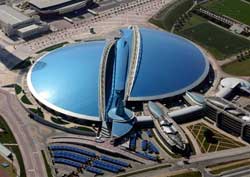
Aspire Dome is seen in Doha in this aerial view. Qatar will host the 2022 World Cup.
The Sunday Times has done excellent investigative work and has brought out the vices and deadly sins of the world of sport, which doesn’t want to adapt to the times and morals. Football is certainly under investigation, the dearest and most followed sport, but it would be wrong to think that it’s alone.
The target is the FIFA World Cup in Qatar 2022. Bin Hamman, Qatari, former potentate, former pretender to the FIFA throne, now dethroned and back in the desert, is alleged to have softened many senior managers, certainly not virgins, cosseting them with substantial cheques. What hurts is that it’s no surprise.
You should know that there’s a list, logically unofficial, that the various consultancy agencies know well, of senior managers of the various federations who are inclined to accept gifts. Let’s be clear – there are also senior managers who actually expect gifts, which they don’t consider as gifts but a right acquired with the position. This bad habit has been changed by politics and, in some cases, also made more efficient.
QATAR OUT? Now, somebody is asking for a re-vote on the World Cup 2022, and this opens a debate on a problem that has been on the table for some time. Can a country be penalized for the illegal behaviour of some of its senior managers? Is such a step legally possible after the official signature of a contract?
The experience of the past says no, but it’s up to the world of sport to start asking itself about what should be built in the future. In addition, the senior managers of the Qatari organising committee are denying any involvement in the action taken by Bin Hamman. However, those asking for a re-vote also want to put Russia’s victory on the table. It’s better to take a step backwards in the history of sport to understand the current situation.
SALT LAKE CITY A violent scandal shook the IOC at the end of 1998 when it came out that the committee for the candidature of Salt Lake City, capital of Utah, had corrupted some members of the IOC to ensure its acquisition of the Winter Olympic Games. The Olympic family expelled some of its corrupt sons with dishonour; the two top officials of Salt Lake City 2002 were also ejected but the Olympics stayed where they were. Why didn’t anybody think of changing the site?
BAD HABITS How did it get to this? Why was one eye, if not both, closed in front of corruption that was almost open? When there was the race for the Centenary Olympic Games, the duel between Atlanta and Athens had many dark sides. The situation was repeated for the Winter Games 1998 between Nagano and Salt Lake City, and perhaps it was then that the American managers decided on the subsequent challenge of offering incentives to a certain number of Olympic members. And nobody has ever breathed a word against this dishonesty, thus the future managers of candidatures thought the road of corruption was, all things considered, accepted.
CORRUPTION Corruption is a subtle evil that has flung open the doors of sport to organized crime which, by exploiting the ‘weaknesses’ of the federations, has created a rich market for its illegal bets on matches and fixed results. Collateral effect terrible, devastating. It requires radical actions if not all sink in shame.
CONCLUSION Each country should make blood tests for integrity on the senior managers who put themselves forward to lead sports federations and only accept those who guarantee solid morals; this is the only way for the revolution, if not, people will continue to talk of scandals without changing anything. In the end, the scandal is the lesser evil for them, sometimes, it’s even an advantage for some.
Disclaimer
Comments expressed here do not reflect the opinions of Vanguard newspapers or any employee thereof.