
Cement
By AKintola Omigbodu
The process of making Portland cement involves heating crushed limestone and clay up to 1500 degrees Celsius. The materials sinter and aggregate into spherical balls known as clinker.
The clinker is cooled and ground to a fine powder and the resulting product is ordinary Portland cement which is the most commonly used cement in civil engineering and building works all over the world.

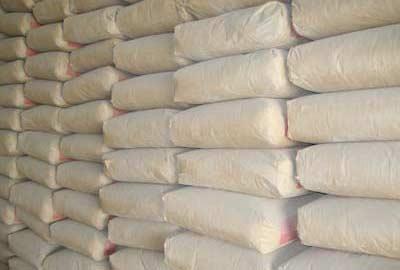
Recently, there were indications that for operational reasons Portland cement would not be readily available from the cement manufacturers. Thus, the price for a 50kg bag of Portland cement rose from N1800 at the end of March 2014 to N2400 by the end of April 2014 and was back down to N1800 by the end of May 2014.
There was drama surrounding the price movements. During the period when the price per bag was at N2400, the Standards Organisation of Nigeria, SON, placed newspaper advertisements indicating that the ordinary Portland cement we have been using on major construction all these years is only good for plastering works in buildings.
The result was that the Portland cement manufacturers released more cement into the market and a price crash followed. This is enough indication that the Portland cement manufacturers have their strategies for keeping prices at high levels.
Blocks made from sand/Portland cement mixtures are used for building construction. The 230mm thick (9inch thick) blocks were selling for about N150 per unit in the Lagos area before the rise in Portland Cement prices. During the period of higher Portland Cement prices, I came across a block maker who had two different standards of 230mm thick block units for sale.
The first standard was for one bag of Portland Cement plus the appropriate sand quantities to be made into 30 block units selling for a higher price of N180 per unit.
The second standard was for 35 block units to be made from one bag of Portland Cement plus an appropriate sand quantity with each block unit selling for the regular price of N150. One can readily see why we are far from getting homes at affordable prices for our population.
I recall that about 40years ago, shortly after the civil war, I was involved in projects in which 20 block units were being made against each bag of Portland Cement. If 30 block units per bag is what is now affordable, we have clear signs of our diminished economic circumstances or we are paying too much for a 50kg bag of Portland Cement.
The European Commission introduced a harmonised standard for cement in 2001 and it appears that the SON is about introducing a Nigerian standard using the same nomenclature as the EC standard. The notation for the main types of common cement in Europe are CEM I, CEM II, CEM III, CEM IV and CEM V. The main constituent of all these cements is the ordinary Portland Cement clinker and the coding indicates the identity of the second main constituent and its proportion. Thus, CEM I consists of ordinary Portland Cement clinker plus up to 5% of minor additional constituents. CEM II has ordinary Portland Cement clinker plus up to 35% of other single constituents. CEM III comprises ordinary Portland Cement clinker and higher percentages of blast furnace slag, CEM IV comprises ordinary Portland Cement clinker plus higher percentages of pozzolana while CEM V is ordinary Portland Cement clinker and higher percentages of blast furnace slag and pozzolana or fly ash. CEM I and CEM II are the types produced in Nigeria.
Cement types are further identified by standard strength classes, the compressive strength at 28 days being the primary reference. Thus 32.5 class can have 28-day compressive strength between 32.5 Newtons per square millimetre, N/mm2, and 52.5N/mm2; 42.5 class can have 28-day compressive strength between 42.5 N/mm2 and 62.5 N/mm2 while 52.5 class has 28-day compressive strength above 52.5 N/mm2. Cements are also tested at ages of 2 days or 7 days to establish a code for early strength, N for normal early strength and R for rapid early strength.
TO BE CONTINUED
Disclaimer
Comments expressed here do not reflect the opinions of Vanguard newspapers or any employee thereof.