
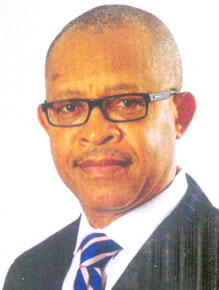
Emeka Okwuosa, an engineer, is the Executive Chairman of the Oilserv Group, two oil services companies, and one of the pioneers of indigenisation in the Nigeria’s oil and gas industry.
He spoke to journalists in Houston Texas on a number of industry issues including local content development and the Group’s role in the scheme of things. Sweetcrude’s Clara Nwachukwu and Sebastine Obasi, were there. Excerpts:

I run Oilserv Limited and Frazimex Limited, which have other sub-companies around them. It is a group of companies that are tailored towards the service of the oil and gas industry as well as exploration and production of oil and gas resources. These two companies grew up organically on the basis of my personal vision regarding the development of the industry in Nigeria; following the experiences I had working internationally close to 11 years for Schlumberger Overseas.
From 1993, when I came back, I made up my mind based on the experience I had that things will have to change in Nigeria. In conjunction with my colleagues, we started the Petroleum Technology Association of Nigeria, PETAN, with the sole purpose of developing capacity in oil and gas extraction, from service provision to exploration and production.
The good story is that after 20 years, we can beat our chests and say we have actually been able to achieve a lot. But we have not gotten there yet, because the target is still far away. If we hear about local content as a law today, some of us may not know that it took us 20 years fighting for this.
After the first 15 years, NNPC did a good job of setting up a sub-division within its group. Again, luckily and incidentally, the Group General Manager of the Division at that time was the same Ernest Nwapa.
That is why when you see Nwapa today, his position in the Nigerian Content Development and Monitoring Board, NCDMB, gives all of us joy because you see an individual who understands what the issues are, who was involved from the beginning in getting to where we are today.
That gives him the background and opportunity to be able to drive the process, because it is not about us as individuals, but how we can create opportunities in Nigeria for the future of the country.
When we talk about the future of the country, it is not a political statement; we are talking of how we as individuals can impact on the system to ensure that the extraction of oil and gas is done in a manner that would retain most of the values in Nigeria.
Moving forward, Oilserv that is purely engineering, procurement and construction, EPC company in land, swamp and offshore terrains has great capabilities. We build pipelines, flow lines and facilities associated with these pipelines; from manifold stations, pigging stations, metering stations and others.
The capacity we have today is similar to what Wilbros had when it had monopoly in the country. Our capabilities include intricate jobs like river crossing, traversing difficult terrains, making repairs, quick interventions and rehabilitation of major trunk lines. I can tell you today that by the scope of the work Oilserv by far surpasses what Wilbros used to do.
You can look at these and give the credit not to us but to the drive by Nigerians, because when you talk about Oilserv, we are not just doing challenging jobs but also building capacity and training. I can tell you that all the people working in Oilserv today are Nigerians. Some of these individuals left universities in the 1990s and early 2000s and came in as fresh graduates. Today, some of them are general managers, some managers.
You can see that Nigerians can do it if given the opportunity, but you need to be trained. Nobody should be asking to be spoon-fed. What we are talking about is building a credible capacity that can stand the test of time, and be able to develop economic activity around it to such an extent that we can actually deliver these jobs elsewhere.
Today, we deliver services outside Nigeria. We move into other countries as expatriate companies. Nobody would have thought about this 20 years ago.
Now, Frazimex is specifically on engineering design from feasibility studies, front end engineering and detailed engineering. Frazimex is also involved in gas development. You hear about gas to power. Today, gas is the key in terms of capacity building in the Nigerian economy.
If Nigerians can articulate and be in position, which I think they are, to seriously go on to implement the Gas Master Plan, GMP, beyond the original ideas, make gas available all over Nigeria, then you would see that with energy available, it is possible to have things like power generation made easy. If we have power generation and distribution right in Nigeria, the country will change entirely.
What people fail to understand also is that gas is related to our ability to feed ourselves. Gas is the main source of urea production. When we talk about urea, we talk of fertilizer. The fertilizer that you apply to good yields in agriculture comes from urea. Unfortunately, the only fertilizer plant we have in Nigeria is the one built over 30 years ago which is now owned by Notore. How come a country with so much gas resource have only one fertilizer plant? I know that some quantity of fertilizer out of the total need is still being imported into the country. Meanwhile, we sell our gas as LNG, then countries that buy gas would go and produce fertilizer and sell to us.
Just like the same story about refined petroleum products; does it make sense to have crude oil and you cannot refine it? You sell the crude, provide jobs for people somewhere else, where they have refineries and they come back and sell to you sub-standard petroleum products. And you have no control over the quality.
Obviously, these are the issues we have to address and in addressing them, what we are doing in our own little way is to continue building capacity in our own field in such a way as to be able to make a difference in our country.
What synergy exists internally between Oilserv and Frazimex and how has that yielded growth value to the companies?
Is Oilserve going into gas or fertilizer (i.e. petrochemicals), and If you are, what plans have you put in place to achieve these? If you are also going into exploration and production, are we expecting an Oilserve that will replicate or surpass what Seplat is already doing?
On the relationship between Frazimex and Oilserv, I would like to clarify that one part of Frazimex manages and handles engineering design and feasibility. You have the other aspect of gas development and power. You have another aspect also that manages exploration and production portfolio.
For Oilserv, which is purely an EPC company, the synergy there is that it retains the main value of the EPC. But when we bid and get EPC projects, which means it covers from engineering all the way to commissioning; Frazimex comes in to manage the engineering aspect for the Group.
Bear in mind that Frazimex is a stand-alone company, which means that it tenders and gets jobs revolving around engineering alone and then can work for any other company to provide engineering services as part of the total package. Where it works very well is that in a typical project where Frazimex might be involved in engineering services, it gives Oilserv a better opportunity to go in and explore interests in the EPC stage of the same job.
That is one aspect of the link. But like I stated, Frazimex is a stand-alone company. It can provide its services to any other company including our competitors. As I speak to you, Frazimex is handling engineering scope of a job by one of our competitors. That does not stop Frazimex from working for us as a group.
On production of oil and gas products, it is a matter of opportunity. It is also a matter of strategy. And we do not have the strategy to go and start up a fertilizer company today because that is not within our immediate operational scope. Together with other companies we can as an entity, but we cannot go it alone because it is not in our strategic plan. That is a complete business of its own.
When I talk about gas development, it goes from extracting gas, whether associated or non-associated gas, and being able to create values from them. And how do you create values? It is about separating the high Cs from the low Cs. By the time you take the high Cs, you have propane, you have butane and even the liquids. Take them (that is the liquids) out, you create value, which is liquefied petroleum gas, LPG.
Then the low C, which is the methane, is the one you put on the pipeline to be used to power generators and all that. The process of extraction of the high Cs is a major business on its own. It is actually the methane that you get that you can now use for petrochemicals. There is a value created there even before you get to the petrochemical level; that is where we are mostly involved in.
Another involvement we have is development of capacity for power. When you talk about giving gas to power plants, the most common is to lay pipelines to channel the gas.
You may not be able to do that in some areas because you have remote plants where you have no availability of pipelines. So if you have a 20 megawatts plant and you start running a 200-kilometre pipeline to it, it is not going to work because the cost is not worth it.
What you do is to look for alternative sources of getting the gas, either as compressed natural gas, CNG, or liquefied natural gas, LNG.
In the world of today, we have micro and mini LNGs. Instead of having the huge LNG we have in Bonny, you can build low capacity LNGs that you can transport in trucks. The technology is there. And these are the areas we are working to put things together to meet the challenge of gas-to-power requirement in Nigeria.
In view of the peculiar vandalism challenges in gas supply, is it possible to use LNG in closing the range between production centres and consumption centres? Is it not possible to set up an LNG plant in a place like Lagos to supply gas to the power plants?
Also, your company was one of the companies awarded the East-West pipeline, what is the status of that project, what are the challenges and how soon do we expect its completion?
The use of LNG and investment on gas supply alternatives are all commercial issues. If it is commercially okay and can be funded, it can be done. If it is not commercially okay and cannot be funded, it cannot be done; it is not based on technicalities at all.
It is possible to go and set up a re-gasification system, where you buy LNG, re-gasify and pipe, but it is not worth the cost in Nigeria because we have the gas already. All we need to do is pipe it where we want to use it than to build a re-gasification plant.
That means that you sell your gas as LNG and import another LNG back, re-gasify and pipe all in the name of averting pipeline vandalism. All the challenges of pipeline in Nigeria are superficial and transient. All it takes is for the country to have a proper master plan and execute it in a way it makes sense. There is no difficulty in building pipelines; it is a matter of how we go about it. Building a re-gasification plant is not commercial enough to make it workable.
We have a lot of gas offshore, if the country decides to harness the gas, it is a policy issue. NNPC will take it, talk with the international oil companies, IOCs, and strike a commercial arrangement whereby the IOCs will extract proper values from their gas, whereas government will create the right environment to be able to utilise this gas in a way that it is commercially attractive.
Disclaimer
Comments expressed here do not reflect the opinions of Vanguard newspapers or any employee thereof.