
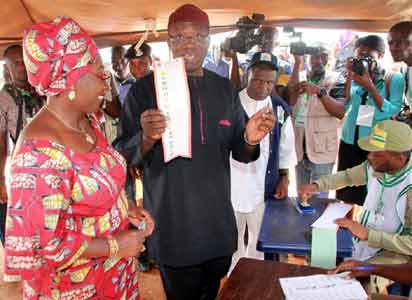
Governorship Candidate, All Progressives Congress, APC, Dr Kayode Fayemi; with his wife, Erelu Bisi Fayemi, on the verge of casting their votes at Ogilolo Ward, Isan-Ekiti… on Saturday.
By Obi Nwakanma
Democracy is a system of social organization in which profoundly conflicting interests clash, and are resolved in a ballot in which the highest number take precedence. But that’s not all of it: it is also a habit of the mind willing to accept the sacred results of the ballot. The ballot in a democracy is the Holy Grail; sacred because it is the expression of the highest will of the most important factor in the social contract: the governed.
The willingness to cede momentarily, individual power, and invest it collectively in a public system of representative government, by which those we elect through the democratic practice act in our names and resolve is the material difference between tyranny and freedom; between chaos and order. The struggle for democracy in modern Nigeria began with the anti-colonial nationalist struggles, and the later struggle against military rule, the last of which culminated in the emergence of this fourth republic.
From 1998, Nigeria’s transition to a new democratic society commenced with the election of the former General Olusegun Obasanjo who had been literally sprung from prison to contest election in a field in which certain key interests were at stake. As I have noted at some point, I was inside the Jos Stadium that 1998, sitting right next to Bamanga Tukur and the late Chuba Okadigbo, during the inaugural PDP convention that nominated Obasanjo as its presidential candidate. I, in fact, took the call from the American CNN and handed it to Bamanga Tukur from whom they wanted confirmation of an Obasanjo nomination and an analysis of the terrain and mood going forward. I was witness to something which has since proved malignant in the attempts at the political transformation of Nigeria, from that moment, when Aniete Okon, formerly a senator, announced the nomination of Obasanjo as the PDP candidate. The corruption of the political process in this current phase of Nigeria’s democratic rule began with the process that produced Obasanjo in Jos.
It gave me a particular chill. Once in 2010 in Dallas at the 80th birthday party for C.C. Momah, I asked the former Senator Zik Obi, in whose Law offices in Western House, Broad Street, Lagos, the PDP was literally formed, how the horses had fled from their reins, and he laughed and said, “It was the bulldozer.”
The plutocratic Generals, under the watch of the doe-eyed Abdulsalami Abubakar, sweating from an overdose of ill-acquired wealth, sought to protect their stakes in the futures market of Nigerian democracy. They bulldozed Obasanjo to power fresh from the mean quarters of prison. What took place in 1998 was hardly an election. In many parts of Nigeria, stuffed ballot boxes, recording hundred percent voter participation, and in some instances, over-participation, all went to Obasanjo. The protests about the elections were muffled, because Nigerians just wanted to move on, whatever it took, from the rule of soldiers. The period between 2000 and 2004, saw the highest number of political assassinations and kidnappings in Nigeria than at any other moment of its life. These were public and prominent people killed publicly and prominently. Nothing of that nature had happened in Nigeria before; not even under the Abacha dictatorship. More people in opposition were killed or disappeared under the PDP government of General Obasanjo from 2000-2004 than at any other time in Nigeria’s history.
The mood leading to the second election in 2003 was remarkably edgy and dangerous. In that election, even Jimmy Carter, Obasanjo’s longstanding friend, was just too embarrassed by its conduct and result that he quietly left Nigeria as an election observer without comment. It was the “do-or-die election.” I lost any respect I may have had for Adams Oshiomhole, who was the only person, against the will of the workers that he represented, who stood by Obasanjo at his second inauguration on May 29, 2003. The point of this is that elections in Nigeria since 1998 had taken the form of “do-or-die” politics, in which all the demons of rage and violence are unleashed to counter and dismantle the electoral will and aspiration of the public.
Nigerians began to lose confidence in the sacredness of the ballot and in the value of democracy. In 2007, the late Yar Adua publicly acknowledged the profound flaws of the election that brought him to office, and vowed to use his term in office to carry out electoral reforms that would make for a more transparent process. Mr. Yar Ardua, many Nigerians believe, had his heart in the right place. If that heart had not given up too quickly while he was in office, the late president, many Nigerians still believe, would have taken Nigeria to a new place.
He had the makings of a great president. But he died in office, and in his place, Dr. Goodluck Jonathan came, and also pledged to make elections and the democratic process more open and transparent. He appointed Professor Mahmud Jega, Political scientist, past President of the Academic Staff Union of Nigerian Universities, and Professor of Politics at the Ahmadu Bello University, Zaria, as the Executive Chairman of the National Elections Commission, (INEC). By all accounts, the Jega-led Electoral commission has brought, from the evidence of the elections conducted under his watch, some new sense of sanity and transparency to the electoral process in Nigeria. Increasingly, the Nigerian electorate is beginning to feel, not only the sacredness of the ballot, but a sense of trust for the ballot. The elections last week in Ekiti is clear evidence that something utterly, and confoundingly wonderful may be happening in Nigerian democracy. Politicians are now debating; working hard; and may no longer take the voter for granted. They will earn their mandates or lose it. But the great hero of last week’s election in Ekiti is my friend, Dr. Kayode Fayemi, the incumbent governor and candidate for the APC, who was defeated quite roundly by his PDP opponent, Peter Ayodele Fayose in the Ekiti elections.
As the results came in, Dr. Fayemi bowed to the will of the Ekiti, congratulated his opponent for a hard-won election, and conceded. In his concession, he pledged to continue to work for the good of the public. It was amazing grace. But of course, Kayode Fayemi is a gracious and sophisticated man, and has given Ayo Fayose, who was equally gracious in victory, something to think about. He knows that he will now be measured by Kayode’s action. It is no longer do-or-die. It is service and humility. Kayode Fayemi is still intact. I think the University of Lagos, or Ibadan, of Nigeria, would do very well to appoint him to their professoriate as a distinguished Professor of Security and Strategic Studies, and betterstill, from there, he must continue to serve Nigeria, if President Jonathan has the good sense to use Kayode Fayemi’s expertise and appoint him to the President’s National Security Advisory Board.
Disclaimer
Comments expressed here do not reflect the opinions of Vanguard newspapers or any employee thereof.