
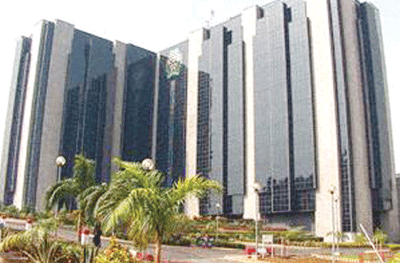
The Central Bank of Nigeria head office in Abuja.
By Adisa Adeleye
There is no doubt that many laymen, not excluding myself, are often confused about some sweet economic jargons and interesting elegant statistical figures being constantly thrown at them. However, some are no longer stranger to the melodious music of macro-economic stability of the domestic economy.
Perhaps I may add my view, at the risk of causing more confusion, to the vexed question of surplus funds to the money market in an economy whose real sector is virtually starved of funds for development. It looks as if the term gexcess liquidityh is a method devised by our Central Bank to describe surplus (unnecessary) funds in our monetary system in order to sustain price stability and avoid inflation. To the ardent supporters of the ‘Classical‘ theory, any increase in the supply of money would automatically lead to increases in price, and as expected, inflation would follow.
Inflation to many of us laymen, represents a process of rise in prices. Thus, inflationary process can come about as a result of change in demand and supply conditions or both. However, the essential feature is that demand exceeds supply at the existing price level. This is more likely to happen if the zone of full employment is reached (about 3 per cent unemployment in developed economies). At the state of full employment, any direct impact of more funds in the economy will tend to impact directly on prices until adjustment is made.


File: New CBN Governor— From left, new CBN Governor, Mr Godwin Emefiele, his deputies, Sarah Alade and Adebayo Adelabu during a World Press Conference in Abuja, yesterday. Photo: Gbemiga Olamikan. See story on Page 8
In the Nigerian example, the case of excess liquidity (excess funds in the system) is an exergenerated one and often, deceptive. The real economy sector, the engine of growth, is already thirsty for development funds (which is inadequately supplied at high cost) and would soak any imaginary excess. Also, there is no need for increase in prices following increase in demand because such increase could easily be met from unsold stock. Perhaps sustained increase in supply of funds (arising from fresh monthly allocations) by the Revenue Allocation Committee) is what the real sector of the economy needs for sustained growth and development. Also, the country‘s idle manufacturing plants need fresh injected capital for development to full capacity.
It is the views of many analysts, and justifiably shared by many patriots that the theory of excess liquidity requiring mopping up of excess funds through the sale of Treasury Bills to avoid inflation is disingenuous, mildly put. The Nigerian economy is characterized by high unemployment, low capacity utilization and high cost of production. It is expected that increase in loanable funds would tend to stimulate effective demand, raise industrial capacity utilization and increase prospects for more employment.
It is observed that the Nigerian Monetary Authority, the Central Bank is conservative in nature and is mortally afraid of the dreaded scourge of the economy. Inflation, it is agreed, if not properly treated could develop into hyper-inflation, and subsequently, destroy an otherwise flourishing economy.
It is the method of treatment rather than the intent that calls into question the ability of the doctor. Inflation has two sides – the demand and supply conditions. The Central Bank‘s solution had been, and still is partial – based on the demand equation leaving out the supply angle.
The Central Bank‘s strategy to combat inflation has been based on the discredited monetary policy, i.e. interest rate manipulations. In the 19th century and the early 1930s, the Bank of England held dearly to its Bank Rate – the lending rate of interest to the money market – to effect business and economic environments.
A reduction in the Bank Rate would increase borrowers and stimulate the economy while an increase would have the opposite effect. The ineffectiveness of the Monetary Policy with its super angel, the Interest Rate suffered disgrace in both Britain and USA. Higher rate of interest did not stop speculative booms of the early 1920s while lower interest rates did nothing or little to affect misfortunes of the Great Depression. Capitalism as an economic concept was at its lowest ebb. Lord Keynes thought interest rate as an indirect way of influencing investment, and thus, a groundabout wayh of influencing economic activity and of little practical utility.
While the god of interest rate failed woefully in the Depression of the 1930s, it was the bold step of President Roosevelt of the United States who implored the use of fiscal measure of budget surplus (spending more than income) to stimulate the economy through many public works, clearing of drains, building of docks, building of houses and roads. The injection of more funds into the economy saved the US from the depression.
Similarly in Britain, Lord Keynes through his great book, gThe General Theory of Employment, Interest and Moneyh revolutionized economic thinking by invoking the awful contribution of government in creating and maintaining full employment. The message is clear – inject more funds into the economy through infrastructural developments to stimulate effective demand, get idle plants operational, produce more goods for home demand and export and increase employment.
The vital question being asked is, why the Federal Government through its fiscal (Finance Ministry) and the Central Bank (through discarded Monetary policy) inflicting on the nation such economic misery?. Its seemingly progressive fiscal policy is constantly being obstructed by the harsh monetary policy of the Central Bank. The attitude is entrenched, not new. Instead of ‘easy money policy‘ (low interest), the country is saddled with punitive high lending rate to the productive sector of the economy.
In the early 2000s under the controversial President Olusegun Obasanjo, the Executive and the Central Bank stood unwisely against a more progressive legislature. This is borne out of the bloated 2002 federal budget which did not escape the sharp eyes of the Central Bank.
The ex-Governor of Central Bank, Chief Joseph Sanusi (not the present Emir of Kano) was reported to have said that, gthe full implementation of the 2002 budget as approved by the National Assembly would dampen prospects for re-establishing macro-economic stability for sustainable growth during the year. We vouch on the need to sterilize the resultant excess liquidity by raising interest ratesh.
The then Minister of Finance (Alhaji Adamu Ciroma) agreed that such N437 billion deficit would cause inflation and negate the poverty eradication policy. Hmm! Birds of the same feathers (classical economists in the 20th century) placed in the corridors of power. Yes, budget deficit of such magnitude could be inflationary if expenditure was meant to finance frivolous consumption and not strictly on infrastructural reconstructions.
Now the economic dilemma is: For fifteen (15) years, the ruling party has been chasing the shifting shadows of macro-economic stability with reduced inflation. We are told that this had been achieved, but at what cost? There is still large pool of unemployment which increases every time graduates are turned out, and poverty is deepening in an atmosphere of frightening insecurity.
What should be expected, a wait for a change of government in 2015 or, formation of a genuine national government to handle the problems of today?
Disclaimer
Comments expressed here do not reflect the opinions of Vanguard newspapers or any employee thereof.