
By Adisa Adeleye
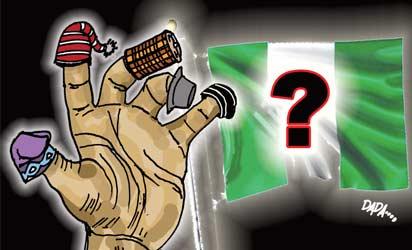
Some comments on my article in this column last week on “The Theory of many Nations within a Nation” and the concept of `National Unity` have exhibited a great deal of cynicism, little realism and a bit of vision. Some Nigerians are in the habit of viewing any opinion expressed, good or bad, from their own tribal or religious perspective.
I must make myself clear. I believe in Federalism as a most suitable proposition for ‘many nations within a nation‘ of which Nigeria is a typical example. Without the fear of self-delusion, I believe that the Hausa/Fulani, Ibo and Yoruba are great nations, and not tribes within the geographical expression ‘called Nigeria‘. Each of these nations is greater in population and human resources than any of my ‘idol‘ countries – Switzerland and Belgium.
The difference is that the people of Switzerland and Belgium have been able to overcome their racial differences (not total) and are now able to live in peace and prosperity. The simple answer is – know your peculiarities and establish methods of living together under an expressed Constitution. Such an arrangement would allow each nation to achieve as much as possible within its limited means without let or hindrance, but with needed assistance, if and when necessary. This does not, in any way, suggest succession or break-up of Nigeria. It points out to a simple fact – the emergence of “United States of Nigeria”.
My assertion is not that the three major nations (not tribes) are the only relevant groups in Nigeria, but they are the more populous with marked territories and recognized cultures. Infact, Nigeria is a home to many other ‘small nations‘ with recognized languages, fine traditional mores and culture. Nigeria is a country blessed with diverse mineral and human resources, and if these are properly harmonized, could provide the whole of Africa with the concept of national unity, peace and prosperity.
The pertinent argument is on what type of political arrangement could sustain a state of peace and prosperity for a fairly long time. Some fairly successful states have adopted federal constitutions with the Federal Government not too strong as to override the wishes of the ‘big and small nations‘ within the nation. The Swiss Democracy does not allow the monopoly of power by a single party (it has to be a coalition of many political parties). The Federal Head of Government is not the supreme head, but one among the equals. In Belgium, the federal government is negotiated among the constituent national groups.
Under such an arrangement, the present Federal Government of President Jonathan will be a coalition of the ruling party and the Opposition where every major decision is accepted by all. There will be no room for division, political rivalry and bitterness.
It is correct to state that Nigeria since 1950 and after Independence in 1960 had experimented with several ideas on how to live together in harmony and prosperity. Late Chief Awolowo was the best exponent of what some regarded as pure regionalism. However, his forays into the central jungle (where he was unjustifiably roasted) showed there was need for a federal set-up to make Nigeria strong, peaceful and prosperous.
It is a pity that some people who do occasionally refer to “Aburi Accord” (a form of military dictatorship) often forget with sadness, about the North`s `Eight Points Programme of 1953 – a form of loose federation. The consequence of that presentation was the granting of internal autonomy to both Western and Eastern Regions in 1954. The Northern experiment of self-rule followed much later.
Guided by the past and recent events, many analysts argue with conviction that if Nigeria had adopted the North‘s Eight Point Programme of 1953, the need for Biafran war (1967-1970) would not have arisen. I harped on the same topic in my article published in the Daily Times Newspapers in 1966 with the title ”CAN WE AFFORD TO BREAK APART” .
It is an unassailable fact that the stability of the Nigerian nation would have to be built on the understanding of the big nations, the small nations and of course, the Ijaw nation – small in population but rich in black gold (crude oil and natural gas). This would depend on federal government releasing 60 per cent of our oil to the producers; 20 per cent to itself and 20 per cent to all other states. The phrase, ‘our oil‘, is a misnomer or serious economic joke that would always encourage oil theft. These oil robbers believe that they are taking their share from the common pool which does not belong to anybody but to a government who cares little for their well-being.
The appeal is to the members of the current National Conference to take their task with such responsibility that the end would justify the means employed in achieving desired political stability and economic prosperity.
NEW CENTRAL BANK GOVERNOR
It is envisaged that the appointment of a new Central Bank Governor to succeed the former one, Sanusi Lamido Sanusi, may not lead to any dramatic change in the uncertain economic horizon. The former governor, with his Monetary Policy Committee had constantly pursued a tightened monetary policy where and when the policy (easy money) is required as it is in many economically advanced countries..
The macro-economic stability often claimed has been based on high exchange rate (N160 to $1), high interest rate (MPR of 12 per cent) and Inflation (on paper) rate of 8 per cent. That policy has greatly retarded growth rate in Manufacturing Industry and increased mass unemployment with consequences of increased armed robberies, kidnapping and widespread poverty.
Even to the ardent supporters of the ‘Quantity Theory of Money‘ in its classical version; increase in the supply of money should affect interest rate downward, to make investment attractive. In a situation of high unemployment, the necessary fiscal measure of injection of more funds into the economy should be supplemented by a generous policy of low lending rate to the real sector.
Or what economy is our strong lady, Dr. Okomjo Iweala coordinating, if the Central Bank is allowed to pursue a ruinous economic policy which is obviously anti-people.
Disclaimer
Comments expressed here do not reflect the opinions of Vanguard newspapers or any employee thereof.