
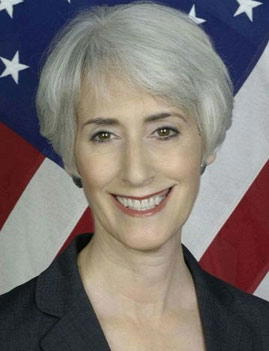
Wendy R Sherman
By Vera Sam Anyagafu & Prisca Sam-Duru
THE abduction of over two hundred school girls from Chibok by the dreaded Islamic sect, Boko Haram and the response of the Federal government to their release has taken an international dimension.
Recently, The United States Under Secretary of State for Political Affairs, Wendy Sherman, and Assistant Secretary of State for African Affairs, Linda Thomas-Greenfield, both declared the stand of the United States Government, during a meeting convened by French President Francois Hollande in the wake of the horrific abduction of over 200 young women from their school in Chibok, Nigeria. Excerpts;.
WHY the meeting?
When President Hollande called the meeting with not only Nigeria’s head of state but heads of state of the surrounding countries, he did so to have both the short-term goal of coordinating all of our efforts to, I say these days, bring our girls home, because I think now these young women have become the girls of the world, not just of Nigeria. #BringOurGirlsBack
He also brought everyone together to look at the mid term and the long term to ensure that there was coordination in the region and coordination globally to bring all of the assets to bear to deal with the horrific terror of Boko Haram, to try to secure the borders in the region, to ensure that these kind of acts don’t occur, and to ramp up the development in the sub-region so that there is not a breeding ground for terror.

Wendy R Sherman
Breeding ground for terror
It was an excellent meeting. I think it’s quite extraordinary that there were five heads of state as well as representatives of the United States, the United Kingdom, and the European Union, and it was a very focused meeting. Conclusions of the summit have been published, so I don’t need to run through them for you and take up the time with that.
And the United States is very glad to be part of this. As you know, we have deployed assets to Nigeria to help find the girls and to bring them home, and we are also helping the Nigerians out in every way we can. We’ve had a long presence in Nigeria and a very robust, multifaceted engagement with the Nigerians.
Is it true that the Nigerian president first asked the U.S. and then the UK to host this summit before he asked France, and both the U.S. and UK declined?
None that I am aware of.
There’s been a lot of emphasis during this meeting on coordinating information to localize these girls, but there has also been strong criticism of the Nigerian army and the way they handled the situation in Nigeria. Isn’t there a contradiction in giving information to an army that one does not trust to be able to carry out a job?
No decisions have been made yet because first we have to find out where the girls are. And where they are will certainly dictate how, in fact, one can get them home, and there are many ways to do that.
This is – if there were to be a rescue operation – there may be other ways to bring them home, but if it were to be a rescue operation, that’s a very specific skill set and not every army in the world has that skill set. I know that there are some training that has been on with units of the military in Nigeria to build those skills, in other words Special Forces skills. Whether they’d be able to attempt a rescue, I think it would just depend on the circumstances.
Do you think it could be a way to bring back the girls?
Well, it’s certainly a way. As I said, there are many ways. And I should say Linda Thomas-Greenfield is our Assistant Secretary for African Affairs, and Ambassador Kaidenow is our Counter terrorism Coordinator. And I want to encourage each of them, if there’s something they need to add because they know a heck of a lot more than I do, to feel free.
Are you optimistic about finding these girls?
I don’t – what I can say is that all of the countries that were at the table today are very focused on coordinating all of their information, all of their intelligence, all of their resources. And there are countries like Canada and Israel who weren’t at the meeting today who also are providing assistance. So everybody is focused, and usually when you have that many – you have everybody pulling in the same direction, you can find your way to finding the girls. But I don’t think we know yet.
Can you describe those entire assets that the U.S. would deploy? And it has been mentioned by President Hollande that Boko Haram had links to other terrorist organizations. Which terrorist organization? Can you be a little bit more specific?
So what I would say on the latter question is Boko Haram is its own terrorist group, and the United States has designated Boko Haram as a Foreign Terrorist Organization. In this day and age, there is probably no terror group that does not have some links somehow, even if tenuous, to some other organization. But for the most part, we treat Boko Haram as its own terror organization.
Secondly, in terms of assets, we have a multidisciplinary inter agency team that has been deployed to Nigeria. I think you also are aware that we are flying ISR. That’s surveillance reconnaissance. And I met with the national security advisor of Nigeria while we’re here and I’m confident that all of that is proceeding forward as it should.
One more question also sort of related to that. Hollande can talk about the weapons for Boko Haram coming from Libya, in which there’s been a known flight of heavy weaponry. The training, to an extent, came fromMali when Mali was under attack. And then he said it’s still being looked into where the funds are coming from. Does the U.S. have any sense or any particular idea where the funds are coming from?
I think some of this information is not information that I would talk about publicly in terms of what we know the connections are, how things get done, where they are today. I think that the arms flow out of Libya is a well-known story. There is nothing secret about that anymore, and if there ever was a secret about the arms flowing out of Libya, and great concern and international attention that’s being focused on Libya as well.
There was a Quint meeting in London this week that Secretary Kerry participated in talking about a number of items. Libya was one of them. And we have a very focused, coordinated effort going on with close allies and the Libyan Government to try to do whatever we can, and with countries in the region to try to deal with border security, which is a constant concern throughout a great deal of the sub-region.
Just to make sure that I understood the answer you gave previously, you were saying that you – at this stage you cannot exclude that there would be a Western and U.S. participation in a military operation to secure the release of the girls?
Let me be clear. What I’m saying is there are many ways to bring this horrific situation to a close. When and if we know where they are, then the Nigerians will have to decide how to proceed. Right now, as our President has said, we are providing intelligence assistance to them. He has said we are not putting boots on the ground.
What would be the next step? Do you expect a new meeting soon?
There was, in fact, a discussion about a follow-up meeting happening soon, and my guess is that will be worked out in the next days, just as people coordinate schedules.
It’s not my decision. This is also really driven by not only the Nigerians but by Benin, Cameroon, Niger, and Chad. Really, this is African led. This is not Western, U.S., UK, EU, France led. We have the resources that we can bring to bear, and that’s our responsibility to do so and to support Africa, but this is African led.
Just to connect the dots a bit between my colleague’s question here about whether Western military might be involved, it sounds like Obama has ruled that out for now. So seeing as how that’s not a possibility, how concerned are you about sharing intelligence with the Nigerian army the moment that the girls are located?
We are all working together, so it’s not like we’re over here and we’d see something and the Nigerians would know at that second and they’d decide what to do. We are working as a team.
And so decisions are going to be made in a conscious and thoughtful way with all of – we have laws in our country. We have ways that intelligence can be used when we share intelligence with other countries.
We – it has to get used in a way that’s consistent with our values and our approach to the use of intelligence. So I think this will be a very thoughtful process.
During the meetings, were any sort of contingency plans discussed in terms of how a rescue operation might be conducted?#BringOurGirlsBack
No. It wouldn’t be appropriate for this meeting.
Disclaimer
Comments expressed here do not reflect the opinions of Vanguard newspapers or any employee thereof.