
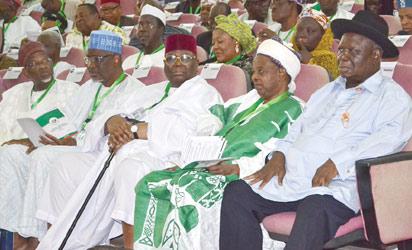
Delegates at the on-going national conference
By Muyiwa Adetiba
The Nigerian main nationalities represented by their delegates at the on going conference took brinkmanship to a new height last week. The North reportedly set the tone when it published its stance on thorny issues of the conference.
Not only did it demand the cancellation of derivation, it questioned the underlining principle behind it and implied that it more or less ‘carried’ the nation during the early days of nationhood when oil was not our main stay. So for the North, it is pay back time.
Characteristically, the South, especially the Western part of it, refuted the claims and came out with demands of its own. It wanted autonomy or nothing according to published reports.
It also wanted the right to secede at any time of its choice. The South-South and the South-East were not too far behind in the scope of their demands. The South-South insisted on resource control without which it would go back to the trenches. In fact, it wanted a minimum of 50% of derivation.
The South-East appeared softer on the trenches front—perhaps given its recent past—but also insisted vehemently on a strong federation and autonomy. They all seemed to have raised the stakes in heating up the polity with their blackmail and counter blackmail.
As I see it, shorn of rhetoric, the North wanted the status quo to remain with maybe some fine tuning. It wanted a strong centre to control the army, police, judiciary etc. It wanted a common pool where the common wealth is collected and disbursed perhaps equally irrespective of origin. The South on the other hand, wanted a greater say in its affairs including resources, state police etc.
It is worth bearing in mind that if regional autonomy was so perfect, we would not have had a civil war and would not have needed to bring in the present system. And to those who want the present system to continue, if it was so good, we would not have this simmering discontent that has led to the convocation of the national conference.
This goes to show that neither the unitary system (having a strong centre) nor the federal system (having a weak centre) is inherently bad on its own. While it can be argued that one would promote competition and enterprise and the other indolence and corruption, it can also be argued that one is a sure path to quick disintegration given the strong ethnic and religious cleavages in the country. It also shows – because we have tried the two— that neither the parliamentary system nor Executive Presidency system is inherently bad.
What is wrong— I have argued this in the past and will continue to argue it until I am hoarse— is the structure of governance. All these cries of changing the system— without changing the structure— are because insecurity is rising; because poverty is rising; because greed is rising. It is not necessary because we are earning less.
We earn enough, even now, to fund the critical areas of the polity if we can change the structure of governance that pampers our leaders. As a brief example, compare our presidential fleet of aircrafts with that of the most prosperous country on earth. U.S has two, we have eleven.
The U.K, our colonial master, has two official cars for its PM; we have 23 and want two more.A US Senator earns the equivalent of a university professor; our Senator earns the equivalent of 20 Vice Chancellors or more! We have 42 cabinet ministers. US with a population of 500million to our 180 million has 24 cabinet ministers. Need I go on?
Simply put, we run a ‘Rankadede’ structure. A structure that deifies whoever is at the top, be he a King, an Emir, a President or a military Head of State. He dispenses favour while the rest of us pay obeisance to him. How far he goes in making the rest of us ‘happy’, how far he goes in looting the treasury depends not us, but on his personality.
This I mean to be his politics, his compassion, his values. He in turn surrounds himself with rent-seeking elites who do his bidding and enrich themselves in the process. How far he goes in reining them in again depends on his personality. We expect him to be rich. We expect his lieutenants to be rich. We are expected to be satisfied with the crumbs.
That is why 80% of our resources are used to cater for only 5% of the population. That is why we have a rising number of private jets when we don’t have a national carrier. That is why we have private castles when majority don’t have homes to go to. That is why poverty is rising; why unemployment is rising; why insecurity is rising.
We know now, that our leaders whether from North or South, whether from the progressive, conservative or military, take care of themselves first because the structure allows them. So it does not matter whether we go back to the military or the parliamentary; whether it is unitary or federal; whether it is state or regional. We have to do something about our elites and their parasitic mentality. (You notice how they are replacing themselves with their children and wives).
A friend argued the other day that an enthronement of the rule of law would solve our problems. I agree only to the extent that it would curb impunity since that is the hallmark of this structure. On a deeper level, we have to dismantle this rent seeking, extractive structure and replace it with an inclusive structure that recognises intellect, industry and rule of law.
One that puts competence ahead of tribe, religion and birth because the son of a prince is not inherently smarter than the son of a peasant if the playing field is level. Unfortunately, it would mean economic suicide for 80% of those talking tough at the conference.
Disclaimer
Comments expressed here do not reflect the opinions of Vanguard newspapers or any employee thereof.