
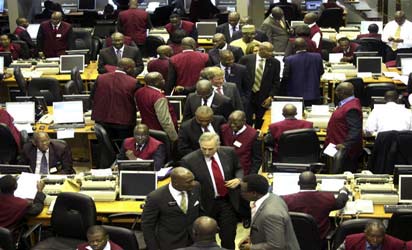
Nigerian Stock Exchange
“Stock Exchange lost N780bn in turbulent Q1”, PUNCH, April 22, 2014.
The report by Simon Ejembi went on to disclose that “the Banking Index fell by 16 per cent in the first quarter of this year; more than any sectoral indices, in what some analysts say is the worst performance by the Exchange in 10 years.”

File photo: The floor of Stock exchange
Those who might find this result startling, especially those who lost some money on account of this report, have themselves to blame.
I certainly was not surprised because I had expected it. In the first week of November 2013, I had warned our readers, in my SUNDAY VANGUARD column, FRANKLY SPEAKING, to be prepared for another round of losses on the Nigerian Stock Exchange in 2014. And leading by example, I had called on my Stockbrokers to offload some shares – mostly bank shares. It was a wise decision and it will become wiser as we move into 2014. Banks and their shares are, once again poised to take a beating on the Exchange.
April had been just as turbulent as any month since the year started. The reports by listed companies, which had excellent 2013 had been released. That has had the effect of pushing up share prices.
There has also been a new listing which increased the aggregate. Additionally, the rules had been slightly amended to allow some share prices to move up or down with only 5000 shares changing hands. All these had affected the performance during the month in ways we still don’t understand fully.
However, what should be of interest to investors is the fact that the pattern of reporting year-end results had not changed very much and that was the core reason why the present losses were predicted last November.
Nigerian companies listed on the Exchange follow the same routine annually.
By November, and in some cases as early as October, the Board and Management of the companies already know whether or not they are heading for a successful year or not. Year-to-date actual results compared with budgets and forecasts for the year already reveal the situation in which the company will find itself by December 31.
There are only three possible outcomes – better than expectations, just on the mark and below expectations – all these without taking into consideration the creative accounting methods that are frequently employed to achieve ostensibly good results. Then, the management games start.
Managers are like kids going home with their report cards at the end of the term. The kid, who came first, rushes home; the one who came last reluctantly drags his feet homewards.
Companies which had achieved, or are likely to achieve, results better than budgets very quickly close their books at the end of December and start preparing their Annual Reports and Accounts.
With or without creative accounting, they know they have a good report to give. Thus annually, the first results to be released are those of the first category of companies – those who had a successful year. This year is not therefore an exception.
The next batch of results comes from those on the border line. This could mean that the turnover target was achieved but profit estimates were down or vice versa.
Because most investors only look at the profit and dividends declared, adequate turnover which would ordinarily have resulted in low profits and no dividends would call for the figures to be “massaged” a little bit to make them acceptable to shareholders.
This requires a lot more time to prepare. So, as general rule of thumb, if a company has not released its Annual Reports and Accounts by end of April, of the following year, then, it is probably safe to assume that it is in category two or three.
The real problems are those in category three – those who had relatively disastrous results; turnover is way down; profits are low, or losses had been incurred and there is really nothing to cheer about in the results.
These are the firms which take forever to file their reports; some taking almost the whole of the following year to do it.
The Nigerian Stock Exchange, NSE, and the Securities and Exchange Commissions, SEC, are forced to step in before some of these firms would act.
That has again provided another rule which we use to determine the direction of things – even when the results have not been released. The longer it takes a listed company to file its returns the more likely that the news is bad.
That, however, is not all. Policies announced by the Federal government, during the year, especially by the Central Bank of Nigeria, CBN, invariably impact aggregate performance in the economy on a broad front. Furthermore, despite the steps taken to reduce the influence of banks in the All Share Index, they still constitute the biggest sector. When banks are in trouble; everyone is in trouble. At the moment, the banks are still reeling from the effects of the CBN’s policies introduced late last year. New measures had since been introduced which will make 2014 a difficult year for banks for their clients and which will erode profits by increasing cost of goods with little opportunity for sellers to increase prices.
Irrespective of what the banks do, they are facing a very difficult year ahead. And so is the Stock Exchange….
Visit:www.delesobowale.com or Visit:www.facebook.com/biolasobowale
Disclaimer
Comments expressed here do not reflect the opinions of Vanguard newspapers or any employee thereof.