
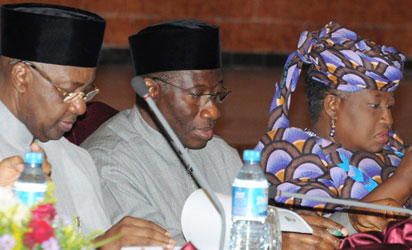
President Goodluck Jonathan (middle); Vice President Namadi Sambo (left) and Finance Minister, Dr. Ngozi Okonjo-Iweala during the opening of the Presidential Retreat on Maritime Security at the Banquet Hall, State House, Abuja, yesterday. Photo: Abayomi Adeshida.
By Ben Agande
In this interview, the Special Adviser to the President on Performance Monitoring and Evaluation, Professor Sylvester Monye, speaks on the rebasing of the economy; the Presidential Committee on Airport Security which he chairs and other matters.
As the Chairman of the Presidential Committee on Airport Security, what will your committee dodifferently from other similar committees in the past?
The committee’s mandate is very clear: clear the mess in our airports and stop the unwholesome practice there. The committee was set up by Mr President to bring some sanity to the operations at the airport and make passengers experience an enjoyable one.
If you go to any airport any where in the world, you will see how airport businesses are conducted. If you come back to Nigeria, it is a different story. If you are to simplify the mandate of the committee, it is to bring us in line with international best practices.
How are we going to do it differently? The answer is very simple. There are rules. What we will do differently is to enforce the procedure and to ensure that those rules that have been established are fully implemented.
Those who are culpable of these violations are big men in the society. How do you intend to tackle them or clip their wings? How do you bring the airport workers in sync with this new thinking?
First of all, the objective of this new policy is not to clip the wings of anybody and we have absolutely no intention of clipping any body’s wings. What we are doing is to make our airport users comply with the International Civil Aviation Organisation code of conduct and practices.
What we are saying is that if you are travelling abroad, it is only passengers that go beyond immigration. If you are not a passenger, you should not go beyond immigration. If any body wants his aide to go beyond immigration, he should pay for a ticket for him to travel. It is as simple as that. The intention is not to cause any person any discomfort but to comply with the best practices.
Secondly, when you arrive Nigeria, no body should drive to meet you at the aircraft. If you have the strength to travel, you should have the strength to walk to the arrival hall. The objective is to make everybody know that this is what we expect of them.
The Secretary to the Government of the Federation has issued circulars to all Nigerians including state governors advising them of this new procedure and seeking their cooperation in the implementation. We are not trying to inconvenience anybody but to provide some order and sanity in our airports. Sometime in our airports, we have more trolley handlers than passengers. This is unacceptable.
However, there is a provision for foreign affairs trained protocol officers who can assist VIPs if they need assistance. We are not unmindful of our peculiar situation. The foreign affairs protocol officers are substitute for the hordes of other protocol officers. They can wait outside the arrival halls of the airport.
Apart from this, the environment of the airport is also covered in the mandate of our committee. If you go to the Lagos airport between 7pm and 9pm for instance, what you see there is simply obscene. People take the laws into their hands. People block the roads unmindful of other passengers. We will create an avenue for people to drop off or pick their passengers and move on. Nigerians are wonderful people; once you tell them what to do, they will follow it.
Many Nigerians believe that dividends of democracy promised by this administration have remained a mere promise. As the Special Adviser to the President on Project Monitoring and Evaluation, what would you say is responsible for this perception?
I do not agree that the deliverables promised by this administration have not been met. What I can say to you is that for you to measure any performance, either of this administration or any administration, you have to have a performance indicator. If the government said we are going to have Benin-Sagamu
Road for instance, has the government done so? If you have all these indicators and they did not meet the deliverables, then you can say the government has not done well. The government should be measured based on its promises and the extent to which these promises have been met. That is the most objective way of assessing performance.
Has the overlapping roles of government agencies in any way affected their over all performance?
I don’t think so. If you look at government, it is a holistic system that allows you to interface with different agencies. These agencies may have defined roles but you find invariably that the performance of one agency must impact on the performance of another agency.
If there is any industrial disharmony in any other agency of government, it is the Ministry of Labour that steps in to resolve it. There must be overlap. What we need to do is to strengthen the working relations between the agencies of government.
The re-basing of the country’s GDP has generated mixed reactions with some Nigerians saying that the fact that Nigeria is the biggest economy in Africa has not affected the well-being of its people. What does this rebasing mean for the ordinary Nigerian?
I am going to use an analogy to explain the rebasing. Rebasing simply means to choose the base year through which the country will be assessed. It was in 1990 that we had our base year taken from, so every assessment of the economy in terms of structure and size was predicated on what was happening in 1990. We did not take into account things that have happened in our economy over these years.
What the rebasing has simply done is to look at the current market price of our products and services at today’s price. That will now tell us the size and structure of our economy. For instance, in 1991, agriculture was contributing 33% to our GDP but with the rebasing, we discovered that it is contributing 22% of the GDP.
In 1990, service sector was contributing 26% but with the rebasing, we discovered that it is actually contributing 51%. In 1990, telecommunications was contributing zero percent; with the rebasing, we discovered that it is contributing 80%.
Some 24 years ago, you were probably in the university or preparing to go into the university. Somebody who knew you 24 years ago knew that you had School Certificate. But in the last 24 years, so many things have happened and yet somebody is still looking at you with the eyes of 24 years ago. What we are saying is that don’t look at us with the 1990 eyes.
Assess us as we are today. By simply telling you who you are today, does that put a dime into your pocket? It doesn’t make you richer or poorer but you are simply recognized for what you are today and not 24 years ago. What we did is to assess us as we are today. People were assessing us as small boys but with the re-basing, we discovered that we are big boys.
We thought that we were smaller than South Africa but with the rebasing, we discovered that we are bigger than South Africa. We didn’t know that telecoms was contributing as much as it was contributing. That is the beauty of rebasing. Nigerians should not debate whether it has provided more in our pocket or not. This is not economic gimmickry. It is simply us looking at ourselves as we are today and telling ourselves the truth.
Disclaimer
Comments expressed here do not reflect the opinions of Vanguard newspapers or any employee thereof.