
By Adisa Adeleye
Any place, anytime, insurgency news appears always tragic. Nothing had become more tragic in USA than the 9/11 terrorist attack in New York, killing and maiming hundreds of people of various nationalities.
Since then, citizens of United States have become more security conscious and the government of the United States has become the world leader in anti-terrorism crusade.
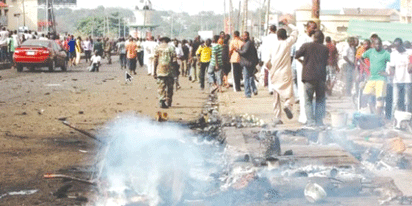
In Nigeria, the Boko Haram insurgency which started as a minor offensive group has grown out of proportion to become an international terror group that requires international collaboration for its eventual defeat and total annihilation. Judging by the array of weapons (security advices) set against the terrorists; it is a matter of time to see the end of any type of insurgency in the country.
It is true that many approaches to terminate terrorism have foundered on the mighty rocks of optimism or lack of proper understanding of its structure and major characteristics. There is no doubt that terrorism has long been under estimated that the gallant security forces seem to look like Barmaid Shaws “Chocolate soldiers”. The terrorists appeared to have the ability to strike at will with deadly precision, confusing and confounding many civilians and security personnel as well.
However, it is not false optimism (though not cautious) to envisage the end of Boko Haram through assumed consciousness of all patriotic Nigerians and international help. First, Nigerian politicians must forget now the romance of 2015 elections and the doomsday forecast of all local and foreign pessimists.
It is clear that the Nigerian politicians could kill or maim to achieve influence, power and money which the political uncertainties of 2015 offer. The crossing over of certain politicians and their followers from the same party of the same political ideology and economic principle, but bearing different names, appears as a treasonable diversion at this moment of need for unity.
It is a pity that those calling for less emphasis on 2015 elections are being grossly misunderstood. Many things have been left undone in the pursuit of democratic dividends – peace and prosperity. If the resolution at the National Conference could point the right way to achieving the position of egalitarianism and prosperity under a peaceful environment, it is worth the trouble. This looks as a very nice opportunity that should not be missed.
The eventual restoration of peace should have the decentralization of security apparatus in mind. A single police unit in a federal set-up is undesirable. Each zone should be able to maintain its police and other security apparatus without undermining the existence of the federal Nigeria Police Force.
Any zone that is not ready for such a step should be left to catch up later. The same goes with the Judiciary – each zone to have its Courts of Appeal and Supreme Court. The Federal Supreme Court would be the final arbiter in all legal matters. Such arrangements would create greater opportunities for more employment at the zonal level; apart from reducing heavy job loads on the shoulders of federal courts and law officers.
It is generally agreed that political arrangements in a plural society should be so arranged that no section of the society is cheated. In the distribution of amenities and the exercise of political power, care must be taken that the minority is not suppressed by care-free majority. The main problem with the present 36 states structure is that except in some lucky states in South East, South West and Bayelsa, other states feature predominant tribes and restless minorities.
While hopes are rising for the cessation of hostilities within the country, efforts should be seen working towards electoral reforms which would usher in responsible government of the people by the people for the people. This is possible where election is free and fair and electoral rules are clear and simple.
It is suggested that election to be fair in a plural society must produce a government approved by all members of the community. This is possible in a situation where proportional representation method of voting is adopted. The government will be formed on the basis of votes secured by each party.
In a multi-party system, if party A scores 40%, party B- 35% and party C- 25%, the result would be a coalition government of A, B and C parties. This arrangement leaves no party isolated and no room for divisive politics.
The present experience of Nigeria is the opposite; it is “winner takes all” mentality. The winning party takes all offices, shares all booties and distributes juicy posts to its supporters leaving the Opposition to sulk and plan evil.
The beauty of the Swiss democracy is that its federal government is a coalition of its main political parties. Its major decisions are agreed to by all parties in the Cabinet. Thus, Switzerland enjoys a relatively politically stable state supported by economic prosperity. Though German, French and Italian human and materials predominate, there is nothing like Ibo problem, Yoruba agenda and Northern hegemony as we have in Nigeria.
As a friend phoned me last night that even if Boko Haram insurgency ends, there would still be problems of mass unemployment, power supply (not stable under federal government control, and sometimes epileptic under private ownership) and unequal distribution of income.
Where unemployment is growing (especially amongst university graduates), there is tendency for idle hands to find some sinister work to do. Inadequate power supply would tend to retard economic expansion and unequal distribution of national resources would always cause disaffection.
It has been stated many times that a serious government in order to increase will have to reject funds into the economy to stimulate effective demands and therefore, increase opportunities for extra production of goods.
This is possible under a policy of budget deficits (spending more than what is taken in, in taxes) for infrastructural developments and not consumption. In a policy of full employment, there is no room for tightened monetary policy as being presently pursued by the Central Bank.
All these problems have to be addressed even when Boko Haram insurgency is forgotten.
Disclaimer
Comments expressed here do not reflect the opinions of Vanguard newspapers or any employee thereof.