
Pope’s farewell
By Muyiwa Adetiba
As catch phrases go, this is as good as many. And those who have been attracted—or entrapped—in the past by alluring phrases like ‘Land of the flowing sun’, The paradise of the East’, ‘An exotic blend of Western and Eastern civilisation’ to mention a few, only to find that what was offered and purchased was not what was delivered will hesitate to buy into it. (Nobody to my knowledge has been able to melt the sun to see its liquid form.)
So many cynics might see the catch phrase ‘Holy week in the holy land’ along the line of another tourist scam. It is poetic and appealing, but can it be true? Can a land so unsettled by intolerance and lack of brotherly love be called holy? Yet, the phrase rings true. Israel and its environs represent some of the historically holy places for the world’s two largest religions. And the week, also called the Passion Week, is recognised not only by Christians as a Holy Week, but by Judaists as well because it is when the ‘Feast of Preparation’ and ‘the Pass-over Feast’ are celebrated.
I bought into the programme of spending the Passion Week in the holy land for two main reasons. One, I have always wanted to go to Israel. I included it when I did my tour of the Middle East while in Punch but was advised to drop it because an Israeli visa could affect my chances of visiting some other countries. Two, with age came a deepening interest in the Bible which in turn has led to a desire to visit those places where Jesus and the early men of God trod.
But there is no denying, even if one went with a religious group that the Israeli Government and people, see the throngs of people visiting the historic sites largely as tourists and Israel is well geared towards tourism.
Even the catch phrases that pre-dated the founding of modern Israel had good tourist rings; if you remember such phrases as ‘the land flowing with milk and honey’, ‘the promised land’, ‘the land of Abraham’. Some even stretch it further to call Israel ‘God’s dwelling place’.
There is also not denying the fact that a lot of atheists and ‘unbelievers’ visit these places regularly. And in any case, the Jews, majority of whom do not believe by the way that Jesus is the Messiah, have learnt to be well, Jews. They will sell anything to anyone who makes the mistake of listening to their sales pitches. Many of those who market ‘genuine cross from genuine olive tree,’ do not believe in the virgin birth.
Many of those who eloquently describe the Stations of the Cross’ and take you on the boat ride that ‘Jesus took’ are not Christians. And many pilgrims have bought badly configured rosaries because they had assumed the sellers were Christians. Some members of my group almost made that mistake when they thought they had a good deal since they negotiated a bulk purchase—the Jews will negotiate anything— until one of us opened the box and counted the beads out of curiosity.
The deal flew out of the window in a jiffy. But credit to the Jew—and a mark of a true entrepreneur—he called the person to one side and asked her what was wrong with the rosary. I am sure he would go back the following day with a different set of rosaries!
From a tourist point of view, Israel makes you wonder; especially if you come from an arable country like Nigeria. What you see is not a land flowing with milk and honey, but a barren land of hills and desert, unfit for any one except the desert Bedouins. What you see also is a land that has been subdued by science, ingenuity and hard work. Despite the preponderance of hills and rocks, the highways are straight. Despite the absence of rivers and seas, the taps keep running. Despite the desert that stretches as far as the eyes can see, tomatoes and vegetables are grown for export.
From a Christian point of view, the trip was a mixed bag. There are about 1.2billion Catholics in the world. Other Christian denominations will probably add another 2billion. Yet the land where the foundation of Christianity sprang from has less than 300,000 Christians.
With about 1.5 million Muslims and 6million Judaists, they are a minority within a minority. You are disappointed for example, to find that there are more mosques around many of the historic sites. Even the temple the destruction of which Jesus foretold as he was entering Jerusalem, and which is now symbolised by the Wailing Wall, has three mosques around it! But then, some of these places are holy to Muslims too. At the foot of the wall, devout Judaists are still praying fervently—oblivious to the teeming crowd— for the coming of the messiah who will redeem Israel!
There are many pleasant memories for me however and certain things stand out. For example, to be in the Upper Room on a Thursday — the anniversary of the Lord’s Supper— and to walk the same agony road from the garden of Gethsemane to the Golgotha hills around the time Jesus did, were a privilege.
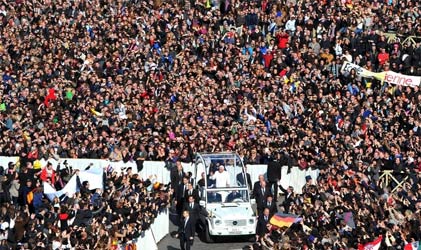
So was seeing the tomb of Jesus and celebrating Easter at St Peter’s Square in Rome within touching distance of the Pope as he drove round. Celebrating Good Friday in the church erected on the relics of where the Holy Family once lived in Bethlehem is something I will always remember.
In all these, you see the toil and sacrifice of those who fought to keep Christianity alive during those years of war, turmoil and ruins. One man, St Francis of Assisi exemplified this. His Franciscan order has reclaimed many of the historic sites in Jerusalem and Rome that would have been lost forever. For them, it is work in progress still.
Disclaimer
Comments expressed here do not reflect the opinions of Vanguard newspapers or any employee thereof.