
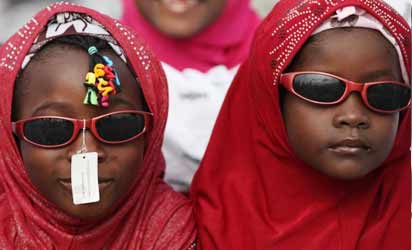
Kids with hijab
By BASHIR ADEFAKA
A NIGERIAN Muslim girl reportedly made a record which reserved a place for her among the World’s 50 Smartest teenagers. Saheela Ibraheem, only 16, made the headlines earlier last year when she was accepted into Harvard University, making her one of the youngest students ever to attend that school as a rising talent.
Saheela was also accepted at 13 in other colleges, including prestigious MIT, the University of Pennsylvania, Cornell, Brown, Princeton, Columbia, and the University of Chicago. This rock-star genius uses the Muslim head covering, hijab, to school and attended a public secondary school, Conackamack Middle School in Piscataway for most of her high school studies.
If Saheela had been transferred to Nigeria to complete her secondary school education in a public school , particularly in Lagos or Ogun state during the same period, she would have been denied access to education based only on the fact that she wears a hijab; something that did not matter to the school authorities at Conackamack Middle and other educational institution she attended.
Use of hijab
Barely a year ago, the Lagos State Commissioner for Education, Mrs. Olayinka Oladunjoye, on Tuesday May 14, 2013 trashed the religious and civic rights of all Muslim pupils in Lagos State public schools when she declared that “usage of hijab and other religious materials in public schools was against government’s policy” and so banned same.
That shocking administrative declaration was made on the heels of very ugly incidents in some public schools in Lagos state where school heads, obviously said to be Christian bigots, had punished and humiliated female students for wearing hijab at times after the school hours.
The social impact of the policy had caused many Muslim parents to relocate their kids to Muslim private schools leading to segregation, exclusion and invariably teaching impressionable kids intolerance.
Under this discrimination, some Christian leaders are currently calling for Christian governor in the state come 2015. One wonders if we really have a ‘Muslim’ governor now! Under Fashola administration what else do the Christians want from a Fashola administration under which Muslims get all manners of discrimination and persecution.
Do they want Fashola to crucify the Muslims and come back to say it was their brother who did it? Or perhaps when they achieved their aim of a Christian governor, the Muslims would have to leave the state for them or go to hell? Where is the tolerance?
Facing the Kaabah’s investigation revealed that Governor Raji Fashola, SAN, albeit offered an out-of-court settlement but nothing has changed in terms of Muslim students and hijab in the state.
Corporate organizations and establishments are not unaffected as appearance in hijab “has always meant a 50 percent cut off from the applicant’s interview chances of gaining employment, no matter how brilliant she is.
Only September last year, Mr. Disu Kamor, Executive Chairman, Muslim Public Affairs Centre, MPAC Nigeria wrote a special report titled, “Hijab: Persecuting Nigerian Muslim Women”. In the report he accused the Nigerian High Commissioner to Jamaica, Mr. Olatokunboh Kamson, over what he described as public humiliation of a Muslim sister in hijab.
Disu Kamor had stated in the report that, “During a normal introductory session at the meeting, Ambassador Kamson openly called the victim (a Muslim sister in hijab) “egungun’ (meaning: masquerade) as she stood up to introduce herself ).
It is obvious that the High Commissioner did not consider the impact of his unguided utterances on the Muslim.
“A week after the bizarre incident in Jamaica, another Muslim sister in hijab was denied services at the Nigerian Embassy in Washington because she refused to expose her ears for the biometric identification of the international passport process. A senior immigration officer who intervened insisted a new Nigerian law prohibiting the covering of ears for Muslims in hijab must be enforced.”
These are only symptomatic of a much wider and worsening challenge that confront Nigerian Muslims.
For the sake of clarity, Islam prescribes that both men and women behave and dress modestly. In the case of Muslim women, they are religiously obligated to wear the hijab as part of their everyday dressing, once outside of the house. There are a number of ways in which Muslim men and women express such teachings and rather than face discriminations and harassment, these women should be treated and valued equally as other citizens.
Disclaimer
Comments expressed here do not reflect the opinions of Vanguard newspapers or any employee thereof.