
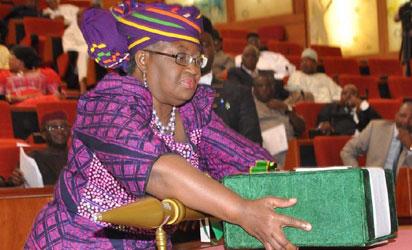
File: Okonjo-Iweala
“Traditional democracies will end up in the garbage heap.” Alberto Fujimori. 1998.
Fujimori, Peruvian President of Japanese descent, not only was removed from office, but ended up being prosecuted for, among other crimes, not implementing the nation’s annual budget.
Nigeria, under the military, could be counted on for one thing – the budget for the year would be delivered on time. It was so when the nation’s financial year ran from April 1 to March 31 of the following year.
And, the practice remained unaltered until 1999, when General Abubakar handed the reins of power to President Obasanjo – a retired General turned civilian Head of State. Unexpectedly, the fiscal discipline which had characterized military administrations was lost from the time Obasanjo became President.
In his eight years in office, not only were the annual budgets presented late to the National Assembly, NASS, which had been under the control of the PDP from 1999, not a single year’s budget was implemented fully till today.
Thus when Dr Yemi Kale announced the result of the rebasing exercise, the nation’s Statistician-General, discovered that his ground breaking effort, which deserved commendation, was greeted with widespread skepticism. The head of the National Bureau of Statistics, NBS, was a victim of guilt by association.
Nigerians cannot believe that a nation whose leaders had demonstrated such monumental indiscipline with regard to the annual budget could overtake South Africa which, by comparison, had exhibited seriousness in the implementation of its economic programmes.
The laxity started with Obasanjo, ably supported by the PDP-controlled NASS and the pattern has not changed till today.
One of the most important implications of this, which had escaped the attention of most observers, is the fact that the Nigerian economy has been, and remains, on “auto pilot” for years now. President Jonathan, like his predecessors, Obasanjo and Yar’Adua, is no more in control of the Nigerian economy than anyone of us.
The major drivers of the economy are not subject to his control; and he has done very little to exercise control over them. They drift along subject to forces which the President of Nigeria neither understands nor can influence. Let me illustrate with some examples.
Rebasing of the GDP had confirmed what most astute economists knew for a long time, namely, that sale of crude oil does not constitute the overwhelming percentage of our economic output as conventional wisdom had led us to believe.
However, crude oil provides the largest pool of foreign exchange providing the capital for other activities to take place. Crude oil, more than any other revenue generator, illustrates the impotence of the Federal government of Nigeria to control the economic activities which have the most significant impact on our lives.
Global crude oil prices fluctuate constantly based on so many external variables over which the government of Nigeria has no control. Let us consider two. Global supplies and demand for crude oil. Crude prices rise and fall depending on the volume some other oil producers can export and what the consumers can absorb.
Any disruption to the supplies from a major supplier, e.g Iraq, drives the price up. We have benefited from these disruptions since 1999 and the rising global demand for crude. And each year we had promised to diversify our economy to reduce the dependence on oil.
The measures required to achieve diversification invariably get incorporated into our annual budgets – which are never passed on time nor implemented when eventually approved. This year is proving to be the worst in the fourteen years since we returned to civil rule.
From the very first mistake in 2000 till now, our three Presidents and the ruling party have increasingly turned budgeting to an annual joke from which the nation is rescued by the turbulent global politics which had almost always guaranteed that the price of crude remains high.
But that only means that we are gambling with Nigeria’s future. All it takes is for the world, at least the Middle East, to experience six months of peace and for Libya and Iran to start exporting up to their quota levels and the price of crude will drop drastically.
When that happens, it will not matter any more whether the budget is passed on time or not. Neither the Federal nor the state governments will be able to fund their projects, especially those designed to help diversify the economy, and everybody will feel the lash. Certainly, those in government, Executive and NASS, would regret the annual delays which occur with regard to preparing and passing budgets.
Finally, nobody needs to be an economist to know that the 2014 budget cannot be implemented anymore – for two reasons. One, a budget finally approved half wat into the year had already deleted those projects and programmes which should have been completed by mid-year.
Two, once 2015 election fever starts in the second half of the year, few Ministers, lawmakers or top government officials will concentrate on implementing the budget.
Even the President, whether as candidate or party leader will be distracted. The Executive branch will be busy with elections and the NASS will abandon their supervisory functions.
Obviously, the 2014 budget can be regarded a total write off. Pity.
¨This report was prepared before the budget was signed into law.
Disclaimer
Comments expressed here do not reflect the opinions of Vanguard newspapers or any employee thereof.