
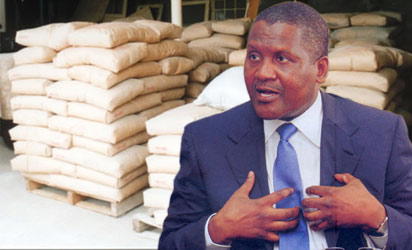
Aliko Dangote
By Franklin Alli, Ebun Sessou & Aderonke Adeyeri,
To say that the last four months have been sleepless nights for local cement producers is no exaggeration.
Dangote Cement Plc is controlling over 60 percent of the market shares with 20 million metric tonnes while other players are Lafarge Nigeria comprising Lafarge WAPCO in the South-West, Ashaka Cem in the North , Atlas Cement and Unicem in the South-East, with a total capacity of 8.5 million metric tonnes.
No sooner had the local producers under Cement Manufacturers Association of Nigeria rejoiced for having led the country to attain self-sufficiency in cement production after more than 50 years of Nigeria’s history, than an unknown coalition of civil society groups and professional bodies in the construction industry cut their joy short.

Aliko Dangote
The coalition ignited the tension in the industry in February this year. They decried the use of 32.5 cement grade in construction works, arguing that it was responsible for incessant building collapse across the country. They petitioned the Standards Organisation of Nigeria, SON, to initiate actions and standardardise cement products in the country.
They believe that nearly all the cement manufacturers and importers in the country were in the habit of taking advantage of the lax in regulation to vary their pigmentation in favour of lower quality cement which is normally used in building works.
In a swift reaction, members of Cement Manufacturers Association of Nigeria, defended their products, saying the quality of their products “conforms to the highest international standards and the industry is constantly working with the regulatory authorities to ensure up-to-date testing, certification of products, and quality norms.”
The manufacturers said “experience throughout the world has shown very clearly that cement quality is not the source of building collapse. Rather, the root cause is most frequently related to poor construction practices. The level of skill, education and awareness in the construction sector must be improved.”
On the other hand, Dangote Cement Plc, at a press briefing in Lagos, distanced itself from the producers of 32.5, saying it is the only company in Nigeria producing 42.5 high quality cement.
In a bid to respond to market demand for higher quality, Dangote also launched 52.5N high quality Portland cement grades into the market saying it is three times superior in strength than the normal 42.5. Devakumar Edwin, Group Managing Director/ CEO, said that with the higher grade of cement quality, the incidence of building collapse in the country could be controlled.
“For the past three months, we have test-run the new products, and it is now available in the markets. In the second half of this year, we are coming out with yet another new superior product,” he disclosed.
He explained that the Portland cement is produced in conformity with Nigeria Industrial Standards (NIS 444-1-2003) and other relevant standards.
He said that in addition to the 42.5, the 52.5grade are now being produced at the company’s three plants in Ibese, Ogun state, Gboko, Benue state and Obajana in Kogi state, and are selling for the same amount as the lower grade 42.5N type,” he said.
Joseph Makoju, Honorary Adviser to the President of Dangote Group, Aliko Dangote, described the introduction of the new cement grade by the company as ground breaking.
“Nigeria is now one of the best quality producers of cement in the world. No matter the sophistication of the structure, this is the best grade for any civil construction. Dangote did not create the standard. The standard has been there. We have only blazed the trail by starting its production. It is good for lead bearing columns,” he said.
Nevertheless, the Standards Organisation of Nigeria (SON) quickly reacted to the outcry by the coalition, and set up a high powered technical committee to look at the existing grades of cement in the country with a view to recommending the best grades that should be in place for the good of the country.
The technical committee, headed by Professor Innocent Onyeyili, has its members drawn from the Manufacturers Association of Nigeria (MAN); the Council for the Regulation of Engineering in Nigeria (COREN); the Raw Materials Research and Development Council (RMRDC); Cement Manufacturers Association of Nigeria (CMAN); the Nigerian Building and Road Research Institute (NBRRI); and representatives of the Dangote Cement Company; Ibeto Cement; and Lafarge WAPCO.
Technical Committee’s Report
Saturday Vanguard, learnt that SON Governing Council met recently in Abuja and approved the Technical Committee’s recommendations on the new cement standards, and that the recommendations have been forwarded to the Minister of Industry, Trade and Investment, Dr Olusegun Aganga, for final approval.
Saturday Vanguard also learnt that the new standard for cement production in Nigeria approved by the Technical Committee is Nigeria Industrial Standards (NIS 444-1-2003).
The new guidelines mandated manufacturers to display on the cement bag labels, the following information: CEM I 52.5R and 52.5N for use in the construction of bridges. CEM II 42.5R, 42.5N for use in the casting of columns, beams, slabs, blocks moulding. CEM I & II 32.5R, 32.5N for plastering of buildings only.
Reacting to the development, Lafarge Nigeria kicked against banning or limiting its 32.5 cement grades to plastering by the Nigerian authorities.
“Use of 32.5 is not the cause of building collapse. Rather, the cause is very well known – unqualified workers, contractors’ greed and non-adherence to building code and concrete standard,” said Joe Hudson, Managing Director/CEO Lafarge WAPCO.
Hudson emphasised that contrary to competitor’s claim, 32.5 cement grades is not responsible for building collapse in the country. “The Oriental Hotel, Lagos; the twin towers in Kuala Lumpur, and the bridge linking Malaysia, were built with 32.5 grade of cement. Also, Sephaku Cement, our largest competitor in South Africa manufacturer 32.5 grade. If 32.5 is good for the South African and Kenyan markets, I don’t know why they are saying it is not good for Nigeria,” he said.
“A lot of noise has been going on in the industry in recent months and we want to demystify the noise and state our clear position. The competitor is “de-marketing”our product by linking it to building collapse. It is competition rather than technical issue. They are fighting our products, whereas people know that Elephant Portland cement stands the test of time,” said Hudson.
According to him, as a multinational company, the cement produced by Lafarge in Europe and other continents is the same as that manufactured and marketed in Nigeria.
He pointed out that with 181 years of cement manufacturing and over 50 years in Nigeria, quality in Lafarge is the same across the world.
“If you take the bag of cement produced here to France or Germany, you will find out it is the same quality, because in Lafarge, there is tight control. And we send our samples to our laboratories in over 16 countries for testing. It is meant to ensure we are complying. In Nigeria, more than 90 percent of our sales are 32.5 and we are certified by SON on quarterly basis,” he said.
“We are very surprised and shocked to hear that there is a new standard when the Standards Organisation of Nigeria has not informed us about the new standard. We have been worried that the standard could be changed. If a new standard has been approved so quickly without conscious agreement from all the stakeholders, due process was not followed because the Technical Committee met recently and even the minutes of the meeting have not been circulated.”
Olivier Lenoir, Managing Director, UniCem, noted that an investor has just invested $500 million in the company, and just when the business has just taken off, the rule of the game is changing?
The other week, the House of Representatives Ad hoc Committee on the composition and pigmentation of cement in the country held a three day Public Hearing on the issue.
Hon Yakubu Dogara, Chairman of the Committee, noted: “There is no gainsaying the fact that the serial incidence of building collapse in the country has become a source of anxiety. Some have blamed substandard material including cement, while others have blamed it on lack of regulatory framework.”
Speaker of the House of Representatives Hon Aminu Waziri Tambuwal, said that the lawmakers would not relent in their effort to unraveling the causes of building collapse in the country.
Contributing, Hon. Ayi Essien, a member of the Ad hoc committee, said Nigerians are worried about the quality of cement as well as the professional administration of the cement in construction work.
Speaking at the public hearing, Director General of SON, Dr. Joseph Ikem Odumodu, defended the agency’s restriction of 32.5 grades of cement to plastering only, saying it is to mitigate the problem of building collapse in the country.
Odumodu said Nigeria cannot afford to be a pariah state on the issue of cement quality, adding that world’s progressive countries have since stopped using the low quality 32.5MPA. He said his organisation had restricted the use of 32.5MPA low grade and will enforce compliance, adding that SON had issued a directive that 52.5R be used for bridges; 42.5Rfor casting of columns, beams, slabs and for moulding blocks; while the low grade 32.5 can only be used for plastering.
Earlier, Chief Olusegun Osunkeye, Chairman Lafarge WAPCO, described the recent happenings in the industry as “a mere competition activity and an attempt to fight rough. I must be quick to add here that we do not abhor competition in Lafarge. In fact, we view competition as the only good thing for any industry and the society at large, as it brings out the best in the player, especially when it is healthy.
“No matter how hard they try to cover the truth,” continues Osunkeye, “the truth will always prevail. Cement consumers in Nigeria know what is good for them. The professionals in the industry know what is suitable for the different applications.”
Mr. Vincent Nwani, the Director Research and Advocacy, Lagos Chamber of Commerce and Industry, also commented on the issue, saying “Thecurrent development in the cement manufacturing industry is uncalled for, and it is a huge challenge for the industry.
According to Nwani, beyond quality and availability of the products in the market, the need for cement to sell at an accommodating price level cannot be over-emphasised.
“Of course, the rich will continue to construct even if the prices increase by 1000 percent. But a lot of middle class and poor people are at the mercy of this development. Before now, a bag of cement was sold for N1, 650. Right now, it goes for N2, 600, N2800 and N3000. Although, Nigeria is the largest economy in Africa, the capital consumption of cement in Nigeria is 0.09 tonnes, while in South Africa, it is 14 tonnes,” Nwani said.
Regarding the relegation of 32.5 grade cement to only plastering by SON, Nwani said, “If the Federal Government has approved 32.5 grades for only plastering, it is senseless. And it is not good for the economy. The problem is not the size or quality of the cement to be used but the mixture of other materials to be used for the construction. The most important aspect is the quality of the mixture and how builders are regulated. So, for us in LCCI, it is important to address how building materials are used in building and in construction sites.”
Forcing competitors out of business is uncalled for, said Nwani. “In this industry, there is need for competition, especially between the big and small cement manufacturing companies, if not, there will be artificial monopoly and it is not good for the economy.
Forcing other cement manufacturing companies out of business will not only reduce the cement consumption per capital, but also reduce the ability of the middle class, as well as the poor, to build their own houses. There is a report (although not confirmed) that 80 percent of Nigerians live in rented apartments, especially in the urban and sub-urban cities. In South Africa, the ratio of people who live in rented apartments is 16 percent, while it is 22 percent in Ghana.
This suggests that there is need for Nigerians to build houses on Mortgage plans. Of course, cement is not only the raw material that is used for building, which means that increase in the price of cement has technically raised the prices of other building materials.
Lawmakers at the states level also lend their voices to the issue. The Chairman Committee on Commerce and Industry, Lagos State House of Assembly, Hon Bisi Yusuf, is worried about the high rise in price of cement in the country.
Market survey conducted by Saturday Vanguard, showed that a bag of cement which sold for N1, 650 before, now goes for N2, 600, N2, 800, and N3000, depending on the brand.
In a telephone interview with Saturday Vanguard, Hon. Yusuf said, if the price increase continues, many Nigerians would find it difficult to have shelter over their heads.
He said that this development will also force construction companies to layoff workers.
Another lawmaker, Hon. Saka Fafunmi, commented that the major component of cement is limestone, and it is locally produced, adding that, increase in price of cement will aggravate inflation and worsen the economy.
Disclaimer
Comments expressed here do not reflect the opinions of Vanguard newspapers or any employee thereof.