
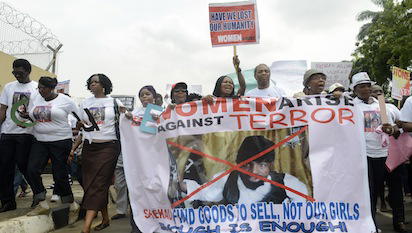
Women Arise civil society led by Joe Odumakin (C) accompanied by afro-beat musician Femi Anikulapo Kuti demonstrate to press for the release of missing Chibok school girls in Lagos on May 12, 2014. Boko Haram released a new video on Monday claiming to show the missing Nigerian schoolgirls, alleging they had converted to Islam and would not be released until all militant prisoners were freed. AFP
By Muyiwa Adetiba
The whole world focused on Nigeria last week. It started with the sudden realisation— as if woken from a deep slumber— that the over two hundred girls abducted had not been traced, let alone rescued, and ended with the World’s Economic Forum where the potentials of Nigeria— and Africa were highlighted.
In between were the demonstrations that gathered momentum and enlisted high profile Nigerian and international personalities.
In between were the offers of help from the usual countries— U.S.A, U.K, France and Canada and even some unusual ones— China and Israel. In between were the security challenges of hosting the Forum itself when barely a week earlier, Nyaya, a suburb in Abuja, had been bombed, the second time in as many weeks.
In between was the sudden but almost complete shut down of social and economic activities in the nation’s capital for a whole week! — an indication of the 19th century type of security we are still practicing.
A BBC correspondent described the media attention between the economic forum and the abducted girls as 50/50. Our President, elated that over 13 Heads of government, and many international business men defiled the security challenges to make their presence felt, declared the week an unqualified success.
But he knew, just as we all knew, that the spectre of the 230 abducted girls would not go away, because he made allusions to the girls— after two weeks of nothing—during his international press conference on the economic forum.
Our President seemed so upbeat by the offers of assistance especially from the U.S and U.K that he proclaimed, almost from the proverbial roof top, that the offers marked the beginning of the end of Boko Haram. The relief on his face and in his body language was palpable.
But it was a relief that any self respecting leader should have tried to mask for a couple of reasons. You are opening up your security books for foreigners to scrutinise and possibly exploit because they will in the end, know more than you want them to know about your internal security.
You are also admitting the tardiness and ineptitude of your military and security institutions. Also, by admitting that you are unable to contain the insurgency on your own, you are inadvertently conceding to those who say the insurgents are better armed and better motivated than our men. Finally, and the most worrisome point, is that you are allowing foreign powers to set up bases on your soil. So, invite them if you must but don’t preen about it as every invitation has its repercussions.
But I do agree that the events of last week could mark a turning point, or as the president put it, the beginning of the end in certain areas of our nationhood. It might include, but might not be limited to the area the President had in mind.
To start with, the events of the week have exposed the rot in the system for the world to see. More will be exposed as the world continues to beam its search light on Nigeria. Moreover, the advocacy groups that sprang up and mobilised eminent people are not likely to go away quietly once the girls are recovered.
They will mobilise again in one form or another, to address the fundamental flaws in the system. Some were highlighted by the New York Post when it criticised the lack of leadership in the country and described as ‘stunningly callous’, the attitude of our First Lady towards the abducted girls. It also commented on the ‘deep corruption’ in the country.
To win the battle— and the war— against insurgency, issues of leadership, poverty, social inequality and corruption will have to be addressed. The advocacy groups know that now.
Secondly, the noises that came out of the economic forum were good to the ears. Although many of the things that came out were not unknown to us, it was still good to hear the assurances of experts regarding our potentials and capacity to explode economically. That they defiled the security odds to come to Nigeria at that particular time shows that commerce always knows where good money is.
Many, from the sound bytes, are willing to invest in the potentials which abound in almost every sector of the country. This could be a turning point— or the beginning of the end— to economic stagnation and unemployment in the country. But there is a caveat; the educational sector according to the forum, has to be improved upon. The Forum was also worried about the security challenges and the cost of doing business in our dear country.
In other words, our infrastructure, attitude to work and the ever recurring issue of corruption will have to be addressed if we truly desire the economic take-off that is due us.
It seems to me that the President wants a quick end to insurgency without addressing the root causes of the insurgency. He wants a rapid transformation of the country without addressing corruption, rule of law and the need for inclusive governance. He wants a large, burgeoning middle class; he wants a responsive civil service but he is unwilling or unable to do away with the way we have been doing business. It is like a man who loves omelette but hates to break eggs.
Yes, the events of the past week can mark the beginning of the end of our irresponsible past if someone courageous can seize leadership and turn the ship of state into the right waters. That person can be the President himself. It can be the advocacy group. Or it can be an entirely new group. Most of us long for a new beginning; something tells me it is not that far away any more.
Disclaimer
Comments expressed here do not reflect the opinions of Vanguard newspapers or any employee thereof.