
By Jide Ajani, who was in London
At the British African Diaspora Conference, the theme of which was, “NIGERIAN ENVIRONMENT, BEYOND POLITICS AND AMALGAMATION, organized by the AFRICAN PARTNERSHIP DEVELOPMENT, Delta State governor, Dr. Emmanuel Uduaghan, grabbed his audience and took them through the developmental strides of his administration.
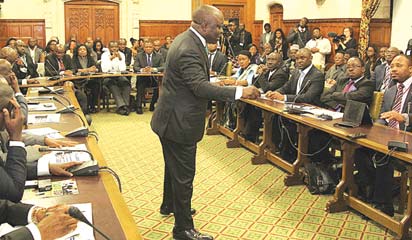
The event, which took place, penultimate Tuesday, at the Grand Committee Room, House of Parliament, Westminster, London, UK, regarded as the second Debating Chamber of the House, saw a state governor who was at once deliberate in his presentation and expansive in the scope and vision of what Delta State should look like. In the chamber were parliamentarians, professionals and international journalists. To be fair, Uduaghan’s seven-year old administration has more than delivered on his campaign promises. However, as he engages the last year of governance, what would be uppermost on his mind is how his successor would build on – and not dismantle – his legacy. This is the story of Dr. Uduaghan.
PROLOGUE
He came face to face with horror – this was some 25years ago. Dr. Emmanuel Uduaghan, a medical doctor then, was hurriedly called to try and save a dying woman who was caught up in the pains and complications of child birth. When he got there – a hospital somewhere in Delta State – what “I found was a woman, a dead woman, covered with cloth”, he narrated to his captive audience inside the Grand Committee Room, House of Parliament, Westminster, London, UK. Though Uduaghan, who is today the Delta State governor, made it clear that “this is not a story that I often enjoy telling; but it needs to be told so that people can appreciate where we are coming from and why a good healthcare delivery system is very paramount to my administration. When I pulled the cloth from her body, I discovered that it was lifeless. What happened?”

He answered the question himself. He explained that the woman had not undergone the necessary antenatal care because of lack of funds. To make it worse, at the time of delivery, she went to hospital, was turned back because she was not registered, and found her way to a local hospital. There was no scan and, therefore, it was not possible to have discovered that the baby in the womb was not properly positioned for easy delivery – the child was bridged, because rather than come out with the head, it was the buttocks; the woman had lost strength and the child was still-born. That is the horror of poverty and lack of good medical care.
A pall fell upon the chambers after this sordid tale. But Uduaghan then gave hope. ”That is why we have taken great pains to establish the General Hospital in Oghara, with state-of-the-art facilities. That is why medical care in Delta State is free for pregnant women and some other categories of dwellers in the state”.
THREE HOURS EARLIER
Just three hours earlier, Uduaghan cut the picture of a day-time creature suddenly caught by the cold hands of darkness. With a slight shiver and cocooned in his robes, the Delta State governor sat in the middle section of a three-seater sofa in his hotel room in London. He was suffering from cold – call it flu. With a coterie of aides and appointees as well as two or three legislators milling around, Uduaghan welcomed his guests – four journalists. It was obvious that fatigue and weather had played a disturbing role on the health of the governor. He acknowledged greetings; engaged in a tete-a-tete and prepared for the event of the evening.
THE BRITISH AFRICAN DIASPORA CONFERENCE 2014, according to its organizers, African Partnership Development, is a programme for Africa with focus on Nigeria, especially at a time it is marking its 100th year of British amalgamation of the Southern and Northern Protectorates. Tunde Alabi, the Executive Director, welcomed participants and explained the giant strides of the body. It was the sixth session to be organized by Alabi’s body.
ENTER THE FEMALE PARLIAMENTARIANS
Coincidentally, that was the same day the parliament was voting on the nation’s budget. The significance of the budgetary event was that two prominent MPs were always in transit between the event and the voting chamber of the parliament. Meg Hillier, Chair of the ALL PARTY PARLIAMENTARY GROUP, a position she has held since 2010; and Chi Onwurah, MP for Newscastle-Upon-Tyne Central, had to make sorties between participating in the voting on the budget and the conference. Hillier said Nigeria held promise and this was discovered upon many visits to Nigeria.
She, however, let food for thought regarding the trafficking of Nigerian women abroad – the country is the largest source. She believes the future is bright for Nigeria.
For Onwurah, the prospect of Nigeria becoming one of the 10 rising economies in the world is a possibility. She supports a strong united Nigeria and she would “love to have the socio-political and economic infrastructure in place as quickly as possible and would also like to see the country more prosperous”.
THE INSPIRING PARABLE OF A VILLAGE BOY
Udughan spoke after his colleague, Aliyu Magatakarda Wamako of Sokoto State, had made some comments – the latter flew in from Washington DC just to make an appearance..
The Delta governor grabbed his audience and took them on a historical voyage. From his presentation, it was obvious that the dress or the office does not necessarily make the man. What makes the man is the stuff he churns out, his disposition and his effective communication skills which should either present him as a charlatan in a powerful office, or a man of intellect who is transforming an office. Uduaghan is of the latter.
Firstly, he stepped down from the podium where he sat (although by the time he moved to the centre of the chamber, his true height was revealed).
Clad in a white shirt, black tie, a black pair of suspenders and a black suite, Uduaghan embarked on his voyage – firstly about Nigeria’s amalgamation history, post-independence journey, the discovery of crude oil, its effect on agricultural produce, the military coups, the imposition of unitarism, the effect of crude oil exploration on the Niger Delta and the issue of militancy in the area which he attributed to marginalisation.
The very first sign that Uduaghan was communicating very effectively dawned on all when he relieved his childhood experience of how he would rush to the farm in the very early hours of the day to tap rubber, rush back home and prepare for elementary school – this was in early 1960s. His story made most faces long, some shot out of their necks in disbelief, glanced at the persons sitting next and
immediately refocused on the governor For his rise from grass to grace, it is fitting that he is in a bear-hug with the poor in his state, sopping to their needs.
’MY SUICIDE MISSION’
About his administration, he said, “The first thing is about economic development which we believe would help our politics” Uduaghan drew a parallel between the need for gainful employment spurred by very active economic activities which his administration has engaged, and the reduction in militancy, insisting that “when there is no hunger, there is no anger and, therefore, no violence”,
adding that “it is very difficult to recruit gainfully employed people for criminal activities”.
He lamented that most companies have left the Delta area because of environmental and infrastructural degradation.
He made it clear that the unemployment crisis is real and a time-bomb. Therefore, his administration created an economic development environment to cater for youth employment, stressing, “That is why we are involved in Delta Beyond Oil”.
On current challenges, the Delta governor enumerated the need for peace and security, infrastructure, and human capital development as issues being tackled by his administration.
He noted that being a governor, upon taking oath of office, is a suicide mission.
”As a governor, I engaged some of the brains behind militancy or sent people to them. And with time, they began to believe in our commitment to developing the environment, provision of jobs, development of critical infrastructure and the demonstrable delivery of democracy dividends”, Uduaghan stated.
It was at that point that he told the painful story of the pregnant woman. Another tale of woe which he told was the embarrassment of confronting pupils in his very early days as governor.
”You visit some schools and naturally the students would get up to say (in chorus) ,’Good morning Mr. Governor’.
”Now, for me, it was very embarrassing because these were pupils you saw sitting on bare floor in what is called their classroom. After greeting you, the natural thing to do is to say they should sit down
after acknowledging their greetings.
”But in all honesty and good conscience, how would I tell them to sit, when the only place they would return to is the floor – bare floor?
”But we have taken care of all that and we are still doing more.”
In the area of Diaspora involvement in the development of Nigeria (and specifically Delta State), the governor said the State University Teaching Hospital, Oghara is a wonderful testament. With an imposing structure, state-of-the-art facilities and first class medical personnel – some of them brought in from abroad – Uduaghan has transformed the face of medical care in his state.
Although he was quick to admit that whereas the attitude to work of the Diaspora doctors and medical personnel is rubbing off on their Nigerian counterparts, thereby providing excellent medical services
comparable to anywhere in the world, he, nonetheless, explained that his “administration is moving on by providing well-furnished General Hospitals as well as other medical institutions to cater for every
category of our people”.
He also spoke about Delta State One Stop Shop for Investors (DSOSSI). The governor did not leave out the leader of his party, President Goodluck Jonathan of the Peoples Democratic Party, PDP. He enumerated the achievements of the Jonathan administration. On the security challenges confronting the country, Uduaghan made it clear that the threat of Boko Haram predated the present regime but that the military has been able to confine it to three states, just as he stressed the improved operational capabilities of the military. On power, he told his audience that the once exclusive sector has been opened to private investors and, in due course, things would get better. But he made his audience understand that the unity of Nigeria is very dear to him and that it would do the nation a world of good if “we all ensure the unity of the country”.
There were questions and comments. Ade Aminu, a Nigerian who is the acting Mayor, Lambert Borro,
appreciated the good works of the governor and urged for better relationship between Nigerians in the Diaspora and those back home.
Before him, Sam Foxman of Developed Africa, another partnering group for the conference, said he believed small entrepreneurs could move the wheel of development much more that those big firms governments always focused on. He used Delta State as an example with its micro-credit scheme from where over 10,000 persons have benefited and are into exportation of quite a number of items.
Joe Okemena, UN Special Envoy on African Development, as well as Chair, Nigerians for Labour, a pressure group galvanizing to get more Nigerians on the ladder of the Labour Party and parliament, explained that some $200trillion is available annually for drawing from international development agencies. He, however, lamented that only about 30% is drawn down annually. He admonished the Nigerian authorities to endeavour to access the funds for the development of the country.
THE CHALLENGE OF SUCCESSION
Now, even as he prepares to enter his last year in office as governor, it would be nice to come down to earth with Uduaghan. In a polity of clashing socio-political and economic interests, what is the succession agenda? There are already agitations that zoning should be the order of the day. Yet, it has already manifested in the larger polity the danger which zoning without merit poses.
During his presentation, the Delta governor made it clear that some of the policies in place have the backing of law so that continuity can be guaranteed. However, like the words of Alfonse Capone, you can go further with a kind word and a gun than just with a kind word – the governor should know what that means. Legislation alone does not guarantee continuity.
The Asaba International Airport, the Delta Towers in Abuja (adjudged as one of the best edifices in the skyline there); the 11-storey High Court Complex that is under construction and is sure to be the best judicial complex in the country, the Teaching Hospital in Oghara which would still be expanded are projects dear to Udughan’s heart. His Excellency would do well to allow popular participation rather than pander to the myopic sentiment of allocating his office par succession.
Competence, unalloyed loyalty, understanding of the dynamics of governance as well as a strong commitment to and firm belief in the principles of his outgoing administration, garnished with popular acceptance, should be the abiding ingredients in engaging a succession plan. The governor knows the people working with and around him. He knows those to whom, with mass participation, he can entrust the reins of power to, come 2015. It would be his call. Abuja’s meddlesomeness would rear its head once again. To appreciate the issues raised herein, he should, for once, imagine what would have been his lot had any other person other than him taken over as governor of Delta State. A good man should not be denied the benefit of having a successor he believes in and in whom continuity is guaranteed.
When the time comes, the call would be his – the burden, watts and all.
Disclaimer
Comments expressed here do not reflect the opinions of Vanguard newspapers or any employee thereof.