
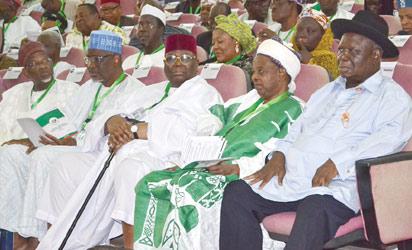
Delegates at the on-going national conference
Demand abolition of NDDC, N-Delta Ministry, others
By HENRY UMORU, JOSEPH ERUNKE & Levinus Nwabughiogu
NORTHERN delegates have said that unless the 1999 constitution was amended to take away the ownership of mineral resources from the Federal Government, total resource control by any Nigerian state was a breach of the covenant of the federation.
Likening the desire for resource control to a claim to pullng out of the Nigerian federation, the delegates said that all regions in the country were equal stakeholders in the Nigerian oil.
In the same vein, the delegates vehemently rejected the abrogation of onshore/offshore oil dichotomy, which they said gave away a national resource to only littoral states and called for reversal of the system.
These positions were contained in a booklet circulated to various committee members, which Vanguard obtained yesterday.

Delegates at the on-going national conference
The issues of resource control and removal of local governments as the third tier of government from the concurrent list have so far proved contentious and set members against one another especially in the committee of Devolution of Power mandated to discuss the issues.
The book which was titled: “Key issues before the northern delegates to the 2014 national conference,” maintained that the North accounts for 80 percent of the Nigerian population leaving the South with 20 percent, stressing that Northern Nigeria is the back bone and strength of Nigeria.
“The North rejects the frequent assertions by the South on the population figures of the North and state clearly that the rate of population growth attributed to the North over the years is extremely understated”, the booklet read in part.
Onshore/offshore dichotomy
The delegates added that “the North recommends the rejection of claim to oil resources by oil producing areas that led to the cancellation of the onshore/offshore oil dichotomy which action gave away a national resource to littoral states, seriously eroding revenue available for the distribution to all part of the country. The North demands a reversal to status quo ante.
Institutions and programmes
“The North recommends that all institution and programmes established for the benefit of a few states be abolished. These include the Niger-Delta Development Commission (NDDC), the Ministry of Niger Delta and the Amnesty Programme for the Niger-Delta ex-militants and the Component C of the SURE-P programme, the HYPADEC.”
According to them, “the derivation which is now at 13 per cent should be reduced to five percent and must be limited only to the onshore”.
They continued: “The demand for resource control is indeed also oblivious of other relevant facts: the Nigerian constitution gave the ownership of all mineral resources found in any part of the country to the Federal Government of Nigeria. The history of revenue sharing between the Regions and the centre was 50:50, but limited to revenue derived from activities that involved human effort. All mineral resources had belonged to the centre, and this new adventure on resource control is totally new concept, and alien to the practice in Nigeria.”
“The North demands a new revenue sharing formula which seeks to empower the strata of government closer to the people than the centre, i.e. the states and the local governments to be able to deliver on their governance responsibilities to the people. ”
The formula is also to ensure a strong enough Federal Government for the security of the country, and give the country the stability of direction and focus on human and economic development…We recommend a vertical revenue sharing formula as follows: federal government 26 per cent, states 39 per cent, local government 35 per cent.
Also we recommend a horizontal revenue sharing formula for the states and local government areas as follows: equality 35 per cent; population 30 per cent; population density 2 per cent; land mass 20 per cent; terrain 5 per cent; internal revenue generation effort 5 per cent; and social development factor 3 per cent.”
Disclaimer
Comments expressed here do not reflect the opinions of Vanguard newspapers or any employee thereof.