
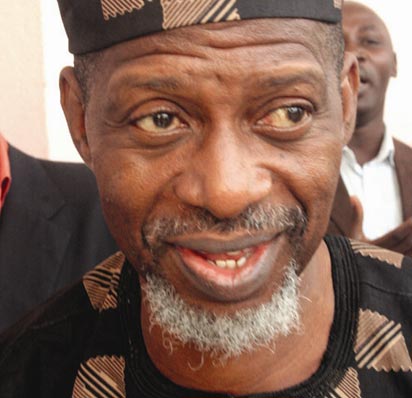
Odia Ofeimun,
By Odia Ofeimun
A CONSTITUTION that will outlast its makers must derive from collective ambitions that are not driven by immediate, or merely alimentary, concerns! Unity is not enough. Nor welfare. A good constitution must seek a shared future, based on justice and a common, benign morality. It is such a constitution that we seek as a syllabus of ideals into the next Nigerian century. And beyond.
And, there is no reason to try re-inventing the wheel. Our many struggles in the past have given us golden indications of how we may go. We need to look with large-heartedness at our history, and to concede that so much good work has been done in the last century requiring us to take our country very seriously. Hence, in asserting that this conference must be different, I have no reason to engage in far-fetching. I am relying on the cumulative goodness of preceding creativity and hardwork. Let us add a new sense of direction, and studied will, to make good our roadmap.


*Odia
In my well-considered view, we are, as Nigerians, inheritors of great debates, marvelous precepts, and well-honed constitutional provisions – loaded asterisks – that are answers to our much-vaunted National Question. In over one hundred years of trying, we have arrived at principles that are true to our needs and ought now to be harnessed with the integrity of self-motivated people. In no particular order, the principles cover but are not limited to the following:
A Presidential system with a four year, renewable, term for chief executives who shall be elected on the basis of universal adult suffrage by the whole constituency over which they seek governance.
A bicameral legislature based on universal adult suffrage
A judiciary entitled to a first line draw on the Consolidated Revenue Fund
A post-office pension for past chief executives and officers of the legislature so long as they were not impeached .
The withdrawal of immunity from criminal liabilities for chief executives
Special courts for the prosecution, with despatch, of cases emanating from corrupt practices.
States courts of appeal to be established in six geo-political zones
A mayoral administration for the Federal Capital Territory
Transfer of basic education, maternal health care, and housing from Chapter two, on Fundamental Objectives and Directive Principles of State policy to chapter Four under Fundamental human Rights; therefore justiciable
Creation and re-creation of states strictly to ensure that, as much as possible, all people of the same ethnic or language group in contiguous territorial formation are together in one state
The creation of a Gbagyi state, Ekiti state, Ijebu state, Nupe state, Anioma state, Kanuri state, etc. with common welfare policies as guaranteed across all the states of the Federation.
Removal of pensions, prisons, railways, stamp duties, and wages from the Exclusive Legislative list to the Concurrent list;
Addition of road safety, healthcare, public complaints, arbitration, aviation, and environment, health, housing and electricity to the Concurrent list.
A shared and federated defence and security system with a directorate of each of the forces under each level of government; every tier of government entitled to a police system in the format of the judicial service. Secularity of the Nigerian state guaranteed; no state religion
All political parties to enjoy subvention commensurate with votes scored in local government elections.
All incumbents who change their political parties in midstream shall return to the electorate for their mandates to be re-determined in a bye-election.
Every language to be a national language taught at school in the domicile of each language; a multi-language choice at higher levels, with Universities in each catchment area empowered to research into the history, folklore, literature and culture of the areas.
The autonomy of the local government system to be guaranteed: no joint LG/state account; but a Revenue Mobilization and Fiscal Commission for the state.
Local governments and states to be involved through equity and management, in resources found in their areas.
Derivation principle to be applicable to all revenues, including Value Added Tax (VAT)”.
A revenue allocation formula that takes cognizance of items on first line draw; and shift of items on the Exclusive and Residual list to the Concurrent list.
Drastic reduction in cost of governance through downsizing of ministries, commissions, parastatals, offices of special advisers and special assistants.
A half-yearly report of actual cost of government to be undertaken by specially created Code of Conduct/Public protector’s office answerable to parliament.
“No expenditures without proper appropriation.” All budgets of such entities as the CBN, NNPC, NIMASA, Customs and Excise etc to be laid before the National Assembly
A separate office of the Attorney General of the Federation; distinct from the office of the Minister of Justice
The office of the Accountant General of the Federation to be distinguished from the office of the Accountant General of the Federal Government.
All who are convicted for electoral malpractice shall be banned from running for any office for nine years.
I must acknowledge the debt that these asterisked items owe to various constitutional conference reports, civil society soirees and special commissions. The empowering vision comes from tapping into the best that the Nigerian mind has framed in pursuit of a handle to collective aspirations.
The ideals that they embody offer great opportunities for celebrating as well as transcending the challenges of our history. True, not everyone of the asterisked items is argued or defended beyond the mere statement. But an over-view of the social concerns that they are designed to address is at the heart of this book.
They are, in this sense, additives to arguments advanced in Taking Nigeria Seriously, and When Does A Civil War Come To An End. I make no claim to special knowledge and have avoided any such presumption. This is one citizen’s plea to fellow citizens: to appreciate the necessity for a National dialogue, the insolvency of a sovereign national conference; and the imperative of facing up to the challenges of the national question with creativity.
I have added lectures and interventions which bear direct relevance to the issues that this particular National Conference, or any self-respecting one, would consider. Ultimately, I am interested in how what was once described as a geographical expression can become a genuine cultural expression; how to create untrammeled conversations between Nigerian nationalities and ethnic groups; and how to accommodate the role that the National Assembly has to play if we desire a law-governed approach to the resolution of the crisis that Nigeria has faced.
Disclaimer
Comments expressed here do not reflect the opinions of Vanguard newspapers or any employee thereof.