
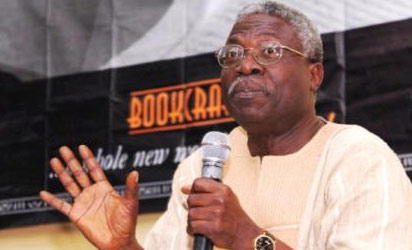
NIYI OSUNDARE
(for Columbus Chukwujindu Ihekaibeya, 1942—2004)
By NIYI OSUNDARE
NO two acts could have been more dramatic in their tragic coincidence. I was halfway through Biodun Jeyifo’s powerful elegy for Tunde Sawyer, his former classmate at the University of Ibadan (The Nation, Jan. 12), when the obituary notice of yet another highly remarkable UI alumnus popped up in my email box.
This notice came from Professor Chukwuma Azuonye, the noted scholar and teacher, and it is about no other person than Chuks Ihekaibeya, our mutual friend, and my classmate and valuable colleague at the Universities of Ibadan and Leeds in the late sixties and early seventies respectively.

NIYI OSUNDARE
These two mortuary notes sent me into a reflective spin. Jeyifo’s “departure lounge” metaphor and its memento mori; his eloquent, nostalgia-inducing recall of intellectual life at the University of Ibadan in the 1960s; his exposure of Nigeria (for the umpteenth time) as that Hobbesian jungle where life is short and nasty and brutish; his characteristically cerebral but tender and humane representation of our human condition – all this in remembrance of a dear friend and the indictment of a country which never fails its citizens in its infliction of untimely ‘departures’. Azuonye’s own obituary notice is a celebration of Ihekaibeya and an impressively meticulous documentation of his achievements as student, scholar, and officer of the Commonwealth.
Azuonye’s mail hurtled me down the proverbial memory lane, and my mind wound back the reel on the deck of time. The year was 1970. The Nigerian (un)civil war had just ended. The air was rent with shouts of: “One Nigeria. No Victor, No Vanquished”.
But one brief, conscientious look at our war-weary, battle-bruised returnee-colleagues was enough to punch a hole in that slogan wide enough to swallow a mortar tank. The moods of many of these returnees ranged from despondent to defiant, bitter to buoyant, but overall, what I noticed was a burning hunger to catch up on everything, to recover some of the lost time, to learn, to love, to live again. No time, no money for fancy wardrobes and expensive perfumes.
Some of the shoes pounding the campus pavements were worn right to the heels. Occasional chants of ‘Happy Survival!’ interrupted the somber silence whenever long-separated former friends ran into each other again, and the ensuing hours were clamorous with narrations and enactments of all kinds of war sagas.
It was a sober, even belittling experience for many returnees who were now nothing more than classmates with those who were still in high school at a time before the war when the ‘new’ arrivals were already undergraduates. Many of the returnees needed a more than usual lightness of spirit to bear this unfortunate demotion; others reached out with stubborn courage.
Two of my most memorable colleagues in Tedder Hall, Frank and Aloysius Nwosu, one now a doctor, the other a renowned agriculturist, embodied these two ideals. Frank was brilliant, funny, and fabulous; Aloysius was intensely affable and witty. I reveled in their company as I teased them with literary terms and they responded with all kinds of scientific arcana. In my private moments I couldn’t help wondering where these bright men would then have been had the war not intruded.
Sobering circumstances
It was in these sobering circumstances that Chuks and I discovered each other. In the first few weeks of class, I had noticed this bearded, fair-faced man who carried himself with the deliberate aplomb of a book-bound guru. For, everywhere Chuks went, there was always a book in his hand.
Initially, he smiled but little, talked even less, but as time went on and the pains of the war began to wear, Chuks began to smile – that broad, generous, and utterly disarming smile that lit up his face and offered access to the light that perennially shone in his soul.
It was impossible to encounter Chuks without being touched by his boundless vivacity and intensely reflective proclivity. Virtually every time we met, it was book talk, lecture talk, discourse over the new literary theory or concept or expression – or heady disputation over the vocabulary of the English language. Hard-nosed grammarian and doctor of diction, Chuks waxed vigorous in our after-lecture ‘quarrels’ over dangling participles and their unpardonable damage to the health of English syntax; the semantic perils in almost like-sounding but different-meaning pairs such as ‘official and officious’, ‘effect and affect’; ‘considerable and considerate’; ‘simple and simplistic,’ etc.
We even split hairs over the grammatical difference between ‘enquiry’ and ‘inquiry’; the differential syntactic positioning/implications of ‘due to’ and ‘owing to’; and ridiculed the intolerable redundancy in such expressions as ‘can be able to do it’ and ‘should in case’.
In our second undergraduate year, some kind of occasional sparring sessions developed between Chuks, myself, Akanji Nasiru, a close friend of mine, and a versatile, unobtrusively intelligent fellow, and Terimi Adekunle Jimoh (also now late, alas!), a deep, immensely literate bookworm. ‘University Wits’ of a fledgling but ambitious breed, we raided world literature from Sophocles to Soyinka; from Hardy to Achebe; from Chaucer to JP Clark.
The book was our brief, the pursuit of knowledge our ardent desire, the attainment of academic excellence our quenchless passion. Chuks was some kind of literary omnibus, at home in all the genres. But he and I had an uncommon fascination with the metaphysical poets. (Forgive my pathetic confession: up till now, I haven’t succeeded in ridding myself of my own Donne Disease).
I remember one evening in 1971 at the famous Faculty of Arts courtyard, when Chuks and I decided to wage a battle of minds over the metaphysical poets. We spent about two hours ranging over Donne’s Euclidian tropes, his astonishingly captivating conceits, and the brave theatricality of his love poems. Then, in the tail end of the battle, Chuks mentioned a particularly fetching phrase.
‘From Theodore Redpath’, I said. ‘Ah, you’ve read him?’, Chuks asked, his face a shining book of surprise and inquisitive delight. Chuks stretched out his hand for me to shake, as if we were meeting for the first time. That handshake went beyond the elbow, in a manner of speaking, as the two fledgling scholars locked in collegial embrace. For the next 40 years Chuks and I never met without some mention of that Eureka moment.
THAT short but poignant moment was so symbolic of student life in our university days when the cultivation of the mind was the prime passion and the pursuit of knowledge trumped the search for material frivolities. We at the University of Ibadan strode around the campus, heads high, the way our counterparts did at Oxford or Cambridge or Harvard or The Sorbonne .
Our university in every aspect made sure that there was no exaggeration in that comparison; that our faith was no fantasy, our valour no vanity. Ibadan University’s reputation ensured a global currency of its degrees. First-rate universities all over the world threw open their gates to its graduates.
Intellectual aristocrat
This was the atmosphere in which Chuks thrived. It was the only atmosphere in which he could have thrived. An intellectual aristocrat of an urbane and liberal temper, Chuks had no tolerance for mediocrity. A lover of robust, edifying argumentation, he was constantly in the company of those who traded in ideas.
A colourful, expansive man of letters, he was never shy in his dramatic exhibition of knowledge, and in his habit of frequently running his ideas by those whose responses he genuinely respected. With this demonstrative knowlegeability and oratorical bravura, Chuks quickly earned the nickname ‘Professor’ in friendly circles, a jocular designation which garnered substantive credibility upon his delivery, in 1970, of a powerful citation on Professor Adeoye Lambo, then Vice chancellor of UI, after that famous psychiatrist’s winning of the Haile Selassie Award.
It was a solo effort, astonishing in its initiation, masterful in its delivery, and overwhelming in its lasting effect. An overflowing Trenchard Hall watched and cheered as Chuks enacted the most memorable performance in his university career. His fame spread on the university campus, and he quickly won a place on UI’s team to the next edition of the inter-university debate between UI and the University of Ghana, Legon. Chuks graduated as one of the best students in the 1972 set, and the next field of action shifted to the University of Leeds, one of England’s top institutions.
As fate – or good fortune – would have it, Chuks and I arrived in Leeds one day of each other in September 1973, he on a Commonwealth scholarship, and I on one provided by the University of Ibadan. It was at this fascinating citadel of learning that our relationship became closer and our appreciation of each other received a tremendous boost.
On our first day on the Leeds University campus, Chuks and I surveyed the buildings in their majestic serenity, tracing the footprints of Wole Soyinka, Ngugi wa Thion’go, Ime Ikiddeh, and other notable African forerunners and authors of what is now called the ‘Africa-Leeds Connection’, and we swore to avail ourselves to the fullest of the generous facilities provided by our new university. We both realized that although Leeds was new, it sprang no notable surprise in its physical structure, curricular content and general academic culture, for our undergraduate education at UI had equipped us with the capacity for excelling at any other first-rate university in the world.
First rate university
Yes, even on that first day, Chuks and I did it ‘the Ibadan way’. As we regaled each other with tales of our Lagos-London flight (the first flight experience for both of us), Chuks dug his hand into his coat pocket and whipped out a poem he had written about the flight. I complemented his effort with one that I too had composed while on board. Neither of us was surprised at this coincidence.
Chuks’ lines were purple and poignant (as usual); mine were full of visual images and orikitenored tropes. Each of us had something to say about the prophetic hubris of Icarus, though we were grateful we did not return to earth in a hail of ashes. Some self-congratulation and mutual back-slapping rewarded our readings, as did quite a bit of close interpretation and Leavis-esque criticism.
This creative and intellectual exchange characterized and strengthened our friendship throughout my time in Leeds. It was impossible to keep Chuks’ company and remain intellectually inactive.
Let me summon two brief anecdotes to the aid of this assertion. Early one morning in February 1974, I was still trying to clear my eyes of the debris of slumber when a gentle knock unsilenced my door. It was Chuks on an urgent literary visit to me in my little room in Hey House, Bodington Hall, some one-and-half miles from where he resided. ‘What are you doing here so early, OgaOrator?’, I asked, an expectant smile on my lips.
‘See, just see’, Chuks responded as he breezed through the door, holding a book in his hand. ‘Have you seen this? Have you read this? Ah, this is more than fantastic!’, he enthused as he brought out (again, from his coat pocket!) a thumb-bruised, copiously book-marked copy of Wole Soyinka’s The Man Died he had read all night and just couldn’t wait for the daybreak to share with me. For the next two hours, we flipped from page to page, mesmerized by Soyinka’s riveting account of the Nigerian civil war, his role in this tragic event, and his travails in the solitary confinement unit of General Gowon’s prison.
The second episode occurred on March 12, 1974, (alas, exactly 40 years ago today!). Again, it was Chuks on a visit to me at Bodington Hall; only this time, he was not alone. Again, that gentle knock on the door, and behind it was Chucks with some five or six other colleagues in tow.
As I opened the door, a chorus of ‘Happy Birthday!’ surprised my ears. It was they who actually reminded me, for I hardly ever remember my birthday!
My new Akai stereo set went to work, and for the next two hours, we gyrated to the compelling rhythms of reggae and highlife. Half-way through the jollification, Chuks cleared his throat and said, ‘Ladies and gentlemen, a gift for Niyi’. The loudspeakers went silent; the dancing crowd became expectant.
Whereupon the Orator brought out (again, from his coat pocket!) a neatly folded yellow piece of paper from which he read ‘Crimson Moments’, a poem he had composed for my birthday and typed up on his new small typewriter. (A few weeks before, Chuks had celebrated the purchase of that typewriter, an Olivetti, if my memory serves me right, as his initiation into the esteemed kingdom of writing).
To be concluded
Disclaimer
Comments expressed here do not reflect the opinions of Vanguard newspapers or any employee thereof.