
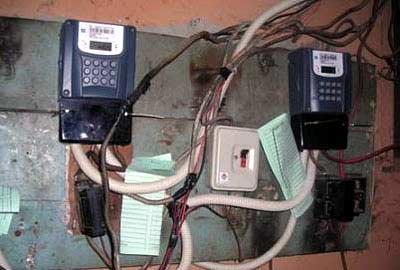
This is the third and concluding part of this report. In yesterday’s edition, we noted that NERC has failed in its task of educating consumers on their rights
ACCORDING to him, “most times those in government see the quantum of money at its disposal as free funds to be squandered and embezzled because they have no clear idea of what should be the role of government in driving economic growth and development.
He said all over the civilized world, governments strive to tame inflation, curb unemployment and reduce inequality, but in Nigeria, government policies and actions widen the gap of poverty, underdevelopment and unbridled corruption.
In other countries where government source investment from local and foreign investors, it is the primary responsibility of government to ensure that the interest of the citizens are protected.
Some Nigerians end up as slaves in their own country from the so called foreign investors. They earn peanuts, their working conditions are deplorable and they repatriate their profit without offering value to the economy. Nigerians should start asking questions about whose interest their leaders serve while they are in office.

Specifically, the participants want NERC to explain why they reneged on the promise to give consumers free pre-paid metres which they promised to give to consumers before the take-off of the privatisation policy.
They also demanded that NERC should explain why it suspended the CAPMI policy and finally, they called for setting up of arbitration courts to try cases that will arise from the arbitrariness of the power companies that have been billing consumers even when there is a nation wide acknowledgment of drastic drop in electricity supply to consumers.
Mr. Michael Faloseyi,
Head of NERC in South West, said since Nigerian Electricity Regulatory Commission signed two regulations – the Independent Electricity Distribution Network (IEDN) and Embedded Generation 2012, the process of electricity generation had been liberalised.
Exclusive consumption
According to Faloseyi, “ the regulation on Embedded Generation allows state and local governments, private investors, communities and individuals, to generate and distribute electricity for their exclusive consumption, using facilities of existing electricity distribution companies or independent electricity distribution network operators”.
The regulation on independent electricity distribution networks on the other hand permits communities, local and state governments to invest in electricity distribution networks in areas without access to the grid or distribution network or areas poorly serviced. State governments with investments in infrastructure for power generation and distribution can now begin to reap benefits of their investment.
Also, state and local governments with enough financial muscle, but had been hitherto discouraged, can now take fuller advantage of these regulations to provide adequate power for the communities.
Faloseyi said “these laws were direct attempts to cater for about 40 per cent of the country’s population without access to electricity. The regulations were meant to address the probLem of poor quality of electricity supply”.
Faloseyi averred that ‘’the impact of these regulations is that communities, local and state governments as well as private investors can now generate and distribute electricity without recourse to the national grid”. These regulations also made it easier for companies to participate with various options available.
Vanguard Conference
Hall participants were unanimous in their views that “consumers deserves protection from the private companies who would end up forming a cartel to dictate the tariff for electricity”.
Efforts to speak with the Chairman of the National Electricity Regulatory Commission, Dr. Sam Amadi, proved futile, but Vanguard checks at NERC headquarters provided the Special report team the opportunity to participate in the Stakeholders brainstorming as well as obtained a draft copy of the National Content policy for Regulations of the Nigerian Electricity Supply Industry (NESI).
Among the issues raised by the stakeholders were:
lThe ownership structure of the companies coming into the power sector
lBuilding the capacity of the new player
lManpower development level of investment fund required
lStreamlining the NCD with other existing laws
lAvoidance of over regulated
lPublic awareness on the rights of consumers and host communities of the power companies
lProtection of local manufacturers of electricity equipment like metres and transformers.
The National Content policy sets out guidelines that gives priority to Nigerians areas of project execution, employment, technology transfer, jobs. There will be a need for skilled manpower and the regulator has the responsibility of ensuring the delivery of manpower needs of the sector. Mr. Steven Andzenge, the NERC Commissioner in charge of Legal, Licensing and Enforcement said the the regulation is necessary at this initial stage of the privatisation drawing valuable lessons from the other sectors. Mr. Steven Andezenge told stakeholders that “one of the challenges that the Commission faced in the past regime in handling the successor companies of PHCN was immunity which those companies enjoyed as they were managed as government entities”.
Andezenge told the stake holders that “now we are going to do things according to the provisions of the law, we are going to insist on good business practices from the privately managed companies, and any one of them that breaches the regulations will be sanctioned”.
Enforcement of regulations
He said, “we know that investors in these companies would not engage in acts that will tarnish the image of their companies neither would they want to loose their funds. We would even sanction the management of these companies when they breach the set down rules in the industry”.
Said Andezenge, “we would be firm enforcing the regulations of the Nigerian content for the power industry.
The whole privatisation process has ensured that 60% was given to the private sector while the Federal Government, state governments, workers and host communities of the new power generating companies hold 40%”.
The stakeholders told Vanguard that “NERC will guard against the mistakes in the telecom sector where the ownership structures were not open to Nigerians and some of the companies that have used the Nigerian market to become global players in the sectors have refused to be listed in the Nigerian stock market to enable Nigerians benefit from the mega profit that these companies are making.
Consequently, they are insisting that there should be provisions in the regulatory status, to compel new power companies that attain certain status on its operations and turn over, to be listed in the stock exchange and its ownership structure, opened to admit capable Nigerians on their boards.
Mr Charles Ilofulunwa,
Managing Director of a local metre manufacturing and marketing company said “there is enough capacity for local manufacturing of pre-paid metres in Nigeria, but the DISCOs are frustrating our efforts.”
Said Ilofulunwa: “We have even gone beyond pre-paid metres to smart metres, which can track the date and time of electricity supply, the actual quantity of electricity consumed, with a capacity to switch the consumer’s supply without officials of DISCOs carrying ladders to carry out mass disconnections”.
He said “We have never seen DSTV operators going from one building to another or from flat to flat to disconnect subscribers. There are modern ways of doing this business and making life easier for everybody. Electricity service should not be a source of pain to the supplier and to the consumers”.
Officials of DISCOs have given conflicting reasons why they suspended the pre-paid meter scheme. Some said that Nigerians have devised ways bypassing the pre-paid meter while others said it was the failure of NERC to fulfill its part of remitting the payments made by the consumers through CAPMI.
Mr. Kola Balogun, the Managing Director of Momas, an Indigenous Meter Producing Company in Nigeria, said “the company like other Nigerian companies that are providing local content, to the power sector, require protection from NERC because the privatisation process would open the floodgate for massive importation of electricity into the country”.


*Electricity consumers at rare NERC forum. Source NERC
According to Balogun, the company has the capacity of producing over 100,000 meters with soft wares that would stop power theft or by-passing the meter by consumers.
NERC said while it would allow importation to thrive, only companies licenced by it and certified by Standard Organisation of Nigeria (SON) would be allowed to import meters.
It said there would be specific standard of meters that would be allowed and there would be price differentials in favour of the local companies.
According to Prof. Nebo “ the ultimate mission of the ministry is to ensure that Nigerian companies that produce insulators, transformers, cables, meters etc are encouraged and patronised because their activities would have positive impact on the economy. The minister said there will be strict attention paid to the issuance of waivers as some of those who were given such waivers would want to use it to import equipment that are not relevant to the power sector.
NERC has suspended the Credit Advance Payment for Metering Implementation (CAPMI) which was introduced in 2011 to deal with the high level of complaints from consumers arising from the culture of estimated billing practices.
This became necessary as the generating companies were using exorbitant cost of meter to deny consumers access to meter, thereby perpetuating the culture of estimated billing system. CAPMI therefore provided consumers the option to make advance payment for their meter into a dedicated account jointly managed by the DISCOs and the meter vendors/installers.
Unmetered consumers
It was expected that once the payment was made, the consumer would get the meter within 45 days, while the cost of the meter would be refunded through graduated electricity billing system where the tariff is spread over a period of time. Vanguard learnt that this system has been suspended as it has become corrupted as DISCOs have began to default in fulfilling their part.
Even when NERC came
with the Multi-Year Tariff Order 2 (MYTO2) in June 2012, there are still a large number of unmetered consumers while those who are metered are given estimated bill and crazy bills to pay.
There is the assumption by NERC that there is efficiency in the economic system which eliminates corruption from agencies of government, effectiveness of public institution to resolve dispute between the electricity companies and the consumers, efficient management of the macro economy and fidelity between the electricity companies and the consumers.
Nigeria is a country where there is huge income disparity and the elites especially those in public service do not pay for electricity bills and other basic utilities, the cost is passed on to the government. Government agencies, military establishments are not known to pay for the electricity that they consumed.
Most companies in Nigeria have over the years generated their own electricity owning to the inefficiencies of the moribund NEPA, PHCN and its successor companies.
Comrade Joe Ajaero said “Nigeria has not developed to the level where this world bank model can be effectively deplored especially when the consumers are sure that there will be steady and constant supply, that the electricity companies are mindful that any fraudulent calculation based on wrong data would trigger inflation and upset the Macro economic system”.
In Nigeria, we have unreliable data collection system,people do not provide faithful information, we cannot even get our census right and that goes to the fact that we cannot determine the demographics of industrial and residential areas, we cannot differentiate between business premises and residential areas, we cannot classify what phases of meter the different categories of users, neither NEPA, PHCN nor its successor companies shave data bank of consumers, but above that we know that there have been cases where corruption has been a major issue in the power sector.
This goes as high as contractor importing refurbished electrical equipments and passing it off as new, people have been given waivers to import electrical equipments and they ended up importing substandard equipment or importing other thing entirely.
In the end NERC expects
that all these cost of inefficiencies should be loaded on the over burdened consumers in the name of cost recovery as Nigeria has not developed to that level where the regulator will get accurate information from the electricity providers on their actual cost of input. Comrade Ajaero told Vanguard that it is only a matter of time before NERC will will be caged by the operators as we have seen in the Telecom and Communication sectors where the operators have the regulators at their beck and call.
LITIGATION OPTIONS (SIDE BAR)
Barrister Achike Meze told Vanguard that his chamber has actually received several briefs from aggrieved consumers who want to institute legal action against the power cartels that government is using as proxies to fleece Nigerians.
According to him, “there are no enabling laws that protect Nigerians from exploitation and manipulation by these power cartels created by government and the role of NERC as a regulatory agency is suspect.
The new companies are enjoying the same protection that was given to PHCN. According to him, there is no anti trust law to forbid the new power companies from ganging up with NERC to fix tariffs”.
Barrister Godfrey Chijioke Ndubisi said “What is happening in the power sector is a repeat of the crookedness that accompanied the deregulation of the telecommunication sector. The Telecommunication companies that came from South Africa and Zimbabwe were given preferences over their Nigerian counterparts and when they began operations they fixed exorbitant and extortionate call rate of N50 per minute call.
Protection interest
By the time Nigerians realized that they were being ripped off, the companies had cleaned out. This atrocity was carried out under the watchful eyes of Nigerian Communication Commission which gave Nigerians the impression that it was protecting their interest. He said we have no reason to trust NERC or any other agency of government who have no patriotic ethos in their existence.
On paper, NERC states
that it exists on the premise that customers have rights as enshrined in the EPSR Act 2005.
These include:
•The right to electricity service which inspired the Commission’s regulation on Connections and Disconnections procedures for electricity services as well as the customer service standards of performance for distribution companies.
2. The right to transparent billing and adequate information which inspired the Commission’s regulation on meter reading, billing, cash collections and credit management for electricity services.
•The right to due process prior to disconnection and right to prompt re-connection of electricity service upon payment.
•The right to prompt investigation of complaints and the right to seek redress. This informed the regulation on customer complaints handling: standards and procedures.
In protecting the rights of the consumer the Commission is also protective of the legitimate interests of all other stakeholders through various instruments and regulations.
Disclaimer
Comments expressed here do not reflect the opinions of Vanguard newspapers or any employee thereof.