
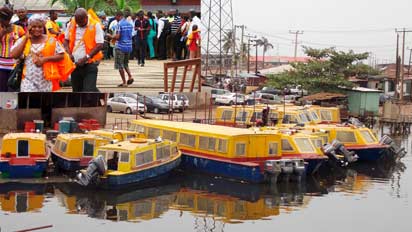
*MOURNING: Boat operators at Majidun Jetty, Ikorodu, suspended ferry services in honour of the victims of Wednesday’s boat mishap that claimed seven lives. INSET: Stranded passengers redirected to the Metro Jetty, Ikorodu, yesterday. NAN PHOTOS.
There are controversies surrounding the boat mishap that occurred on the second day of this month which left eight people dead, while 12 others were rescued after a wooden boat capsized in Majidun area of Ikorodu.
The Lagos State Waterways Authority, LASWA, the agency saddled with the responsibility of sanitising travels on the state’s waterways believes some reports on the accident were not only uninformed but also mischievous.
The Agency’s Managing Director, Olayinka Marinho, gave his organisation’s side of the story in an interview with LEKE ADESERI, the South West Regional Editor.
ON the Majidun mishap that claimed eight lives
On that fateful day, 22 passengers embarked on the journey at about 5:30am and were all putting on life jackets from Ebute Ero. The accident happened along Oworoshoki channel heading towards Majidun.
We got a distress call around 5:50am and got to the accident scene at 6:10am and with the management of Bell Marine, the ferry owners, because the boat that hit the log called other boats from his company who came to assist. We were able to save 14 persons, though we eventually lost eight persons.
With the help of LASAMBUS, we moved the victims to General Hospital Ikorodu. The corpses were later moved to morgue of High land hospital the following day. Our agency and Bell marine management took possession of the corpses we recovered and handed them over to Marine police, Ikoyi where the case was reported.
After this, we went back to that same channel to bring out the boat in order to investigate the cause of the accident and we discovered the hole on the boat and we also discovered all the logs around the channel which caused the boat to sink.
At that point in time, we had been able to go round to most of the victims who survived to clarify some issues to help our investigation.
After the incident, we invited the loggers association to discuss how we will ensure that such mishap do not occur again.
We have taken it upon ourselves to monitor those logs from the entry point of Epe to Makoko. We had an agreement with the loggers Association in 2012 and we are going back to that agreement to ensure their logs do not become hindrance to the movement of our boats and passengers along the water ways.
As regards the search and rescue, LASWA with the management of Bell marine saved 14 survivors. LASWA divers brought out six dead bodies from the boat that sank underneath the lagoon and retrieved the boat from the lagoon.
Immediate precautions
We have spoken with our operators to ensure that all passengers put on their life jacket throughout the journey. We are also looking at how we can widen the windows in the vessels to have more emergency exits in case of accident because I believe some of the passengers were trapped in the boat when it sank.
Issues around life jackets
One of the things that the Agency does is to ensure that before any boat begins operation, we have an inspection unit that carries out a thorough inspection on the boat. The boat must have life jackets for both adults and children. Aside from this, we also inspect the boats quarterly to check the sea worthiness and all safety equipment on board especially the life jacket.
In a case where we discover substandard life jackets, what we do is to seize and burn them regularly. We also ensure these operators are not allowed to operate on the waterways until they provide standard life jackets. Lagos state government, yearly, also donates life jackets to riverine areas. It has been a continuous programme by the state to give out life jackets to riverine areas and we enforce it on our ferry operators.
This year, about 10,500 life jackets will be given out to some of our operators and a large percentage will be given to the people in the riverine areas.
Legislation to minimise non-compliance with life jacket use
We have Legislature to curb this.
We also have the water guards at the jetties. You must wear the life jacket before you get into the boat and you do not take it off until you get out of the boat.
This is because we notice that some passengers who rush out of the boat at times fall back into the water at the point of exit.
The law is: wear your life jacket before you get into the boat and take it off when you are out of the boat.
So we are now putting it upon the operators to ensure the captain of each boat is very vigilant and ensure no passenger removes his or her life jacket during the journey on the water ways. It is impossible for us to put a life guard on every boat that travels on the water way.
Is there any form of punishment?
For now, we are looking at fines on erring operators or banning them for a certain period of time. While we are still on our research on the best approach to this issue, we have done a practical demonstration of how to use and the functions of the life jackets in the past because the importance of the life jacket cannot be overemphasized as regards water transportation.
Water transportation
We have water guards at each of those terminals and that is why we have the confidence to tell you that 22 passengers left with the ill fated boat with their life jackets on.
Do the ferries carry manifests?
We do a rider’s count of the numbers on the water ways. When people talk about the manifest I like to imagine where we can run the water ways like developed countries of the world where their major transportation is the water transportation.
This is like going on the bus; can you carry a manifest in a bus? Is this possible during the rush hours? Sometimes you have like 2,000 persons trying to get into one bus. There are some issues we have to be very practical about.
The ferry transportation business is like a bus service. It happens that our main time of traffic is the morning hour’s rush and the evening hour rush.
What we do is to create an orderly queue and take the head counts. With this, we have the departure time of boats and make sure that each boat with the number of passengers it is meant to ferry. We radio or call the other end, I mean the destination point to let them know when to expect the boat. This is how we do our surveillance within the water ways.
Apart from that, we have our patrol boats that are sited in the water ways to ensure that our boats and passengers are save and also to ensure that our operators comply with the water ways rules and are fast to report any mishap in our water ways.
However, we are planning to bring in five boats before the end of this quarter and very soon you will get to see them on the water ways. They are with 80 sitters’ capacity.
LASWA and the FESTAC mishap
That incident happened on a canal which is not meant for such movements, I mean not for water transportation.
The Chairman of the Local Government in Festac has done so much to stop people from crossing to the other end through that canal. He placed a gate at the other end where the passengers will land to close up between 4th and 6th avenue.
There is no entering or exit point from the canal into the river. My point is that the canal is not a water way recognized route where people are expected to cross.
That crossing shouldn’t have happened because there is a bridge which I believe is about a 100metres where they should have crossed. The Local government has gone as far as creating tricycles for easy transportation in that area.
There were alternative means to do that crossing. It was a very unfortunate incident. It was a minor who was piloting the boat, it was a 12-sitter canoe and he had 24 passengers on board. I think he lost control of the boat trying to maneuver an over loaded boat at night. Our agency does not encourage night travels.
Most of the jetties that we superintend have our water guard who will leave those jetties at 7:30pm to close the water ways transportation.
Going forward, the state is putting on navigation bouys like BRT lane on the water ways. We are doing one in the Ojo area which I think before the end of the next month, will start work in the Ojo axis from Ijegun Egba to Ebute Ojo ferry terminal.
From the Island to Ikorodu area, our terminal leaves from Ipakodo which will be like a BRT lane on the water way so anybody who enters within that channel will be able to navigate easily towards Ikorodu and not miss his way. We are also working on using solar energy to have reflections at night that will demarcate the water ways during harmattan period and in the evenings.
Uneven development of the jetties
Lagos State Government has taken up the infrastructure within the water ways. That is; building of terminals in different parts of the state.
We want to build terminals in strategic areas within the state and the terminals will have facilities like the transition zone, car parks, even fuel banks where we can easily fuel our boats.
This will reduce fire accidents and will be very convenient for us. The state has floating jetties which make it a painless transition between the water ways for the passengers to come up of the boat. We are going from the concrete jetties to an easier one to enter and come off the boat.
There is the Ministry of Rural Development which has built a lot of jetties in the riverine areas from Badagry to Epe. Those jetties are now under the Lagos State Waterways Authority and we have about 59 of them spread across the metropolis of Lagos we are upgrading some of these jetties we are upgrading.
We have many projects at hand that are close to completion. We have one at Oke Afa, Isolo that we are bringing up pretty soon. People will be able to move from Oke Afa through Mile 2 to the Island. The jetties under the state are upgraded by the state and those under the Federal Government are being managed by them.
The law makers’ invitation
I have been invited to the House.
Do you have any idea of what the query is?
I know it has to do with the Majidun accident. I think some publications have not made the investigation easy. We have incidents like this happen in every country of the world. The best thing to do is to ensure this incident does not happen again. The incident was quite unfortunate.
LASWA’s achievement
LASWA has disclosed that at least 12 million residents of Lagos State used the now-famous waterways transportation between January and July 2013. According to the agency, the figure represents an increase of more than 100 percent in three years.
The ridership is a statistical data used by the Lagos State Waterways Authority to monitor the number of commuter that uses the state waterways to move within Lagos. From a 494,010 ridership in June 2010, the ridership as at July 2013 has gone up to 1,862,767million, a development that has reduced pressure on the roads. A further breakdown showed that there was a progressive increase in the number of people that travel by water on a monthly basis. As at January 2013, a total of 1.103,567 as against 481,745 people in 2012 used the waterways . For the months of February and March 2013, 1,471,325 and 1,545,183 were recorded respectively, while the month of April 2013 saw a total of 1,671,225 people using the waterway.
The figures for the months of February, March and April 2012 stood at 892,456, 1.212,768 and 1.560,182 repectively. For May, June, July and August 2013, the figure stood at 1.671,325,1.852,653,1.862,767 and 1.788,370 as against 1.318,372 May 2012, 1.269,754,1.729,712,and 1.135,810 respectively for the period under review. The agency had projected that ridership could be as high as 2 million going by the steady increase of the number of people opting to travel by water.
Additional reports by
Dotun Ibiwoye and
Aderonke Adeyeri.
Disclaimer
Comments expressed here do not reflect the opinions of Vanguard newspapers or any employee thereof.