
Stories By Bose Adelaja
Lagos has long been known as the undisputed commercial capital of Nigeria. The scale of commercial activities is such that you find all manner of outlets for business transactions at every nook and cranny of the heavily populated metropolis.

This is in spite of efforts by the Lagos State government to regulate and curb the excesses of those engaged in one form of business or the other.
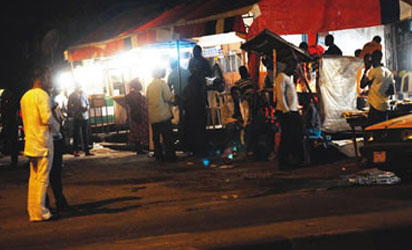
Government has in particular been involved in a running battle with street traders, especially those who operate in the night and who often clog up the roadsides, thus creating or worsening traffic congestion which is a big problem in the state.
It had tried to tackle the menace by building more markets and lock-up shops, believing that many roadside traders will seize the opportunity to operate in designated commercial areas.
It will however appear that the success recorded from this was short-lived as evidence suggests that roadside trading, together with its night-time variant, is presently back in full force in Lagos. And from the point of view of the traders, the reasons for this are not far to seek.
For instance, most of the traders lament bitterly about the hike in prices of government owned shops which have gone beyond the reach of the average commercial operator.
They cite this as reason why many of them have pitched their tents at bus-stops, under the bridges and road sides, most especially at nights when law enforcement agents must have closed for the day.
In most cases, trading activities commence around 7pm and extend till midnight depending on the locations and the goods involved. At Iyana-Ipaja, Cele-Expressway, Ikotun, and Agbado-Ijaye, to mention just a few, commuters and motorists now experience a tough time at night as traders have taken over the roads.
When business is in full bloom, traders will be seen and heard shouting at the top of their voices or ringing bells to attract attention to their wares.
On Vanguard Metro’s separate visits to the markets, some traders lamented the fact that shops built and owned by government are no longer affordable to many of them, especially the low capital operators.
VM can confirm after investigations that the State government has been able to put up many modern structures hosting ultra-modern shops, but these are mostly acquired by the rich, politicians and highly placed public servants who even before completion of the projects have allocated them to their relatives and cronies.
They hijack the allocations at minimal rates only to inflate same before subletting the shops, thus defeating government’s purpose for building these shops in the first place.
Some shops that belong to this expensive category out of the reach of most traders include Tejuoso market, Wahab Folawiyo Shopping mart, Suru/Alaba, Falomo Shopping complex and the Adeniran Ogunsanya Shopping complex. These shops are believed to have been acquired by the privileged rich and sublet to the rich traders who can afford the exorbitant rents.
VM’s findings revealed that some of the ultra modern shops attract a minimum of N5 million, depending on the size, while bidders are asked to pay the sum in the bank.
Some traders who bared their minds on the development said these shops were contracted to concessionaires who in turn imposed high acquisition costs on them not minding the status of the traders.
‘’Before the demolition of Tejuoso Market, the price of the shops was affordable to many of us; but with the latest development, it has gone beyond the reach of the common trader,’’ said Mrs Chinwe Ofala.
Another trader, Mr. Okafor Paul, who hawks confectioneries, said he collects his wares on credit and pay back after sales. ‘’When will I make such a huge amount of money to get a shop. Do they expect me to go into robbery to raise the money?’’ he queried. Another petty trader at Orile-Agege, a widow, Madam Gloria Adiyele, said she has been managing her trading business using a small table in front of her apartment.
She also lamented government’s insensitivity, saying many traders are being denied the opportunity to own a shop. ‘’Why must we suffer in the midst of plenty? The rich ones have used their connections to acquire these shops and there is nothing anybody can do,’’ she lamented.
Olabisi Idris, yet another trader, said government has good intention but lacks monitoring and distributive planning which has rendered its intention meaningless since the hope of the common man has been dashed.’’
When the Oshodi shopping complex was advertised, three of us pooled a total of N150,000 to rent a shop but we were asked to pay a non-refundable fee of N100,000 after which a sum of N2 million should be paid into the bank and none of us could afford it till date,’’ he said.
Some of these traders said night trading, though risky, is less rigorous compared with day time business. ‘’We are free from embarrassment of law enforcement agents, landlords or building contractors, though we pay a token to area boys,’’ chorused Abibat Sekoni and Chukwus Ewenrindo.
Disclaimer
Comments expressed here do not reflect the opinions of Vanguard newspapers or any employee thereof.