
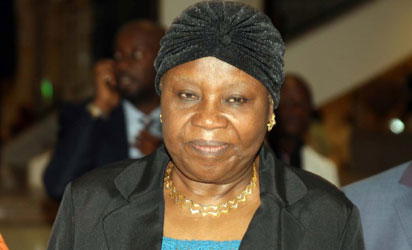
Justice Aloma Mariam Mukhtar
In this respect, the learned trial judge, after considering the claims of the plaintiff against the provisions of the Constitution in support of the claims and the defendants” opposition of the same, came to the Conclusion that the plaintiff was entitled to all the reliefs claimed and proceeded to grant them.
The 2nd, 3rd and 4th defendants/respondents, who were aggrieved with the judgment of the trial Federal High Court, immediately lodged their respective appeals against the judgment to the Court of Appeal Ilorin Division.
The notices of appeal however excluded the 1st defendant/respondent at the trial court from the list of parties in the appeals at the Court of Appeal. However, on the application by the 1st defendant/respondent, it was later joined in the appeals on the side of the respondents.
The appeals were heard by a panel of full court of five justices of the Court of Appeal having regard to the constitutional importance of the issues that arose for determination. In a split judgment of 4 to 1, delivered on 2 July 2010.
The court came to the conclusion that the trial Federal High Court lacked the jurisdiction to adjudicate upon the case of the plaintiff and held that the matter ought to have been taken to the High Court of Justice of Kwara State for hearing and determination having regard to the parties and the subject matter of the case.
In the same judgment however, the Court of Appeal proceeded to hear the matter on the merit and came to the decision that the trial Federal High Court was right in its decision on the merit, of the claims of the plaintiff and consequently affirmed the decision of the trial court.
It is glaringly clear from the record of this appeal that all the parties at the Court of Appeal, except the Hon. Attorney-General of the. Federation, were not happy with the judgment of the court and therefore decided to appeal and cross-appeal to this court against party, of the judgment that the parties were not satisfied with.
While the plaintiff at the trial court and the defendant/respondent in that court the National Judicial Council who were the respondents at the Court of Appeal were not pleased with the decision of the Court of Appeal on the issue of jurisdiction of the Federal High Court to entertain and determine the case of the plaintiff the 3rd and 4th defendants/respondents at the trial court, who were appellants at the Court of
Appeal decided to challenge the decision of the Conn of Appeal in deciding to hear and determine the matter on the merit in spite of its decision that the Federal High Court lacked jurisdiction to deal with the, matter and therefore filed their respective cross-appeals against that part of the decision of the Court of Appeal.
The Attorney-General of the Federation who was on the side of the appellants at the Court of Appeal has neither filed an appeal nor a cross-appeal, as the cross-appeal earlier filed on his behalf was later withdrawn and struck out before the appeals and the cross-appeals proceeded to hearing in this court.
Taking into consideration the position of the parties at the trial court, the Court of Appeal and in this court where both appellants/cross-respondents and the respondent/cross-appellants chose to pursue their respective cases separately. I have decided to list the parties in this single appeal number SC. 281/201 as follows:
“1. Hon. Justice Raliat Elelu-Habeeb – 1st appellant/cross-respondent
2. National Judicial Council – 2nd appellant/cross-respondent and 1. The Hon. Attorney-General of the Federation -1 st respondent
2. The Hon. Attorney-General of Kwara State – 2nd respondent/cross-appellant
3. The House of Assembly of Kwara State – 3rd respondent/ cross-appellant.”
Henceforth, in this judgment, the parties shall be referred to according to their respective designations specified above. In the present case, there is no doubt whatsoever that the dispute that was brought before the trial Federal High Court in the originating summons that was filed before it involves the subject of provisions dealing with the procedure made in the Constitution of the Federal Republic of Nigeria 1999 for taking disciplinary action against a Chief Judge of a State found wanting in the discharge of his functions to warrant his removal from office.
It is therefore necessary in mv view to examine all the relevant provisions contained in the Constitution governing, the procedure for the appointment and removal of Judicial officers. This is because while a constitutional power should not be used to attain an unconstitutional result the language of the Constitution were clear and unambiguous must be given its plain and evident meaning.
Disclaimer
Comments expressed here do not reflect the opinions of Vanguard newspapers or any employee thereof.