
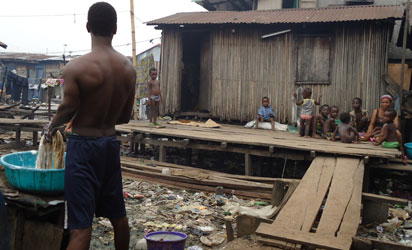
An abode in Lagos
Dele Sobowale
Inaugural lectures are seldom worth the paper on which they are printed. But, last year at Leads University, Ibadan, one lecture caught my attention which was worth more than the weight of the paper on which it was printed in gold. It was the 3rd Inaugural Lecture,delivered by Professor Chibuzo N Nwoke, who I have never had the privilege of meeting.
However, you can see into a man’s soul through what he writes. Professor Nwoke writes with passion about a subject dear to all of us in Nigeria today. Please read on.
This is the first in the series; it won’t be the last. Rest assured.
P.S. The address has been heavily edited on account of space. Those wanting the full text should get in touch. Rich Land; Poor People: The Political Economy of Mineral Resource Endowment in a Peripheral Capitalist State
Professor Chibuzo Nnate Nwoke, Dept. of Politics and International Relations, Faculty of Social Sciences and Entrepreneurial Studies, Lead City University, Ibadan
I. Introduction
I stand before you this afternoon, in all humility and with deep gratitude to God Almighty, to deliver the 3rd Inaugural Lecture of Lead City University.
Mr. Vice-Chancellor, Sir, for most of my mature academic life, I have been concerned with, and interested in the possibility for a poor, underdeveloped country to be transformed to a rich and advanced industrialised state using its God-given endowments of natural resources.
Indeed, in the early 1950s, most mainstream development economists had suggested that resource abundance would help the ‘backward states’, which were thought to suffer from imbalances in the factors of production, because, while most of them had surpluses of labour, they experienced shortages of investible capital. In other words, according to mainstream economists, it would be easy for states with abundant natural resources to overcome their capital short-falls by exporting primary commodities and by attracting foreign investors.
According to this scenario, the governments of ‘backwar’ states would also find it easier to collect revenues and hence provide public goods.
In the field of International Relations, the ownership and control of natural resources has, for long also been recognised as a very important asset of power and influence in the international system.
My own thinking on the natural resource issue is radically different from, and opposed to the mainstream capital shortage, or Resource Curse thesis. I confess that my thinking has been influenced by several radical/progressive scholarship on the Third World’s raw materials issue, which exposed me to, and shaped my understanding of the peripheralised role of Third World raw materials suppliers in the international capitalist division of labour.
In that respect, I need to recall here some of the great scholarship which influenced me, including works by Michael Tanzer, Norman Girvan, Pierre Jalee, Zukhayr Mikdashi, Kwame Nkrumah, V. I. Lenin, Samir Amin, Immanuel Wallerstern, Gregg Lanning and Marti Mueller, Walter Rodney, Harry Magdoff, Bade Onimode, Claude Ake, Paul Baran, Samuel Ochola, Andre Gunder-Frank etc.
As a graduate student in the Graduate School of International Studies, University of Denver, the works of those scholars were part of my daily companion.
Ladies and gentlemen, from Kwame Nkrumah’s work on Neo-colonialism: The Last Stage of Imperialism, I have a favourite quotation for understanding Africa’s resource endowments problems, not as a curse, but properly, in the context of the organisation and functioning of the world capitalist economic system and the specific role forcefully assigned to Africa in that system as a supplier of raw materials.
Visit: www.delesobowale.com
Disclaimer
Comments expressed here do not reflect the opinions of Vanguard newspapers or any employee thereof.