
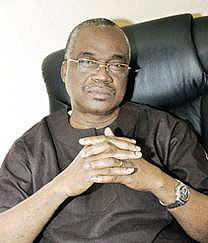
*Awa Kalu, SAN
By Awa Kalu, SAN
MANY lawyers and non lawyers alike are presently glued to their TVs on a daily basis, watching the celebrity trial of Oscar Pistorius unfold. Of course, Oscar Pistorius is a sports Icon, an Olympian better known as the Blade runner. He is a double amputee known all over the world for the extraordinary efforts he has made to live in comfort with an uncomfortable disability.

Oscar Pistorius
Elsewhere, and this includes Nigeria, Oscar Pistorius would be walking the streets living on sympathy-begging for alms-or in more organized places, depending on social security.
In Oscar Pistorius’ case, he is a global superstar who was able to build a healthy and loving relationship with a model and TV star. As an athlete living with disability, Oscar raced and competed against persons who had no physical challenges.
Physical challenges
He won the heart of a lady but unfortunately, the story changed on valentine’s day last year when Oscar pulled his pistol and shot dead the deceased, Reva Steenkamp and is presently on trial for pre-meditated murder. It is difficult to classify the trial as entertainment but there is no doubt that its public appeal is enormous particularly, having regard to the many lessons it offers.
When a public figure is put on trial for an alleged offence, it puts a mirror on the society in which the trial takes place. An innocent bystander is offered a distant view of the moral values of the system, the ability of the society to eliminate criminality is examined and even the political will to place heroes and the high and mighty on trial is weighted.
At the end of the day, even-handedness in criminal justice administration is seen as a triumph for law and order and serves as a manifestation of the supremacy of law as opposed to impunity.
We had to remind ourselves that one major lesson from what we have seen so far from Oscar Pistorius’ trial is that the justice delivery system in South Africa is sophisticated and designed to work in a transparent way.
Of course, it cannot be error free and seeing that it is a trial in the full glare of Television Cameras, there may in the end be a miscarriage of justice. Trial by press has many opponents but is in several places viewed as a victory in the quest for an open society.
For those who have not had the opportunity to watch or to follow the trial, the story line is simple. The accused person, Oscar Pistorius, as has already been said, is standing trial on a charge of murder. He is also being tried for discharging firearms in a public place and unlawful possession of ammunition.
What strikes one as superb for the rule of law is the fact that the offence of murder with which the accused is charged was committed early last year, his trial commenced and is going on from day to day, the Judge has been present each day as well as the prosecuting and defence counsel. Speed in the administration of justice is in the end for the ultimate good of society and the aphorism ‘justice delayed is justice denied’ is still a maxim.
All the witnesses have appeared as and when required- on Shenanigans, no contrived reasons for an adjournment no power failure, no equipment failure and no suborned witness, at least so far. The prosecution has alleged through its witnesses that the accused shot his girlfriend with intent to kill her and nothing less.
On the other hand, the accused admits that he shot the deceased in the mistaken belief that she was an intruder. The prosecution as of date has called witnesses who heard screams from the accused person’s residence in the early hours of 14th February, 2013, the date the offence was allegedly committed.
Criminal justice delivery
Those witnesses have been categorized as ‘ear witnesses’, several forensic experts have been fielded and both their evidence-in-chief and cross-examination have underpinned one’s earlier observation that the criminal justice delivery system in South Africa is undoubtedly sophisticated and what one finds most heartwarming is that almost all of them are serving Policemen.
The blood spatter analyst, the ballistics experts, the photographers and indeed the telephone and communication experts have demonstrated that criminals should no longer have any hiding place. For example, Oscar Pistorius was tested on firearms (Gun) protocol before he purchased his gun.
He was fit and demonstrated a commendable understanding of when and when not to use a gun. The relevant question is whether in our dear country, a firearms dealer, licensed or unlicensed, would have honestly administered a questionnaire on gun protocol on an illustrious customer such as Oscar Pistorius.
Integrity of the evaluation
Far more interesting is whether the dealer would have kept the record of that test and then be willing or able to testify about it in open court. In our environment, would we be in a position to rule out the possibility that the integrity of the evaluation report has not been interfered with for the purpose of favouring one party or the other in the trial?
Still on the ballistics part of the trial, the Television audience’s response to the skill and dexterity exhibited by a Captain Chris Mangena who testified for the prosecution was outstanding. My recollection is that Captain Mangena is at the moment the only black witness who has so far testified in this trial.
However, in the African context, the Judge as well as one of the Assessors and the Interpreter are all black persons and in a multicultural society such as South Africa, there is a lot to be said about trust and fairness in their criminal justice administration system. If you reverse the position in our country, you will find eyebrows raised when the Judge and a celebrity accused are from different ethnic groups.
Eye brows are also raised when they are from the same ethnic group. Above all, what we find instructive in Captain Mangena’s performance is that ability does not depend on the colour of your skin but may be honed by capacity building, hardwork and dedication. Captain Mangena was not at the crime scene when the offence was committed nor was he called when the scene was still fresh.
Nevertheless, he so capably reconstructed the crime scene in such a way as to give anyone interested in the matter a commendable impression of how the crime was committed.
His reconstruction does not lead to fanciful possibilities but leads to probabilities which may point to what probably would have been the last moments of the deceased.
His testimony creates the distinct impression that the deceased ran into the toilet out of fear and was standing behind the toilet door, and so was hit by shots from the accused person’s gun fired through the door.
Interesting trial
The trial is interesting in that notwithstanding the fact that there are no eyewitnesses, the prosecution is doing its best to adduce circumstantial and character evidence that tend to show that the prosecution is not entirely wrong in its belief that the offence was committed with a guilty mind.
However, from a professional piont of view, it does not appear that at this moment, the evidence so far led points to the guilt of the accused with the accuracy of mathematics. This view is only tentative in that the trial is on-going. In the next installment, an attempt will be made to point out the similarities between the proceedings in Oscar’s trial and what would have been, had he been arraigned in a Nigerian Court.
Disclaimer
Comments expressed here do not reflect the opinions of Vanguard newspapers or any employee thereof.