
By Louis Odion
THE debate stirred by Nigeria’s centenary is not about to end. Amid the week-long commemorative dancing and feasting in Abuja penultimate week, it was clear the nation’s presence of mind was acutely impaired. The few rousing oratories at the Abuja garden would hardly temper the feelings of depression and anger nationwide. Public outrage over the callous murder of dozens of innocent Yobe students by Boko Haram insurgents was just as intense as the affray over the ‘pollution’ of the centenary’s honour list with some names considered unworthy.
Now, with the Abuja marque long deserted by revelers and freeloaders, questions are bound to be posed in the times ahead: exactly what central message was sent to Nigerians? Doubtless, Abuja drew some of the nation’s best and brightest that day. But also gathered there were some of the very demons and principalities whose sundry deeds of omission and commission account for the nation’s enduring paradox: hunger amid plenty.
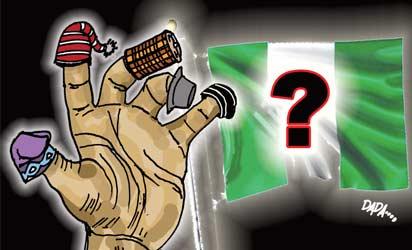
But, beyond those colourful costumes, the songs and dance, what would now be remembered the day after? Perhaps the most elementary lesson history teaches is the power of moment. It refers to that unusual convergence of opportunity and talent. The defining hour, that is. Nations lucky enough to be led by visionary leaders and were sober and skillful enough to leverage communal resource at such historic crossroads had always transited thereafter to greatness. France would, for instance, forever romanticize 1789; Britain 1066; post-Communist Russia 1991; Turkey 1483; America 1776; Turkey 1483…

So, when is Nigeria’s? Wither Nigeria in another century? Such weighty questions would again resonate on the side of the Atlantic in London penultimate Monday. The occasion was an investment round-table at the Institute of Directors (IOD) to mark the Commonwealth Day and Nigeria’s Centenary celebration. For Comrade Adams Oshiomhole, Edo State governor, it was an opportunity to share some bitter truths.
Before then, humour had momentarily swept through the high-ceilinged hall in the chilly London morning. On arrival at the venue in Central London, the former labour president, bedecked in an unusual suit and tie, was naturally the cynosure of delegates from Nigerians used to seeing him in khaki safari or casual shirt and trousers. One guy was heard saying: “This centenary wonder shall not end o, see Comrade in sharp suit!”
Earlier in the hotel room, close aides had teased that the Comrade came to London in his ‘Sunday’s best’ probably to impress the Queen. Ever a humour bag himself, Oshiomhole attempted to explain the sartorial aberration away: “At the freezing level of today, you cannot call the British weather a comrade. Unfortunately, there is no room for people like us to protest this dictatorship of nature. Otherwise, if you go out in ordinary shirt and trousers, people are likely to mistake you for someone trying to commit suicide.”
After the moderator’s opening remarks, the tone for the conversation was set by Nigeria’s former head of state, General Yakubu Gowon. Predictably, the Nigeria’s war-time commander-in-chief, now better known as the prayer-warrior-in-chief, harped on unity as a critical resource for national growth and development. Perhaps, his most memorable line was: “Whatever is wrong, whatever is negative with 1914, it is now the duty of all Nigerians today to make it positive and better.”
Also on hand to market Nigeria today were Governors Emmanuel Uduaghan of Delta State and Isa Yuguda of Bauchi State, as well as representatives of the governors of Osun and Plateau States. Uduaghan imagined “Delta Beyond Oil”. Yuguda unveiled the fortune awaiting tourists at Yankari Games Reserve. Once invited to speak on a presentation made by Nigeria’s Minister of Power, Prof Chinedu Nebo, the usually frank Edo governor did not disappoint.
“I think we have done enough talking back at home,” Governor Oshiomhole began. “Talk is cheap. Let us abandon rhetoric and start action now. I share Professor Nebo’s optimism that Nigeria is world’s next economic miracle waiting to happen. For me, the good news is that there is greater awareness among the political leadership today that there is no way we can become a truly great economy if we don’t do away with the culture of consumption without production.”
On why Edo offers investors more incentives, Oshiomhole revealed that his state is the custodian of vast gas deposit and equally vast fertile land stock to drive agro-allied industries. Just as the state was described as the nation’s true gateway, linking South-west with the South-south and North: “From Lagos, you can connect Benin in thirty minutes. From Abuja, you also get to Benin in less than forty minutes.”
To Uduaghan who had proudly declared that Delta was building a state-of-the-art seaport, Oshiomhole teased, “I am happy Delta is building a port. They are building it for Edo investors”, eliciting rapturous laughter from the audience. Oshiomhole ended by illustrating with the parable of an elephant on its knees: “With our abundant resources, Nigeria today is like an elephant on its knees that is struggling to get up. Once it manages to rise, it will shake the entire forest.”
With that, Oshiomhole no doubt speaks to Nigeria’s contemporary riddle: oil price stabilizing at a relatively high mark years on end would suggest rising national prosperity, yet the living condition of the majority of the people only confirms mounting poverty. Official growth statistics churned out in Abuja continue to proclaim rising tide. For 2012, we are told 6.3 percent economic growth was recorded. Our GDP would soar above 7 percent in 2013. They say foreign portfolio inflows continue to overtake foreign direct investment (FDI) with more than 76 percent share of capital inflows between January and June 2013.
But against the backcloth of these rosy figures, ordinary Nigerians are only left wondering why the stated rising tide has not lifted their individual economic boats.
Disclaimer
Comments expressed here do not reflect the opinions of Vanguard newspapers or any employee thereof.