
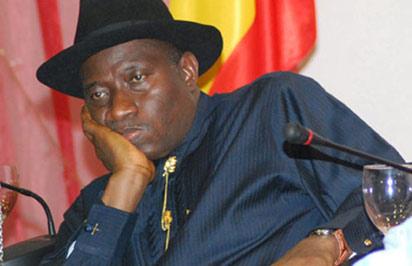
Jonathan
By Bisi Lawrence
President Ebele Jonathan is easily recognizable, by virtue of his surname, as a Christian. He is also apparently the church-going variety with an appreciably increasing frequency in his public appearance in churches over the past two years, or so.
That could be said to make him a Christian President, which could be open to more than one interpretation. But a Nigerian Christian President, if we may go the limit, clearly invites issues. Whereas, a Nigerian President, pure and simple as a title, submits itself to only one description and meaning. That is how most of us would like to see him.

His personality embodies all his attributes. His activities are related and, in some cases entwined, with aspects of these elements to varying extents, even when he makes overt efforts to isolate some of them, It is impossible for him, for instance, to be in church as just the president and not also as a politician if he gives vent to opinions. Unfortunately, he has been rather inclined, on occasions, to actually avoid divesting his presence in church from the aura of his attendance at a political rally. He is wilfully assisted by the clergy who are sometimes sent into rhapsodies in his company, much as they try to conceal it.
The presence of the Head of State or Government was officially accepted during the colonial days and even after Nigeria became a republic.
It was part of our heritage from our former British overlords whose reigning monarch is constitutionally, or traditionally, accepted as the head of the Anglican Church. The Empire Day or Commonwealth Day which we were made to celebrate as part of the Empire or Commonwealth at that time, preserved a place of prominence for the representative of the British Sovereign whom we pray for “long to reign over us.”
But even at that time, the church was still preserved in its dignity and with reverence as “the house of prayer”. The representative of the British government was only acknowledged with the honour of reading one, usually the first and only, lesson of the day from the Holy Book.
However, President Jonathan is permitted —probably even urged —to “say a few words” which usually lean heavily on the state of the nation. The content is, of course nationalistic, from a politician’s point of view, soaked in the aroma of a political party’s flavour and spurred on by the unexpressed but patent appeal of a prospective candidate for the presidency.
Go ahead and try to prove me wrong and I will remind you of snide remarks about “letters” that should not have been written as they were decried from the lectern, or was it the pulpit? In fact, once could sometimes confuse the rostrum with the lectern these days. A halt should be called to these proceedings which may soon turn the House of God into a political theatre restricted, for the nonce, to the President. But then the club may soon grow larger.
For instance, the practice was earlier within the Pentecostal circuit. In fact, it was published that Cardinal Okogie, before his retirement, would not be drawn into the pastime of creating a space for political involvement in his duties when he characteristically, but politely, declined to hold a special prayer for President Jonathan. Now Okogie’s successor has joined the procession of worshippers with the President — “with” we said, not “of”; at least, not as of now.
The Muslims are just watching, at the moment. They look at the show of their President totally aligning himself, so to say, with other people of another faith. It could not be better, or worse, than the recognition of one religion to the denial of the other as it was in the colonial days. But they say nothing with regard to this faux pas, for the moment. It should be moderated now.
The Constitution does indeed allow for freedom of worship for you and for me. It indeed allows for Dr. Goodluck Ebele Jonathan also, as an ordinary citizen. But President Goodluck Ebele Jonathan ceases to be an ordinary citizen when he rises and delivers a speech as the President — when he is permitted to do so in church.
highjacked conference
Echoes: “ (07068715122). That dialogue between Sardauna and Zik may be fictional considering that at 1920 Zik was 16 years of age, and Sardauna was probably was about ten years of age. “ (Reported here last week.)
The dialogue was not fictional. But the date, as you rightly pointed out, was misleading. It must have been a typographical error in John Paden’s excellent book on the Sardauna’s life and times.
In fact, the quoted reference to “understanding our differences” should have been the foundation of the National Conference taking off on Monday. To most of the people who considered the proposal to be no more than a massive distraction (among whom I was one – and still am) what was perhaps the most off-putting of the ludicrous aspects was the “no-go” area of the nation’s unity.
What else could be the worth of such a conference if it could not touch on the bonds that are supposed to tie us together? What, in the first place, are these bonds? Could one of them be the fact that a man who probably could not tell a Nupe man from an Ijaw decreed that everyone should be called a “Nigerian”, over a hundred years ago?
If there is anything of worth that we have learnt about one another during the century it could be nothing more than how we differ from one ethnic group to another. The more we have known of ourselves and resources, the more we have been made to critically valuate our relationships with one another; and the more our various areas of diversity have become highlighted as the functions of the deprivations incurred through the circumstances of our past association. We have to be able to decide whether or not to continue to bear such disadvantages, or how to make the sacrifices necessary to accommodate them – either by trading them for benefits that might proceed from the relationship in one form or another, or by any other means.
But these issues are already soaked with emotional considerations of an ethnic tincture and selfish passions. It would all have a chance of coming out right in the end, all the same, if we had, as a people, developed a sense—say nothing about a culture —of listening to the other man’s point of view. We have all seen into what abysmal depths our common parliamentary debates have consistently been plunged by the outbreak of open violence. If only for that glaring limitation of our ability to sustain a discussion, not even a conference, we should have recognized that we are on a futile mission. We are yet to learn how to understand our differences enough to discuss them.
The importance of the actualization of whatever is achievable by way of decisions at the conference continues to be worrisome. Is it the parliamentarians who will have the final say, or would it be a referendum to be conducted all over the country? Or will that be part of the decisions at the end of the conference?
I wish this Conference well, with all my heart. I hope I am proved wrong in my pessimistic views. A shining light at the end of the tunnel already shows that the delegates have made up their minds that no one is going to tie their hands behind their backs when it comes to the areas they may or may not trample on. In fact, there may be a certain group that would insist on re-examining the basis of the country’s unity itself. How upsetting that would be for those who convened the confab, and thought the journey was going to be conducted gently down the garden path!
It is going to be an exciting week ahead, even more than we have envisaged if the conference is highjacked!
Time out.
Disclaimer
Comments expressed here do not reflect the opinions of Vanguard newspapers or any employee thereof.