
By Prince Osuagwu
MAJORITY of Nigerian telecom subscribers at the 10th year anniversary of the NCC organised Consumer Parliament, at the weekend, in Lagos, seemed to have agreed with the position of Nigerian Communications Commission, NCC on the N647million penalty it imposed on three operators over poor telecom services.
This was explained in the consistent voice vote and rousing ovation participants at the event gave to Etisalat Nigeria which was not part of those penalized, as against boos on others.
Although the fine has been paid by the operators, the debate on who should keep the money is far from over.

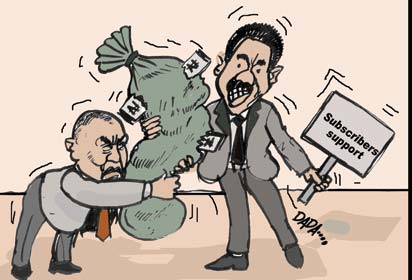
While the NCC maintains that paying the money into government coffers will eat into the returns operators are supposed to make to their shareholders and thereby propel them to step up their service offerings, a group that claims to demand the rights of the subscribers, the National Association of Telecom Subscribers, NATCOMS, believes that the subscribers are better suited with the money.
However, the subscribers seem to be sailing more on the NCC ship, claiming they needed no money but good services. At the event, they had overwhelmingly expressed their frustrations with thunderous boos when representatives of other operators were introduced and a heralding ovation, apparently to show appreciation, as Etisalat’s representative was introduced.
Although, a few high profile subscribers expressed disgust at the embarrassment of the operators, saying that some of these operators that are being booed still hold the pillar of telecom success in Nigeria.
One of them, who introduced himself as Raymond Ndulue, added that “there is no doubt that the services of some of these guys have dipped, but should any of them, for instance, MTN plug off its services today, Nigeria would go back to the telecom dark days. We must weigh our actions at all times. I don’t agree with this method some participants are adopting to express their frustrations. It will make Etisalat feel infallible, but we know it is not”
Another eye-popping irony at the event was the number of subscribers who claimed little or no knowledge of the National Association of Telecom subscribers, NATCOMS, a supposedly umbrella body of Nigerian telecom subscribers.
Subscribers interviewed by select ICT journalists after the event denied that NATCOMS activities were mandated by the subscribers, querying where and when meetings mandating actions of the association executives were held.
At the wake of imposition of the penalty and subsequent payment by the operators, NATCOMS had engaged the NCC on why proceed of the penalty should accrue to the government instead of the subscribers who lost money, precious time and comfort with the poor telecom services they were fed with.
The association’s national president Chief Deolu Ogunbanjo suggested that rather than imposing fines on operators and giving the money to government, the NCC should compel the operators to pay each subscriber on their networks, the sum of N10, 000each.
Pursuant to that argument, NATCOMS, on March 3rd 2014, filed an order of interlocutory injunction against the NCC at the Federal High Court in Lagos, restraining it and its agents, privies, assigns including but not limited to its directors and officers, or any other persons or group of persons deriving authority through them from acting or purporting to act on the operators on the account of poor quality service, pending the final determination of the substantive suit.
But at the parliament, weekend, subscribers said Ogubanjo was on his own. A subscriber, Mrs Iyabo Morakinyo stated that “we do not want money, what we want is good services. We do not even want free airtime which will invariably congest the network and thereby become useless to us. If NCC’s fine will keep these operators on their toes, why not? NCC should do it constantly. Wherever the fine money goes is immaterial. I did not send anybody to pursue compensation for me”
But it was a visibly enraged subscriber, Anthony Edirin who raised so many posers: “I have read a lot about this association said to be fighting our cause. Who are supposed to be the members of this association; is it not supposed to be me and you; are you a member? Does any of your family members, belong to this group? Does one assume to speak for people he does not legally have their mandate?
Have you attended any general meeting of this association where subscribers outline what they want and mandate the association to pursue it? That is the way of associations and not otherwise.
“Is it honourable for three people to come together and begin to answer association that speaks for over 120 million people? What benefit has any subscriber got from the events NATCOMS use their names to scoop funds from the sector?
By the way, how old is this association? Have they ever conducted elections?
Why should only one person be president for life? Even in NLC, we see elections and how power changes hands, why can’t this association take that step?
My brother, time has come when we seized being docile and gullible, allowing people to use us for their selfish gains”.he added
Also, in a recent interview, Telecoms lawyer and Senior Advocate of Nigeria, Paul Usoro, had advised industry practitioners to commend the regulatory role, of NCC rather than criticising it. Usoro had advocated for progressive ideas to move the industry rather than distractions that would undermine growth.
According to him, “NCC has powers to make regulations on any matter for which the National Communications Act, NCA 2003 makes express provision, and such other matters as are necessary for giving full effect to the provisions of the Act.
“In pursuant to these powers, the NCC has over time, made several regulations, including enforcement regulations. It is in these regulations that one finds the penalties for breaches of quality of service standards,”
Hi-Tech checks also reveal that in other emerging markets, similar fines which proceeds do not go to the subscribers also happen. In February 2013, Brazil’s telecom regulator, Anatel, levied a fine of U.S.$17.4 million (R$34.265 million) on the national telecom operator Oi because of poor service quality. Oi was said to have breached twelve indicators specified in the country’s mobile service quality regulations, which were enacted in 2010.
Also, India’s telecom regulator, TRAI imposed fines totalling about Rs 5 crore in 2013 on operators for poor services and on telemarketers for pesky calls.
The regulator disconnected 9 lakh numbers and blacklisted over 1.74 lakh unregistered individuals for making pesky calls and SMSes during the year.
It also imposed what it called “Rs 2.8 crore financial disincentive” across all telecom operators for failing to meet quality of services benchmark in 2013.
All of these fines were recorded to have accrued to the governments.
Disclaimer
Comments expressed here do not reflect the opinions of Vanguard newspapers or any employee thereof.