
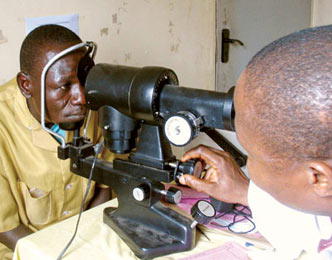
*A driver under going an eye test
An experienced ophthalmic surgeon, and Chief Medical Director, Eye Foundation Hospital, Lagos, Dr. Adekunle Hassan, speaks to SOLA OGUNDIPE on the Eye Restoration Intervention Scheme, EYERIS, an initiative of the MTN Foundation to reach an estimated 33,364 underprivileged Nigerians. Excerpts:
WHat is special about us is that we operate a social enterprise system whereby we use the private sector to pay for the public sector. We did so much work in Lagos State that the then Governor gave us a place in Sobo Arobiodu where we still have the facility to cater for patients who ordinarily cannot afford to pay for the service. They pay as low as N1000 and we perform cataract surgery for as low as N15,000.
The place has been running for long. We also looked at our entire operation and realized that 40 percent of our patients are from Benin, Akure, Abeokuta and Ibadan, we decided that we needed to train not only with private patients in private establishments but also with public patients in public establishments.
Partnership with the MTN Foundation: It all began in 2013 when we signed a Memorandum of Understanding with MTNF.

*A driver under going an eye test
In the first phase, we were to do 12,000 surgeries and we started in Ogun State. The project team visited those areas, assessed the need and furnished us with the data. In Osun state, about 1,000 people benefited from it, and we moved to Minna in Niger State where about 1,450 people benefited. We were even accused of having been paid N80,000 per patient because for cataract surgery you spend nothing less than N80,000.
We had to convince them that no one paid us a dime for what we were doing because we were giving our services free with support from the MTN Foundation who paid for the consumables. We also explained that the free glasses being given are also as a result of the collaboration between us and MTN Foundation for the benefit of the people. From there we moved to Delta State and ended up doing about 1,000 surgeries.
Eye care: A country with a good comprehensive health system must have eye care system. These days, we talk of the eye health system as part of the whole health system. The eye care system is usually specialized and it is made up of teams. Within the team, we have the Eye doctor who is the Ophthalmologist.
The Ophthalmologist is a doctor who is specialized, after being a medical doctor, in carrying out corrective surgeries on the eye. It takes between five to seven years to specialize and become an Eye Doctor. When you become an Ophthalmologist, it means you can operate on the eye, you can treat medically and you can give glasses. Next are the Optometrists.
They prescribe glasses and basic things like that but they work with the Ophthalmologists as a team. Next to them are the ophthalmic nurses. These are registered nurses who have decided to go and do ophthalmic nursing. After them, we have the middle manpower level, the ophthalmic technicians, community ophthalmic technicians and different people at those levels that contribute to the system.
Ideally within that team, you have the primary eye care where from childhood, children are tested and their eyes checked. When we were growing up before you begin primary school, we had our eyes tested, even in secondary school and before you attend the university, you had your eye tested as part of your medical checkup so they can detect any eye defect. A lot of children don’t see far, so you can correct their defect to enable them see and some don’t see near and it also has to be corrected. You see children seating at the back of the classroom or they put them near the door. This team is all meant to take care of the eye health system.
Awareness campaign
We went to Abia State where we were supposed to do 2,000 surgeries, we ended up doing 2,010. The Governor and his wife were present. We were given maximum cooperation. In Sokoto we carried out about 1,000 surgeries. In Jigawa, the story was the same. Doctors came in from Kano State, we carried out over 2,500. Some of their doctors came and learned from our doctors and we in turn picked something from them, like the best ways to mobilize in some areas and so on. It is a synergy and everybody is important.
Before, people thought it was not possible to do what we are doing and have achieved so far. But when you deliver, people will begin to recognize you and what you can offer. We in the private sector don’t need more that 2,000 cataract surgeries to survive. A cataract surgery of N15,000 is done for N350,000 with high-tech, so you see, there is a big difference but the minimum people need so they can see is what we are trying to put out there. Everybody has a right to what they can afford and that is the basic principle.
Cost of surgery
It has to do with the technology applied and the material. The lenses we use in the eyes range from $2 to $1,000, the material we use for surgery varies from $2-$300 and then the machine. We do manual surgery but advanced cataract surgery is done with laser and the machine go for between $80,000 to $170,000. This however doesn’t mean that people still can’t have safe surgery. It is what you can afford and what is out there but at the end of the day, everybody is happy.
Preventable blindness: There are many causes of blindness but the commonest cause is cataract. It is due to the ultra-violet rays of the sun but the cataract backlog is more in the Northern part in the sense that, the availability of Ophthalmologists in the Northern part is not as much as we have in the Southern part. Awareness is more in the South than in the North and also the attitude and understanding of what is happening.
The other one is glaucoma. This one is a silent thief because you don’t have pain or any signs and the pressure inside the eye is high, and when the pressure inside the eye is high, it is higher than the pressure of the blood vessels carrying nutrients to the nerve, it stops the flow of blood and because the pressure goes up and down twice a day, it might just be two hours a day that you get to that critical level, it damages the nerves.
Cataract in childhood: Cataract at childhood is very common but requires more attention and more sophisticated surgery. We don’t operate on one child alone. We usually group all the children together, take them to our Ijebu hospital branch where we have the high technology to do the surgery.
Our success rate for cataract surgery is between 98 – 100 percent. We do have complications but we manage those complications, those are basic. The advantage of these surgeries is that the doctors themselves that are doing the surgeries are not doing the patients any favours, they are also learning and having knowledge transfer. The patient is getting his vision back, the doctor is getting better skilled at his job and MTN Foundation is meeting its objectives to enrich lives of people in communities it operates in.
Primary healthcare
Even with the EYERIS project, we have the complete record of the beneficiaries even up to photo identification so that we can properly analyze the distribution and the various local government areas from where they come from. We are looking at the eye system. The eye health care system can be part of the primary health care system, and the primary eye care can be grafted around the primary healthcare. They can have vision centers in the entire primary healthcare centers.
Success story: It has been phenomenal. I got calls from friends in the UK and the US. Our staff in IT posted some of the photographs on Facebook and people were seeing them and calling me, asking what we were doing in Sokoto and Jigawa where they said people were being killed. I answered that infact, the people were very nice to us, gave us presents and even took us out to lunch. Because of this, a gynecologist friend of mine from the East who comes home once in a year from the UK, asked me if we could do something together on eye care.
Disclaimer
Comments expressed here do not reflect the opinions of Vanguard newspapers or any employee thereof.