
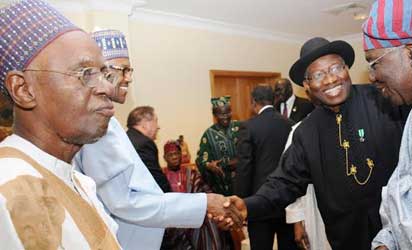
From Left: Former President, Alhaji Shehu Shagari; former Head of State, Gen. Muhammadu Buhari; President Goodluck Jonathan and former Head of Interim National Government, Chief Ernest Shonekan, at the Centenary Dinner and Awards in Abuja on Friday (28/2/14). NAN
By Rotimi Fasan
ACTIVITIES marking Nigeria’s centenary climaxed a fortnight ago with an elaborate award ceremony in the country’s capital, Abuja. This was to honour Nigerians from diverse fields for what we were made to understand was their contribution to the development of the country.
The long list of honourees, parading a crowd of past office holders, politicians and a sprinkling of iconic names from the different ethnic groups, was as undistinguished as it could possibly be.
This is not in any way surprising. Nigerian national awards have over the years consistently lost both emotional and sentimental capital. They are worth less than the dull-looking, counterfeit-like medals that are thrown round the necks of winners. The easiest route for winning any of the awards is through politics.
The quality of contribution does not matter. What counts is the simple distinction that a winner should have held public office, appointed or elected. Thus, we see so many Nigerian politicians and retired military officers today with all kinds of initials after their names indicative of their membership of the league of national award winners.
The situation has become so obscene that current office holders don’t wait to leave office before conferring national awards on themselves or their cronies. Nigerian national awards are now two for a kobo and any one who desperately wants it can get it.
It is therefore understandable when some Nigerians, usually those who have truly distinguished themselves, feel slighted when lumped in the same award boat with persons of no meaningful achievement, corporate or personal. Others chafe at being honoured in one of the lower categories when a confirmed upstart goes home with one of the most prestigious.
To be an award winner, you need do no more than make the acquaintanceship of someone in government. Of course, it may seem arrogant for a person to reject their award on the logic that they deserve better than another.
But modesty does not necessarily dull a person’s sense of relative accomplishment and self-worth. In local parlance, man know him level. But this is not the case for those who draw up the list of our national award winners. It is, for them, an all-comers affair in which the race, of necessity, doesn’t go to the fastest. The important thing is to be a politician (in agbada or camouflage) or a friend or relation of one.
In announcing winners of our so-called centenary award, one would have expected more careful and painstaking effort in selection. This was not to be, however. Rather what Nigerians were confronted by was a list that looked so equally routine and repetitive that it could have been a copy from a previous year.
Truly this was a centenary award, and it should cover or tell the history of the country in terms of the individuals that epitomized it in the last hundred years. In other words, it should be both retrospective and prospective in its mode of recognition. It should, on the one hand recall, in the words of our national anthem, the labours of ‘our heroes past’ while casting a look in the direction of those who would shape the history of the country’s future.
But in the thinking of Abuja, the centenary award was one way to proclaim a version of the ‘no winner, no vanquished’ philosophy of a bygone era. It was an opportunity to open the door to all, especially past office holders, in spite of their contribution to the destruction of the country and what should be our cherished value system.
One could take issues with more than a few of the names on the list of awardees. But the case of Sani Abacha should make my point clear. And this is not because it is the worst. It simply serves to explain what joke we make of ourselves in the eyes of the world. Both for his human rights record and plunder of the national treasury, Abacha was one ruler many Nigerians would not be eager to remember.
As a person, Abacha might have been very good to some people, not the least his family who most benefitted from his despotic rule. His kleptomania has yet no name in our national lexicon and, perhaps, no comparison. It was too crude to bear description. But it was also for the benefit, mostly, of his family and close friends and others who saw in the opening, the overall boss’s corruption created for them an opportunity to feather their own nests.
Abacha could have been a great husband, father and family man I repeat. But as a Nigerian ruler he was simply bad news, a nightmare hundred of millions of Nigerians would be happy not to remember. Fifteen years since he died, the Nigerian state is still at war with his family trying, through legal means, to recover billions of dollars he had stashed away in foreign accounts.
He simply had no place in the class of Nigerians that should be honoured for their contribution to the motherland. Except we understand that contribution in the same sense in which media houses honour, as ‘man of the year’, the person who for ‘good or ill’ most impacted on the polity.
The shameful aspect of Abacha’s inclusion in that list of national awardees and which is an indictment of President Jonathan and his so-called fight against corruption is that Abacha’s butchery of the treasury is still being exposed around the world by foreign governments at a time when Abuja under Jonathan is busy handing him a posthumous award of honour.
If the likes of Wole Soyinka and the Fawehinmi and Fela families rejected their awards, finding the company of some awardees too embarrassing to keep or simply couldn’t see what there is to celebrate at a time when terrorists have all but taken over control of a large part of the country- whatever are the reservations of these and other Nigerians about the honour done known destroyers of the Nigerian state, they should hold nobody responsible but Goodluck Jonathan.
He it is who sees the centenary celebration as an avenue to play 2015 politics by seeking to rehabilitate outcasts of the Nigerian story.
In his bid to see no evil or hear any, Goodluck Jonathan does not mind dining with the devil. His ambition to continue in office is driving him in dangerous directions at a time when his hold on power appears more tenuous than ever. While terrorists make Nigeria ungovernable, destroying young lives and decimating towns and villages, the President responds with rhetoric of future victory.
The oil-producing country he rules over was grounded by scarcity of fuel, a tale of corruption, that is diverting attention from ongoing investigations of kerosene and petroleum scams by the NNPC. But Jonathan must get his second term!
Disclaimer
Comments expressed here do not reflect the opinions of Vanguard newspapers or any employee thereof.