
By Wale Akinola
It is not in the character of Nigerians to have confidence in government. The reason is not far-fetched. Successive governments – at all tiers – over the years failed them. Lack of infrastructure and poor service delivery were the order of the day. So, when at the outset of the 3i’s initiative, designed by the Mimiko government of Ondo State to get the people to participate in the process of deciding the project that was close to their heart for implementation, Community Change Agents were sent to Oyin in Akoko North West LGA, the people simply sent them away.

To them, they had had enough from government fond of making promises on infrastructural facilities without delivering on them. It took the intervention of the Permanent Secretary in the State Ministry of Community Development and Cooperative Services, Mrs. Olufunmilayo Osudolire, to persuade the Oyin Oba-in-council to get the 3i’s process started with the return of the Change Agents to the community. In the process, town hall topped the list of the needs of the people.
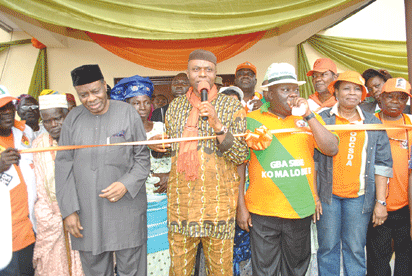
The Mimiko administration delivered the project in two months. The people could not believe their eyes. At the commissioning of the town hall, the paramount ruler of Oyin acknowledged the new dawn. He told Governor Olusegun Mimiko that the reason his people sent away the Community Change Agents when they first came to the community was because they had lost confidence in government which made promises in the past but failed to deliver. The town hall in place within two months changed their pessimism about government.
It is all the state administration needed to restore confidence in government. The Oyin story is just a tip of the iceberg of the participatory governance that is sweeping through Ondo State, thanks to the Mimiko administration. Tagged the 3i’s, the concept emphasises Infrastructure, Institution and Industry. According to the Ondo State Commissioner for Community Development and Cooperative Services, Engr. Clement Faboyede, whose ministry is driving the programme, 3i’s is unique in the sense that it is participatory in terms of the design at the community level.
Catalyst
“It is a clearly defined and designed bottom-up and top-bottom support programme paradigm.
We designed it because of our belief that, ultimately, the development of our state is in the hands of our people with government being the catalyst”, Faboyede told Sunday Vanguard. Indeed, the programme is aggressively transforming rural communities in Ondo State with the people deciding the projects that come to them. The projects are executed under the Infrastructure plank of the 3i’s.
The reason to get the people to decide the project of their choice is simple. They know their most pressing needs as against the former paradigm that entailed government-imposed projects. Under the new regime, the projects are democratically decided. The programme starts when the Community Service Centre is determined based on accessibility by adjoining communities. This is followed by the deployment of Community Change Agents.
Faboyede described the Change Agents as “young graduates, high fliers who have been trained on how to fraternise with all strata of society”. They spend some time in the community, help the people to establish their most pressing needs and prioritise them. Government executes the project on top of the list within two months of the decision taken democratically by the community. Several months after Owode-Owena in Ifedore LGA got a secondary school built for them under the Infrastructure strand of the 3i’s christened, Quick Win, because of the fast nature of delivery, the community is still celebrating.
Rape and kidnapping
The celebration is understood against he backdrop that the community previously sent its children to secondary school at Igbara-Oke, some seven kilometres away. A community leader told Sunday Vanguard that the children at that time faced many hazards on their way to school including rape and kidnapping. When the rape and kidnapping got to the peak, according to the state Commission for Community Development and Cooperative Services, government arranged a satellite school in Owode-Owena affiliated to the Igbara-Oke secondary school so that the community children could attend school close to their homes.
The arrangement did not quite work, forcing some graduate-indegenes to offer voluntary teaching service to the community children. A visit by Governor Mimiko to the community was all they needed for the satellite to assume the status of a full fledged school. Graduates who hitherto offered voluntary teaching service also got full employment. This is the story behind Owode-Owena Comprehensive High School which invariably became the pilot scheme of Quick Win.
Indeed, most of the projects have stories behind them. Igbara-Oke, also in Ifedore LGA, is a beneficiary of a High Court, this time under the Self Help project of 31’s. The community started the project but, unable to complete it, government completed it for them under the 3i’s scheme. No fewer than 64 communities in the LGA are beneficiaries of Quick Win projects with facilities including mono pump, solar powered borehole, basic health centre, motorable roads, classrooms and deep well there.
Striking feature
One striking feature of the Quick Win projects in Akoko area of the state is that what you have are mostly town halls. The town halls, completed with good finishings, have boreholes. Faboyede told Sunday Vanguard the story behind the town halls: “In the Akoko area – northern senatorial district – owning town halls is like competition because the people see them as vessels of interaction where development starts”.
In Owo LGA, there are Itialekeyi and Ehinogbe cassava industries demanded by the people because the communities produce garri from cassava grown in large quantities in the area. The story is different in the southern senatorial district of Ondo State – riverine area – where the communities mostly demanded basic health centres and got them. The state Commissioner for Information, Mr. Kayode Akinmade, linked the demand to the age-long neglect of the riverine area which deprived them of health facilities.
At the last count, no fewer than 661 Quick Win projects across the 18 LGAs of the state have been completed. After putting the projects in place, the next concern is sustainability especially in the light of poor maintenance culture in this part of the world. The sustainability of the projects is taken care of under the second plank of the 3i’s – Institution. The state government put in place a body of four persons in each community to oversee the maintenance of the projects. Faboyede called them Community Change Champions. These people – about 1,200 of them from 350 communities – were taken to Akure, the state capital, and trained in the art of maintenance, book keeping, accountability, fund raising, etc.
Enter the cottage industries
Their activities dovetail into the third strand of the 3i’s – Industry. When the Community Change Champions returned home, government engaged them as consultants to determine the produce in which their respective cluster communities have comparative advantage that could serve as raw materials for cottage industries. Consequently, the Agents identified 58 possible cottage industries that can be established in different parts of Ondo State.
Out of the 58, government, according to the Commissioner for Community Development and Cooperative Services, has identified four to serve as pilot namely: Cassava industry at Ajebamidele in Ifedore LGA; palm oil processing industry at Araromi-Obu in Odigbo LGA and juice processing industry at Ire in Owo LGA. For the reason of viability, the industries will be operated by cooperative societies, and the fund for establishment based on 70:30 percent government – community equity.
The operation, Faboyede said, will follow the pattern of the Itialekeji and Ehiogbe cassava processing industries – Quick Win projects, already being managed by cooperative societies. The state Commissioner for Information, Akinmade, is excited about the 3i’s initiative which, according to him, has put development in Ondo in accelerated mode and checking rural-urban drift. He sees the initiative as outliving the current government simply because the communities have taken ownership of the scheme.
Faboyede equally was optimistic that the initiative has come to stay. “We are starting the third leg which seeks to banish poverty”, he boasted, describing the concept as Kajola-Kajose. “No vagabond government in future will come and scrap the scheme because of its populist nature”.
The Community Development Commissioner assured that more communities will benefit under the programme. He acknowledged that funding is a challenge, but said Ondo is far ahead of its Osun and Ogun neighbours in the implementation of community-oriented programmes in terms of scope and implementation, notwithstanding resources limitations.
Faboyede was full of praises for Gov. Mimiko for driving the scheme for which Ondo communities will for ever remember him.
Disclaimer
Comments expressed here do not reflect the opinions of Vanguard newspapers or any employee thereof.