
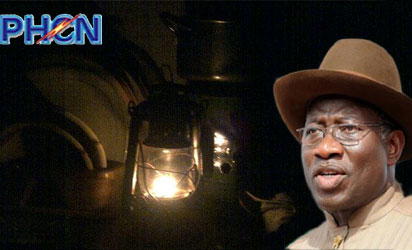
President Goodluck Jonathan
By Favour Nnabugwu
Driven by Nigeria’s low 4,000MW serving its over 160 million inhabitants, General Electric, GE Nigeria has signed a $350million memorandum of Understanding, MoU to light up small communities across the country.

President Goodluck Jonathan
The MoU was signed at the Bank of Industry Head-office in Abuja weekend between GE and the Federal Government of Nigeria by Minster of Industry, Trade and Investment, Dr Olusegun Aganga, Minister of Power, Prof Chinedu Nebo and the Global Chief Executive Officer of GE, Mr Jeffrey Immelt. It is aimed at providing affordable access to power infrastructure that augments traditional large-scale grid capacity development.
The Minister noted that with the agreement, investors will be able to build smaller smaller power plants. It is very clear, today is about signing the $350million facility. It is for financing smaller scale power projectswhich are quicker to build and which are the things we need to drive our economy.”
“In Kano, we have a very big textile industry because cost of production is much more higher, they are not as competitive as they should be because of lack of power.
“This will be a ready solution to that. So it’s not just financing but financing a critical sector that will be a catalyst to economic development in the country and it will support not just SME’s but industrial revolution in our country,” he said.
Mr. Aganga noted that once there is steady power supply, it will naturally lead to job creation adding that “GE is bringing in their global vendors to partner with Nigerian suppliers as part providers across their own value chain. That is already building capacity, transferring knowledge and creating jobs.
Aganga who was obviously dazzled by GE’s commitment to the growth of Nigeria, said, “I am absolutely convinced that the investment is going to pay not just in the power sector but in the oil and gas sector, the healthcare sector, the aviation sector or the transportation sector”.
“This capability is second to none, and Africa will have that. It is really a demonstration of the long-term commitment GE has for developing and supporting both the power sector in Nigeria”.
The top management starting with Jeff Immelt, GE CEO; John Rice, vice chairman and Jay Ireland, CEO of GE Africa are ready to increase power activities based upon a sound understanding of the long-term fundamentals of the country. Their support has been amazing not only in terms of resources but also in terms of their personal investment of time in the country.
Similarly, Prof Chinedu Nebo, Power Minister who admitted that more than 50% of the Nigerian populace were yet to have access to power, noted that the GE investment would help the country to supply power to communities by taking small plant to those areas.
According to him, “The critical issue is that we still more than of Nigeria population without power supply. The facilities that the GE in partnership with Standard Bank and Stanbic Bank are working together to put on the table are to make sure that there is access to financing for distributed power to each community in Nigeria”.
“Moreover, GE’s collaboration with Standard Bank and Stanbic bank was in line with the country-to-company agreements that GE had signed with several African governments aimed at generating incremental power and increasing access”.
Nebo added, “GE understands the President Goodluck Ebele Jonathan’s transformation agenda is all about with regard to power and that is to give access to power to as many Nigerians as possible if not all Nigerians”.
“GE wants to make power available so there will be smaller plants that will be taking to places that have no power supply at all. This is to encourage the private sector to access funds to use in developing power to up grid and supply light to those who don’t have”.
According to the Minister, it will encourage the Private Sector to access funds to use in developing power solutions to have upgrid power solution to those who don’t have it.
“What GE is doing now now is to provide the solutions. Build smaller power plants by using turbines so that you can take this turbines to far places to ensure that people who didn’t have it would have it. We think this is a right step in the right direction.”
The power Minister said, “GE gives some of the best power turbines in the whole world. What GE is doing now is to say, Eh! Nigeria, we have a solution. We can build smaller plants using smaller turbines so we can take those turbines to the remote areas that are not connected to the national grid to ensure that people who do not have power before can have. It is going to beneficial to Nigerians massively”. In the same vein, Mr Jeffrey Immelt, GE Global MD, assured that the multinational company is committed to invest in various sectors of the Nigerian economy.
“We are committed to playing our part in the sustainable growth of the country as regard the power sector $350million investment” Immelt told Aganga and Nebo during the signing of the MoU. He expressed his satisfied with working with Stanbic interms of what’s needed both in debt financing and equity financing that is going to allow this to accelerate. Stanbic CEO, Mrs. Sola David Borha reiterated the key role of power to Nigeria’s economic growth and development.
According to her, “For Stanbic Bank power is a key sector and we believe that it is a game changer for Nigeria. She assured, “We are very well prepared to partner with with GE and ensure that the most needed access to financing iis very much delivered and that the reality of power being readily avaialble to Nigerians actually comes to pass”.
Industrialists to access AFDB $500m facility soon
…As BoI disburses N870.44bn to key sector in two years
By Favour Nnabugwu
Industrialists are to access the $500m Africa Development Bank, AfDB facility to the Bank of Industry soon, BOI, as the BoI announced that it disbursed N870 billion to the various sectors of the country’s economy in two years. BoI assured that the bank is putting finishing touches to necessary documents needed for it to release the funds to the industralits..
The BoI Chairman, Shareholders’ Committee, Mohammed Kyari Dikwa announced this in Abuja at the weekend during the bank’s 53rd Annual General Meeting held at Transcorp Hilton Hotel, Abuja. “Nigeria industrialist would soon begin to benefit from the $500million credit line facilitated by the Federal Government to boost the country’s industrial base as soon as the bank complies with the stipulated disbursement requirements”.
He said, “It is with the expectation to deepen the Bank’s credit delivery process that the Federal Government facilitated the approval of the $500.0 million Line of Credit from Africa Development Bank (AfDB) for BOI to utilize for the funding of the industrial sector at concessionary rate. “As soon as BOI complies with the disbursement processes which has reached an advanced stage, the Nigeria industrialists will start benefiting from the incentive-backed facility.”
Given the breakdown of the N870.44bn disbursed across the sectors within the two years under review, Dikwa said agro-business benefited N53.3billion while entertainment sector recieved N337.60million. Other sectors that have benefitted from the bank’s loan disbursement also include, Aviation (181bn), Textile (50.39bn), Rice (N2.8bn),NAC fund(N9.74bn)Cement(N0.719bn) and Restructuring and Refinancing Fund (N229.18bn).
Speaking on the significance of the various loan facilities of the bank to the Nigerian economy, KyariDikwa noted that the astronomical increase in loans and advances to the real sector as well as increases in other comprehensive incomes contributed significantly to the 53.4 per cent increase in gross income from N10.013 billion in 2011 to N15.358 billion in 2012.
For instance, he said while the total fund disbursed under RRF schemed increased from N218.8bn as at December 2011 to N229.18bn in 2012, representing 5 per cent increment, number of beneficiaries also increased from 498 to 534 during the same period.
He stated “A total of 23 commercial banks and one Development Finance Institution participated in the RRF scheme. The scheme has enhanced the liquidity of participating banks considerably. The RRF covers 12 broad sectors with chemicals and plastic sectors having the highest exposure of 30.42% while transportation had the least of 0.46%.
“Direct employment by beneficiaries increased from an average of 62,097 before intervention to 76,581 after intervention representing an increase of 23%. The scheme had generated an indirect employment in multiples of this figure. Cumulative turnover of the obligors increased from N503.17 billion per annum before intervention to N659.15 billion after intervention.”
He further explained that, going forward, BOI being a critical intervention agency in the actualisation of the Federal Government’s transformation agenda would continue to fund real sector of the economy while looking ahead for enhanced collaboration with both local and foreign partners in its bid to discharge on the mandate.
“While the Bank expands its network of partnerships both locally and internationally, it shall sustain existing collaboration programmes with its domestic and foreign development partners in the public and private sectors and also pay considerable attention to the Federal Government’s priority sectors. “The Bank of Industry will continue to work closely with other Development Finance Institutions and Development Promotion Agencies to achieve synergy and higher efficiency in the process of pursuing Nigeria’s economic development programmes, he said.
Disclaimer
Comments expressed here do not reflect the opinions of Vanguard newspapers or any employee thereof.