
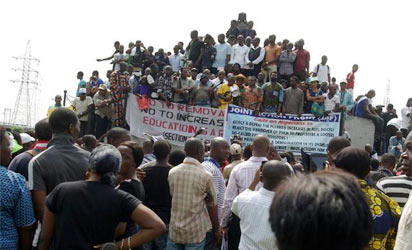
Fuel Subsidy protest
By Rotimi Fasan
IT’S the first day of January and it’s only proper to wish Nigerians a happy New Year with hopes and prayers that 2014 ends on a note of great joy and prosperity for us all. We pray it is a year in which the Nigerian Dream takes on the colour of reality. But the Goodluck Jonathan government ended 2013 with its ill-digested approach to revenue generation and overall development of the country.
Only those who stand to benefit from it can explain the rationale for raising tariff on imported second hand vehicles popularly called tokunbo to 70%, up from 20%. For a country without a car manufacturing industry of its own that could be said to need such protective measures as might be provided by such increase, one wonders who stands to gain from this new tariff regime. The only conclusion open to one is to see the tariff increment as further proof of this administration’s determination to impoverish poor Nigerians that are already struggling to stay alive amid the ravages of its economic and social policies.
Since the mid 1980s when the military government of Ibrahim Babangida chose to follow the belt-tightening path of ‘structural adjustment’, Nigeria has become a huge market for second hand goods, ranging from vehicles, computers and household appliances like television, iron and refrigerators. The Shagari administration might have brought ‘austerity measures’ into our national lexicon but it was the Babangida regime that gave practical expression to the word.
Thus, second hand goods, especially cars, have been a fact of national existence from the mid 1980s. They were the saving grace of middle class Nigerians who discovered they could no longer afford brand new items like their counterparts in the preceding decade. Of course, second hand clothing had been with us for far longer period. Indeed, it was one of the items the Awolowo-led Unity Party of Nigeria vowed to ban as part of its plan to raise the quality of Nigerian life. Not only have second hand clothes remained with us, we have since expanded the second hand market to include cars and household appliances.
This was inescapable in the face of government’s abdication of it role in the life of Nigerians. Nigerian households are local governments in their own right. They’ve taken over municipal responsibilities for which the third tier of government exists. They clear their own refuse and dump them into storm drains; provide their own electricity with generators of different sizes that pollute the environment, dig wells and drill boreholes that damage the earth crust.
In spite of all this, they are saddled with multiple taxes for the very services they provide for themselves. We have neither motorable roads nor a cogent traffic policy. We have no public transport system beyond the ad-hoc arrangements government puts in place in the wake of periodic upheavals that follow removal of so-called oil subsidy. Then would government promise to provide buses, which are invariably refurbished second hand vehicles disguised as new, to meet the transport needs of commuters. The vast majority of vehicles on Nigerian roads belong in junkyards for sure. But without the few second hand ones that are still roadworthy, Nigerians would be no better than Fulani herdsmen criss crossing the country on foot.
Given this deplorable picture of our public transport system, it is both criminal and wicked for any government to contemplate any increase in the price of imported second hand cars at this time. Such a move would only increase the misery of Nigerians, more of whom would have to join the rowdy crowds waiting for the decrepit buses at bus stations. Previous administrations in this country have long recognised the importance of second hand vehicles among other used items imported from Europe and the Americas.
They have put measures in place to control how these goods are brought into the country. There were age limits which placed restrictions on importation of vehicles beyond certain age. Without such restrictions our country would be a monster warehouse of unusable and environmentally dangerous goods. We were heading in that direction just a short while back. We are not entirely back on the track of sanity yet. But that is not the reason for the latest increase in the tariff on used vehicles.
To be sure, Nigeria and Nigerians must see the era of imported second hand goods as a passing phase, a stopgap measure for the present. But government must take the lead in moving Nigerians to that future when they would be free from second hand goods, a time they can become manufacturers of household items and goods including their own cars. Nigeria has however ignored the immediately expedient for the fashionable by embarking on the making of drones instead of cars. One wonders how many Nigerians can be conveyed in drones in their daily struggles to keep body and soul together.
The present government is unprepared for a better Nigerian future. Thus, Nigerians know the imported second hand versions of many household goods or even vehicle accessories are far better and more durable than so-called new ones that break down within days of purchasing them. The second hand market therefore thrives for very good reasons in spite of official attempts to kill it. Nigerians know it is easier to get a second hand wrist watch or carburetor that lasts several years after purchase than brand new ones that can hardly survive a couple of months if not mere days.
A thinking government that is not out to punish the poor and struggling at the expense of the rich would not seek to raise tariffs on imported vehicles now. What it should do as a temporary measure is to ensure certain quality standards are met before such vehicles are allowed in. And if we must face the fact, the Jonathan administration has no justification to raise tariff on second hand vehicles at a time arms and agencies of the administration are protecting wealthy Nigerians and foreigners from paying necessary taxes on their billionaires’ lifestyle.
The Nigerian Senate only a couple of weeks days ago ordered the Nigerian Airspace Management Agency, the same body that has been busy importing armoured luxury vehicles for Stella Oduah, its supervising minister and other officials- the Senate ordered NAMA to suspend charges of $2,500 to $3000 it placed on private jet owners following complaints by the jet operators. We are also aware of the indiscriminate manner officials and cronies of this government have been seeking and getting tariff waivers from the Finance Ministry for all kinds of imported luxury goods.
Poor Nigerians have neither private jets nor luxury goods for which waivers are needed. They only want to live decently even if on second hand goods. Is this asking too much of Jonathan in 2014?
Disclaimer
Comments expressed here do not reflect the opinions of Vanguard newspapers or any employee thereof.