
By Amaka Abayomi, Laju Arenyeka & Ikenna Asomba
With twelve days to the end of 2013, it has become imperative for us at Vanguard Learning to take stock of issues and events that shaped the nation’s education sector, while projecting the way forward.
Budgetary allocation
Two months to the end of 2012, President Goodluck Jonathan, in Abuja, presented the 2013 budget before a joint session of the National Assembly. According to the budget proposal entitled: Fiscal Consolidation with Inclusive Growth, of the total expenditure of N4.92trn earmarked for the 2013 fiscal year, education got N426.53bn (8.67 per cent), the highest when compared to previous years. The allocation amounted to 0.24 per cent increase from the 2012 allocation of N400.15bn, representing 8.43 per cent of the N4.7 trillion total budget for that year.
By the budget, education was earmarked to gulp more funds than other key sectors. While some applauded the government for the gesture, saying that proper implementation is key rather than the figure earmarked, a few others lamented that such amount is a far cry from the 26 per cent recommended by United Nations Educational, Scientific and Cultural Organisation (UNESCO) for any country which intends to record rapid growth and development.

Three new universities
While Nigerians were basking in the euphoria of the New Year, pondering over challenges ahead, the approval of three new federal varsities in Gashua (Yobe), Birnin Kebbi (Kebbi) and Gusau (Zamfara), which was meant to increase access to tertiary education, was greeted again with mixed feelings.
Rising from its Federal Executive Council (FEC) meeting, Minister of Information, Mr. Labaran Maku, said only 10 per cent of school leavers gain admission into higher institutions due to limited space available, saying that skeletal services are to start as soon as possible in the new varsities and academic work should start by 2014/2015 academic year.
Providing further insight on government’s decision, the former Minister of Education, Professor Rukayyatu Rufa’i, said out of 1.3 million school leavers that seek entrance to higher institutions every year, less than 200,000 gain admissions into existing institutions.
However, opponents of this move then, argued that rather than increasing the quantity, the quality of the existing universities should be increased.
Early warning signal
As early as January 2013, industrial unrest was in the offing as staff unions across the nation’s public tertiary institutions had started issuing threats to down tools if the Federal Government (FG) does not accede to core areas of their various demands.
First was the non-teaching staff under the aegis of Senior Staff Association of Nigerian Universities, SSANU, which gave the FG up to the end of January 2013 to pay its members their unpaid Earned Allowance or risk a protracted industrial unrest in the nation’s university system.
The Western zone of SSANU in a meeting at the Delta State University, DELSU, Abraka, Delta State, decried the failure of government to fully implement the agreement reached with its workers since 2009.

Illiterate corps members
Another bombshell was dropped on January 17, when the Director-General of the National Youth Service Corps, NYSC, Brigadier-General Nnamdi Okere-Affia, lamented that most corps members could neither read nor write.
He said: “We have corps members who can hardly communicate in English language, let alone being able to teach in the classrooms. The level of academic deficiency among corps members has heightened corps members’ rejection and redundancy. This worrisome development has resulted in a situation whereby members of the public wrongly condemn the NYSC for the poor academic standard displayed by these corps members.”
Dispelling rumours of scrapping JAMB, NECO
The media was awash with news of the planned scrapping of NECO while JAMB would be reduced to a mere administrative structure that would set standard for minimum requirements on how various varsities would conduct entrance examinations.
Other decisions taken by government on the Oronsaye-led committee include the following: The functions of NECO would be assumed by the West African Examinations Council, WAEC, which will also take over the structures of NECO nationwide.
In order to make up for the deluge of students who sit for the external examinations of Neco, WAEC would be expected to conduct two external examinations, one in January and another in November for external students while still running its internal examination programmes for secondary school students.
ASUP strike cripples activities
Activities in polytechnics were crippled in April, with the indefinite strike action embarked upon by the Academic Staff Union of Polytechnics, ASUP, over issues bordering on the CONTISS 15 Migration for lower cadres, Needs Assessment of Polytechnics, release of white paper of visitation to federal polytechnics, discrimination between polytechnics and university graduates in job placement and career progression and the constitution of Governing Councils to federal polytechnics.
After series of meetings and intervention by the Senate and House of Representatives Committees on Education, the union suspended its strike on July 17. However, to the chagrin of stakeholders, three months later, it threatened to resume strike as it alleged that government has failed to address the issues it brought before it since after the strike was suspended.

Yobe killing of students
Gunmen suspected to be Boko Haram sect members went on rampage in Gujba community, Yobe State where they opened fire on students of the College of Agriculture, Gujba, at 3a.m. as they slept in their hostels. They later moved to other houses, where they killed residents at will. Provost of the College, Molima Idi Mato, said: “They attacked our students while they were sleeping in their hostels. They opened fire on them.”
Sack of Minister of Education
President Goodluck Jonathan on September 11 took Nigerians by surprise when he announced the immediate reshuffling of the Federal Executive Council (FEC).
The reshuffling affected six ministers and three ministers of state, including the Minister of Education, Prof. Ruqayyatu Rufa’i.
ASUU strike: Matters Arising
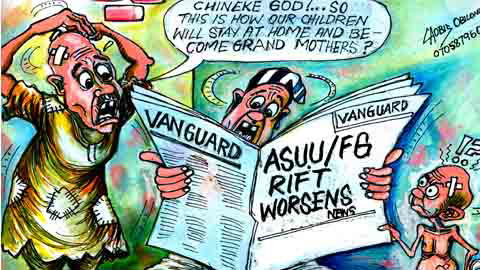
What started like a child’s play, unfortunately ended as a full blown face-off between the Federal Government and university lecturers under the auspices of the Academic Staff Union of Universities, ASUU. On Monday, July 1, 2013, the union called out its members on a total, comprehensive and indefinite strike, which unfortunately lingered for five months and two weeks.
The National President, Dr. Nasir Issa Faggae explained that the union after its NEC meeting comprising 51 out of the 53 ASUU branches across the country, decided to down tool until the FG provided adequate funds for the revitalization of the university system; progressive increase of budgetary allocations to the education sector by 26 per cent; transfer of Federal Government property to universities; setting up of research and development units by the companies; renegotiation of the signed agreement; and paid the earned allowance it owes its members.
According to Faggae, the Earned Allowance, which covers inconvenience and work overload, among others, was an average of N12,500 per month per lecturer.
“It is disheartening that government had refused to pay the allowance to any lecturer in the last four years. ASUU has met government several times on this allowance issue and other ones as contained in our 2011 MoU which was the fallout of the 2009 agreement. It has always been promises upon promises and we can no longer tolerate the action, thus the need to embark on the nationwide strike until these demands are met.”
To ensure that ASUU members return to classroom, government, on July 26, invited ASUU to a closed-door meeting which lasted three hours, leaving out the agitating non-academic staff unions of polytechnics, SSANIP and NASU, which were still on strike.
Determined to put up appropriate conditions necessary for academics in the nation’s tertiary institutions, the Federal Government had during the meeting inaugurated the Universities Needs Implementation Committee, headed by Governor Gabriel Saswam of Benue State, with a mandate to prioritize requisite exigencies.
But despite the committees and two deadlines to suspend the strike, ASUU stuck to its guns that there is no going back till government does what’s needed for the education system.
Their struggle paid off after five months with the lodgment of N200bn into an infrastructure revitalisation funds in an account with the Central Bank of Nigeria (CBN). This led to the suspension of the strike on December 17.
Iyayi’s death
The roundup of events would be incomplete without mentioning the demise of former ASUU president, Professor Festus Iyayi, who died in the course of the lingering strike.
Iyayi, 66, died along the Lokoja-Abuja highway on his way to the National Executive Committee meeting where a vote was likely to be taken on whether the ongoing strike should be suspended in an accident involving the convoy of Kogi State Governor, Idris Wada.
The late university teacher was among ASUU leaders who met with President Goodluck Jonathan in Abuja a week before to deliberate on how to end the then four-month-old strike by lecturers.
Disclaimer
Comments expressed here do not reflect the opinions of Vanguard newspapers or any employee thereof.