
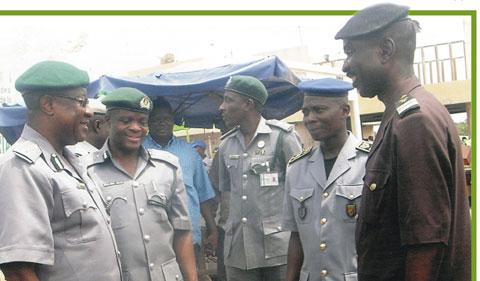
Comptroller General of Nigerian Custom Service (NCS) Alhaji Abdullahi Dikko, Comptroller Gabriel Aliu, Chief Superintendent Ibrahim Turaki and Cheff du bureau of Benin Republic Customs Seme Command, Col Kpodehou Yves at a recent function at Seme.
In less than one month, the Nigeria Customs Service will take scanning operations at the ports and border stations across the country. In this interview with Godwin Oritse, Customs Spokesman, Mr. Adewale Adeniyi said the service has raised doubt over the true state of the scanning machines, a development that may jeopardise the newly introduced Pre-Arrival Assessment Report (PAAR). Excerpts:
What is PAAR all about?
The concept of PAAR is based on Pre-arrival assessment of goods and this is a direction in which most Customs administrations all over the world are going.
It operates under different names and different nomenclature, but the idea is the same and the whole idea just surround the fact that a lot of intervention could be done before the arrival of the cargo so that less time is spent in clearing the cargo when it eventually arrives.
And what are the basic interventions? We want to ascertain a number of facts about the cargo like the country of origin, the value of the goods and based on all these parameters, we will arrive at what level of risk this cargo present for us and this is what will inform the level of our intervention.
This will give us a clue as to whether to subject the cargo to full physical examination, subject to documentary examination or whether we scan or anything.
Before now, we discovered that it is when the goods have arrived in Nigeria that people will start running to the office of the service providers to go and process Risk Assessment Report (RAR), but we now want to ensure that we finish all that processes, all that documentation ahead of the arrival of the goods.
This is the best practice that other Customs administrations are using in line with the provision of the revised KYOTO Convention on facilitation of trade.
In Nigeria, we have decided to call it Pre – Arrival Assessment Report and we will issue it in place of RAR is PAAR that is the difference.
We thought PAAR is a creation of the Nigeria Customs Service that has never been experimented before now, and was created strictly for the Customs. How true is this?
Basically the nucleus of the PAAR development team are the Nigeria Customs Service officers, but I do not see anything wrong with it. We have officers who have the rudimentary about something to work with appointed consultants.
At the different level in the course of developing PAAR, we saw the need to work with some consultants outside Customs and we engaged some and they are helping us with the development, the piloting, the testing of the PAAR project and the eventual deployment of PAAR.
So we are not ashamed to work with consultants, but we can tell that the nucleus of the people who worked to develop it and who are going to be implementing it are Customs officers. They are stationed right there at rolling centre and if you visit that rolling centre, you will see them working.
How will the PAAR project enhance cargo delivery in terms of clearance time and cost?
I would say it is still work in progress, we have done the test that we needed to do and we have satisfactory results.
PAAR is predicated on better effectiveness, in terms of time and we also hope to cut cost.
For time, we intend to issue a document that the service providers were issuing in five days, we intend to issue that same document within a day, so, we expect that, that will affect the cost of doing business, because we are able to do faster and more effectively.
We have a number of features we have put into it for example the issue of SMS alert. Before now, importers have to travel back and forth between Customs, banks and service provider office.
Now if there are issues, if there are clarifications that are needed to be put in your form ‘M’ or for PAAR, you are given an SMS alert and you can upload this and then we are able to react almost immediately and when the final approval, you are also notified via SMS alert.
Thirdly, the entire project is going to be electronically driven, there will be no form for any manual process like we are witnessing now with the service providers, because an integral part of this is the electronic form ‘M’ which has been rolled out.
The Customs now use electronic form ’M’ and we are pulling data directly from the current platform of the Nigeria Customs Information System (NICIS) into the PAAR platform, so we expect that this will help drastically to reduce the time and of course, the cost.
In terms of live test, just this week we got approval from the honourable Minister of Finance to conduct a live test, so we are going to be using the same data that service providers are using to generate RAR, we are going to be using it to generate PAAR .
This will give us the opportunity to compare and contrast difference between the RAR they are issuing and the PAAR we are going to be issuing based on the same data that will be made available for both of us.
We will be able to compile the kind of revenue that they are generating and the potential for revenue that we can generate, we will be able to compare the time it takes to issue RAR and the time it will take us to issue PAAR, we are going to be comparing the valuation base that we can build arising from the data that we have and the data they have been giving us.
These are some of the things that can be thrown up at the immediate stage, these are what you call high level data, but there are so many other generic data that we can get from this information because for the first time, we are getting the opportunity to handle them by ourselves.
With our involvement, we can be able to trace the direction of trade of Nigeria, we will be able to see the flow of trade, we will be able to see which commodities are trending amongst people and based on this we will be able to advise government in a better way and of course, it also means that the security of these data will be entrusted to Nigeria Customs Service and this could mean a lot for us in these days of terrorism, espionage and the challenge to national security.
PAAR will also reduce the issue of human contact between officers and agents or importers.
The PAAR is actually built to eliminate such contact, there could be areas where people will want to ask questions and make enquiries related to imports, we have created help desks.
All area Commands will have help desks and officers who will man these help desks have been trained on what to expect and how to react to such enquiries and questions.
Does the Customs Service have enough manpower to handle scanning when it eventually finally takes over?
If you compare situation of the scanning service that is being handled currently by service providers and by the allotment that was done, we have three service providers namely Cotecna, SGS and Globalscan, while Web Fontaine is providing the information technology platform driving the scanning services.
Between Cotecna, Globalscan and SGS. We do not have one tenth of the numerical strength of the Customs service, in terms of skilled man power, the Customs within the last three years not less than 5,000 graduates have been recruited and about 500 of this number are specific Information Technology graduates and some of the officers that developed PAAR were drawn from that pool.
They have been specially trained; we have hewn their skills and tuned them towards the requirement of Customs.
They were trained alongside consultants from other parts of the world who are into the business of Customs information technology.
So, the software we are going to use to roll out PAAR was developed by some of these companies and the training was also conducted by them, so these officers are well trained, well tested and they are ready to go.
So in terms of abundant capacity, we do not have any problem and the plan is to run three shifts of 80 officers per shift every day working at the rolling centre.
Some of them will be working on form ‘M’ approvals, some of them will working on final document, some of them will be working on classification issues, some of them will be working on valuation issues and When PAAR is issued, it will be sent electronically to dealer banks while SMS will be sent to applicants thereby eliminating the need for them to come over to see any officer.
What is your opinion that Web Fontaine is deliberately causing frequent system break down in Customs operations, so as to remain relevant in the system?
Once a system is built around technology mechanics, there could be a breakdown I think the most important issue is the capacity to respond to the breakdown in good time that for me is a major issue.
So if there was a defect, the defect has been in the subsisting contract between Web Fontaine and the Federal Government of Nigeria and these are issues we are trying to correct as we move into the era where most of these things will be handled by Customs.
If you remember I talked about the nucleus of officers who developed PAAR and if we have our home grown programme, if we have our own grown software, then if there is a breakdown anywhere, we do not need to rush to any consultant.
It means we have our in-house capacity to handle any form of crisis in the entire project.
Towards our build up to take over, we went beyond what the service providers are doing, these scanning machines for example were supplied by Smith and we discovered that all the machines operated by the service providers were all made by Smith and they will not let us have any contact with Smith.
We even discovered these machines were not maintained by Smith so they had to sub-let the maintenance contract.
There was a time we doubted the integrity of these machines, so we had to go on our own to the manufacturers, the Comptroller-General led the delegation where he told that these machines will bequeath to us as part of the contractual agreement.
Disclaimer
Comments expressed here do not reflect the opinions of Vanguard newspapers or any employee thereof.