
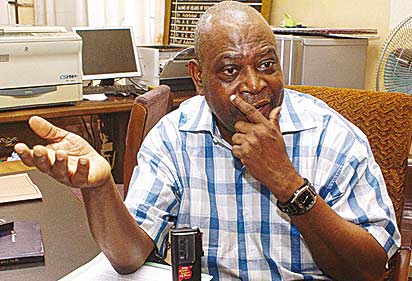
Prof. Iyayi
By Obi Nwakanma
It’s again, one of those sad weeks in Nigeria, when tragedy struck and coloured the already melancholic landscape of our lives. The true nature of tragedy is that it is always that quiet, preventable death at an obscure bend in the road. The killing last week of novelist, scholar, and labor activist, Festus Iyayi is that kind of tragedy: his death is a totally needless and preventable death. If he had not been compelled to rush off to Kano to sign-off on the final negotiations between the Federal government and the striking union of Nigerian University professors, perhaps he’d still be alive today in Benin city.
If the Nigerian public transport system were reliable, and there was a usable, quick rail service from Benin to Kano, as ought to be, perhaps Iyayi might not have found it necessary to do the long haul on the highway by his car. He probably did not trust the airlines either and was leery, as ought any sensible man, to embark on a journey in the crash-prone airlines in Nigeria from Benin to Kano, with its uncertain results. Nigerian aviation is a dangerous zone of experience, and people have been warned repeatedly that the state of some of the planes that ply the Nigerian air space are such as should drive us all to tears. Anyone who flies in Nigeria simply has a death wish.
Festus Iyayi may have thought all these through, and practical as ever, may have embarked on his road trip to Kano with the gritty resolve that saw him battle Alele-Williams and the Babangida government to a halt in the 1980s. Late in the 1980s and 1990s, Festus Iyayi and Ninmmo Bassey were our social and political anchors in Benin City.
They remained authentic and resolved in their fight for social justice and for environmental rights. In Ninmmo’s house, you could expect to drop in unannounced, get a warm dinner, enough liquid restorative for your patched throat and a lively and long debate on the state of Nigeria and the world, and there could be Abdul Oroh, or Odia Ofeimun, or Ike Okonta, or any group of the fierce intellectual and activist kind, and you could expect to end up eventually in Festus Iyayi’s home, and be treated to the same level of generosity of spirit.
My last visit with Festus Iyayi was in 1997 with his close, bosom friend the poet, Odia Ofeimun, with whom he began life as young reporters at the Observer newspaper in Benin in 1968, in the thick of the Nigerian civil war. That experience as a war reporter shaped Iyayi profoundly: it made him not only suspicion of power and those who use it; it gave him the clear insight that shaped the work that he did both as a novelist and as a political activist. It forced him to a greater empathy with the victim. His novel, Heroes, which won the 1986 Commonwealth prize for fiction, was a testimony to his abiding nationalist and humane spirit and his move towards historical expiation.
Iyayi was like that: a man driven to the defence of the powerless; a man with a high sense of justice and obligation; a tireless fighter for the common good. It was his stubborn and principled stance that led him to that epic confrontation with the powerful Professor Grace Alele-Williams and the Babangida-era attempt at the asphyxiation of the Nigerian public university system which has today borne its fruit in the catalepsies that has virtually destroyed the Nigerian university and kept ASUU on the perpetual Maginot line. Iyayi fought for the Nigerian university; for its restoration as the epicenter of liberty and national development; and for its secular and rational character.
He died in the service of public education in Nigeria, crushed under the weight of a governor’s insurgent convoy on the road to Lokoja. Benin City this week lost one of its clearest voices and intellectual icons. Festus Iyayi died because Nigeria is still drawn to the primitive show of power that would warrant the governor of a state to be driven in a speeding relay of cars and in a convoy of extremely armed and out of control cars that have resulted in numerous accidents. No one knows where these powerful men are often speeding to in such great speed, or why they’ll need such display of childish power on the roads.
In the military era, it could be explained that the soldiers were getting their flagging erections up by driving the bloody civilians out of the road. They could do that because they did not need the votes, and they were, in any case, not quite subject to civil laws. The soldiers introduced that culture of armed and speeding convoys because military rule was government in a hurry: a permanent state of emergency.
When Nigerians fought to restore democracy, one of the things they wanted out was the sense of siege that came with emergency rule. Why then should an elected governor in a civilian administration continue to be driven in a loud and speeding convoy of armed vehicles on a public road? The result today is that a lead vehicle in the Kogi state governor’s convoy killed Iyayi.
For what? One of the central problems that’s led to this deadlock between ASUU and the government is to be found in this tragedy: the life of an accomplished intellectual and university professor like Festus Iyayi is reduced to nothing more than pulp by a vehicle conveying a powerful politician who probably on a good measure would not match Iyayi’s intellect, accomplishment, and contribution.
Iyayi’s death should force us towards rethinking this culture of road hugging and overlordship by governors and other powerful political office holders who drive everybody else out of the road whenever they are on the road, or failing which, risk death, like Festus Iyayi. A governor is like every other citizen, and should be entitled to a single police orderly for as long as he is on official duty, and should drive within the traffic laws and as unobtrusively as any other citizen on the road.
It is about time that Nigerians pushed for this primitive assertion of power and unnecessary privilege to stop. The Kogi state governor must today exemplify how not to use the public road. Iyayi’s death should not be in vain and should lead to a cultural shift to more sensible, more civilized conduct by the governors and other authority figures.
If they’re in a hurry, let them use the helicopters, and not drive the citizen off the road. Meanwhile, the governor’s driver should be tried for manslaughter, and his driving license suspended. It will sadly not bring Iyayi back, but he’d certainly, as the great teacher he was, want some lessons to be learnt from this tragedy.
Disclaimer
Comments expressed here do not reflect the opinions of Vanguard newspapers or any employee thereof.