
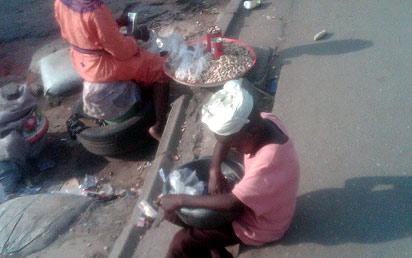
*Child hawkers
By VICTOR AHIUMA-YOUNG
INTERNATIONAL Labour Organisation, ILO, has called on world leaders to step up the fight against child labour, saying irrespective of noticeable reduction in recent time, it is still a very large number.
ILO Director-General, Guy Ryder, told delegates to the ongoing third Global Conference on Child labour to redouble their efforts so that the international community could reach the target it set for itself to eradicate the worst forms of child labour by 2016.
ILO’s latest global estimates on child labour,released in the run-up to the conference, show that since 2010, the number of child labourers has dropped by one-third to 168 million. While the fall in numbers is good news, the ILO DG warned that “ it is still a very large number – it is only 27 million fewer than the entire population of Brazil.These children constitute 168 million reasons for our presence here today.”
The conference will take stock of the progress achieved since the second global conference that took place in The Hague in 2010.
The ILO Director-General cautioned that the current rate of progress was not fast enough, saying “Let us be clear. We will not meet the 2016 target and that is a collective policy failure. We have to do better. Child labour is only a problem of poor or developing economies but affects all countries.”
He urged participants to direct their efforts towards policies and actions that have been successful.
“We are seeing child labour concerns mainstreamed into public policy in multiple, relevant fields. We see greater clarity about the need for better school- to-work transition and skills-matching. We see a new global consensus on the need to ensure social protection floors for all people. We see greater understanding that decent work for adults and youth of working age is a necessity if we are to ensure family incomes that do not rely on child labour– and in turn, that child labour undermines decent work and decent wages for adult workers”, said Ryder.
According to the latest global estimates, child labour is predominant in agriculture, both formal and informal, and in other sectors of the informal economy.
The ILO chief highlighted the role of enterprises and trade unions that have been taking up the challenges of the informal economy: trade unionism is growing among informal economy workers and enterprises have been discussing with trade unions how to clean up their value chains, protect and respect human rights at work and remedy the violations.
But Ryder also warned that there is a danger that as the “long march” against child labour appears to be entering its final phase, the international community moves its attention away from the fight against child labour.
“That would be tragic and must not happen. The call from Brasilia must be for a renewed, collective effort.”
Disclaimer
Comments expressed here do not reflect the opinions of Vanguard newspapers or any employee thereof.