
By Rotimi Fasan
THEY are extremely ambitious and determined. They also wield enormous powers and are without the shred of a doubt the most influential clique of President Goodluck Jonathan’s kitchen cabinet.
Should the President’s term in office end today, the collective actions of these women would in a sense determine history’s verdict on his presidency- a failed presidency of corrupt power abusers.
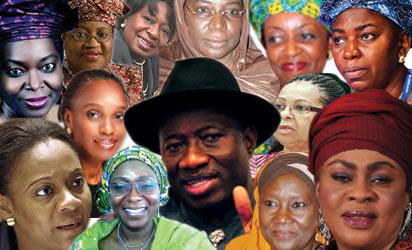
I am talking of the women in the President’s life, a close-knit unit of blood and political relatives, including his wife, his mother and three of his own ministers- Ngozi Okonjo-Iweala, Diezeani Allison-Madueke and Stella Oduah. The least troublesome of this powerful quintet but whose ‘innocent’ actions are no less distracting, if not diminishing for the President, is his mother.
Witness her recent donation of hostels to a university being constructed in her community. An obviously magnanimous act in a country where students often live in habitations that are better suited to beasts and other lower creatures of the animal kingdom but which nonetheless raises fundamental questions as to the financial source of the ‘first’ mother’s kindly gesture.
Where does an elderly lady never known for any act of public philanthropy get the financial muscle to embark on her sudden act of charity? Knowing how public funds are so often put into private ends, how many Nigerians sincerely believe the President’s mother was, in fact, spending money made from the sweat of her personal labour? Which is to say that some acts of kindness raise nagging moral issues that are not easily resolved by the apparent altruism that motivated them.
But the President’s mother is just a ‘Sweet Mother’ in the typical Nigerian sense, a mother enjoying the privilege that comes with her son’s success. She has not obviously set out to offend Nigerians’ sense of propriety in the manner the President’s wife so often does. Patience’s case is beyond ‘brief case’, to put it in a Felaic parlance.
Thank God the backlash from the crisis she cooked between her husband and her state’s governor, Rotimi Amaechi, seems to have left her a little chastened and relatively quiet on the national scene, it has not stopped her exporting her peculiar sense of power, privilege and political insensitivity beyond the Nigerian shores as with her accepting an honourary doctorate for God knows what from a university in South Korea at a time Nigerian universities have been under lock for well over a semester of an academic calendar following a lingering crisis in the education sector.
The kind of award Mrs. Jonathan got often come with heavy financial and material donations to the awarding institution and we can guess, as Nigerians, who would be picking on her behalf the bill for such execrable expenditure.
Nigerians know too much of Mrs. Jonathan’s noisy foibles to detain us here. Talking about it very often give some the misleading impression there might be something personal with criticizing her. But maybe there is. For what can be more personal than speaking truth to corrupt power; the appropriation and privatisation of power and misuse of public funds at a time the vast majority of Nigerians wallow in squalor?
But beyond the domestic female encumbrances on the President is the ‘peculiar mess’ of three of his female ministers who seem to be courting controversy in a manner that leaves one wondering if they are presidential agent provocateurs at a time the President can do with less controversy.
It was ex-President Olusegun Obasanjo who in recent memory first made a conscious attempt to bring women into government in a way that has made some of them very prominent names in the country’s politics. Obasanjo didn’t only want to give women a prominent face in governance, he knew where to bring out the best in them.
He went out of his way to sniff them out wherever they could be found. Space would not permit one to list the number of women that were products of the Obasanjo years and how well they discharged their remit. But the likes of Dora Akunyili, Oby Ezekwesili and Ngozi Okonjo-Iweala owed their prominence today to their time in the Obasanjo team.
But that era, despite some of its controversies as to the true worth of the role of these women, now looks like the golden age of women participation in public service.
What we see today are self-aggrandizing females who seem perpetually concerned with throwing their weight around without any obvious achievement to their names. Not even Okonjo-Iweala whose double designation as Minister of Finance and Coordinating Minister of the Economy, whatever that means, can point to what positive role her continued stay in government has achieved for Nigerians.
Okonjo-Iweala’s intervention in the negotiation between ASUU and Government brought the talks to a halt. Her so-called ‘take-it-or-leave-it’ role in that episode is now clouded in infamy as was her role during the fuel crisis in January 2012.
She seems determined to portray herself as a lackey of foreign financial institutions that specialise in ramming down bitter pills down Nigerian throats. But we all remember how she negotiated her own dollar-denominated salary when she joined government.
Some of us supported this as we thought it was an honest way not to land in the corruption bog that snares Nigerian public servants. I deplore any attempt, as claimed by the Minister’s spokesman, Paul Nwabuiku, to incite fundamentalists against her.
I’m, however, slow to believe this as I am of the nonsense that Stella Oduah’s alleged purchase of fanciful armoured vehicles, her so-called travails, was the handiwork of ‘political enemies’. But if claims of Iweala’s role in the ASUU affair is true, then she is one with the cowardly fundamentalists who are opposed to what they call Western education and its corrupting influence.
The difference is in their motive. They are anarchists who hate Westerners. She probably, simply, doesn’t see the need why Nigerians should have universities or a good public education system.
Disclaimer
Comments expressed here do not reflect the opinions of Vanguard newspapers or any employee thereof.